
Now Reading: ‘Eye of God’ nebula looks like a cosmic lava lamp in new James Webb Space Telescope image
-
01
‘Eye of God’ nebula looks like a cosmic lava lamp in new James Webb Space Telescope image

‘Eye of God’ nebula looks like a cosmic lava lamp in new James Webb Space Telescope image

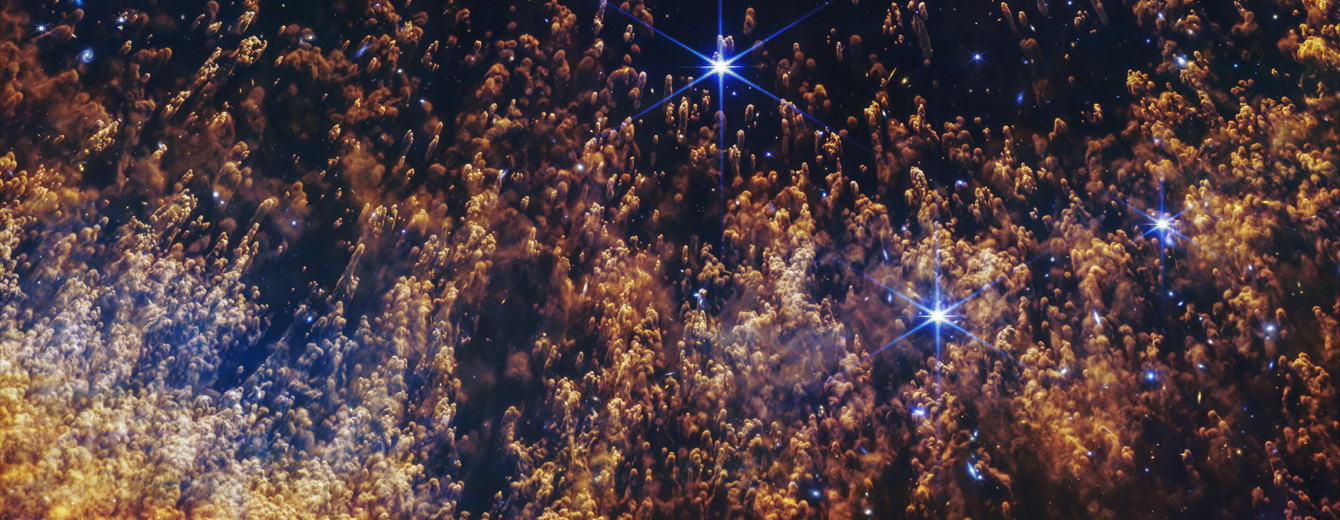
Astronomers have been given a new and incredibly detailed look at a very familiar astronomical object thanks to the James Webb Space Telescope (JWST). The new JWST image shows the Helix Nebula, the ring-like structure of which has led to the nickname the Eye of God.

The Helix Nebula, also known as NGC 7293 or Caldwell 63, was first discovered by German astronomer Karl Ludwig Harding prior to 1824. It is one of the closest and brightest planetary nebulas that can be seen from Earth.
Since then, the Helix Nebula has been imaged by a vast array of telescopes, including the Hubble Space Telescope, with the JWST joining the fray with an infrared image courtesy of its Near-Infrared Camera (NIRCam).

The image clearly traces winds of blisteringly hot gas emerging from the vicinity of the white dwarf stellar remnant at the heart of the Helix Nebula as they slam into outer shells of previously shed cold gas and dust. This demonstrates a sharp transition between the hot gas of this system and its coolest counterpart.
Not visible in the JWST image is the smoldering white dwarf in the center of the Helix Nebula, but astronomers can see the effect of the radiation it emits as it lights close surrounding gas, heating it and causing it to be ionized.
Further out from the stellar remnant are dust pockets of cold molecular hydrogen, in which conditions are just right for the formation of complex molecules. These could one day become the building blocks of new planets, and perhaps even life.Thus, perhaps this cosmic crystal ball also offers a look backwards billions of years into the past before the solar system took shape around our infant sun.










Related Posts


Stay Informed With the Latest & Most Important News
Previous Post
Next Post
Advertisement
-
 01Two Black Holes Observed Circling Each Other for the First Time
 -
 02From Polymerization-Enabled Folding and Assembly to Chemical Evolution: Key Processes for Emergence of Functional Polymers in the Origin of Life
 -
 03Astronomy 101: From the Sun and Moon to Wormholes and Warp Drive, Key Theories, Discoveries, and Facts about the Universe (The Adams 101 Series)
 -
 04True Anomaly hires former York Space executive as chief operating officer
 -
 05Φsat-2 begins science phase for AI Earth images
 -
 06Hurricane forecasters are losing 3 key satellites ahead of peak storm season − a meteorologist explains why it matters
 -
 07Binary star systems are complex astronomical objects − a new AI approach could pin down their properties quickly