
Now Reading: Falcon 9 returns to flight after upper stage engine investigation
-
01
Falcon 9 returns to flight after upper stage engine investigation


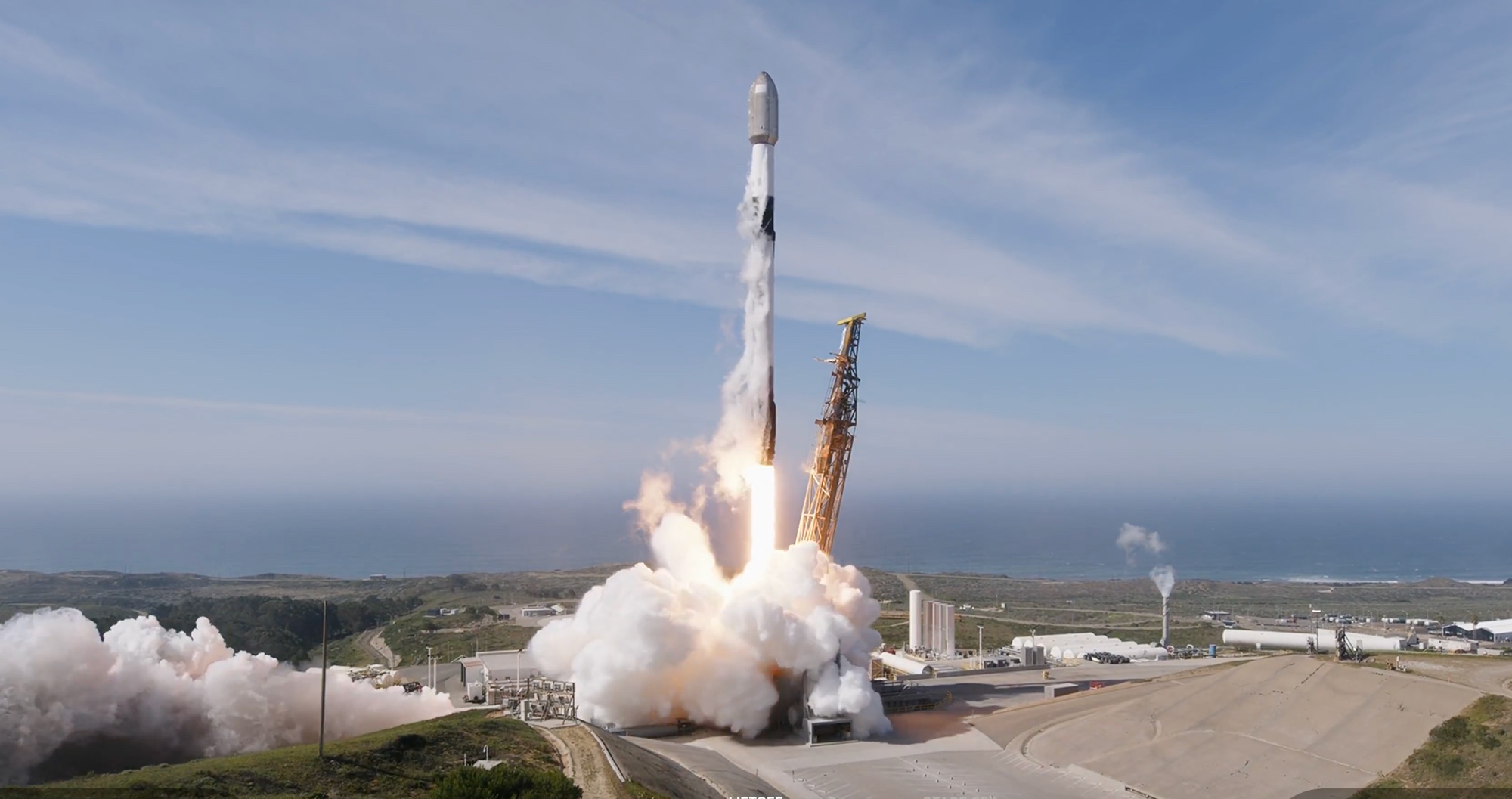

WASHINGTON — A Falcon 9 launched a batch of Starlink satellites on Feb. 7 after SpaceX completed an investigation into an engine malfunction during the rocket’s previous launch five days earlier.
The Falcon 9 lifted off from Vandenberg Space Force Base in California at 3:58 p.m. Eastern time. The rocket deployed its payload of 25 Starlink satellites into orbit about 62 minutes after liftoff.
The launch was the first Falcon 9 mission since Feb. 2, when the rocket carried another set of Starlink satellites into orbit from Vandenberg. While that mission successfully deployed its payload, SpaceX later said an “off-nominal condition” with the upper stage prevented it from performing a planned deorbit burn. The company delayed upcoming launches to investigate the issue.
The Federal Aviation Administration said Feb. 6 that it had authorized SpaceX to return the Falcon 9 to flight.
“The final mishap report cites the probable root cause as the Falcon 9 second-stage engine’s failure to ignite prior to the deorbit burn,” the agency stated. “SpaceX identified technical and organizational preventive measures to avoid a recurrence of the event.”
The FAA did not provide additional details about the cause of the failed deorbit burn. SpaceX said Feb. 7 that a gas bubble in a transfer tube prevented the upper-stage engine from igniting for its deorbit burn. The stage reentered the atmosphere about 10½ hours later over the Indian Ocean.
SpaceX did not explain what caused the gas bubble but suggested it was linked to efforts to refine procedures for upper-stage deorbit burns.
“SpaceX teams have actively and safely been testing opportunities to refine the pre-burn engine chill profiles, specifically targeting the deorbit burn after the safe deployment of Starlink satellites,” the company said. “The goal of this testing is to ultimately ensure space safety, effectively ensuring that all Falcon second stages completely deorbit, leaving behind no space debris.”
The company noted that in 2024, 13 of 134 Falcon 9 upper stages remained in orbit after payload deployment, while only three of 165 did so in 2025. Six of those 16 upper stages have since reentered naturally.
Completion of the investigation also allows SpaceX and NASA to proceed with the launch of the Crew-12 mission to the International Space Station, scheduled for no earlier than Feb. 11. NASA was an observer during the investigation into the Falcon 9 deorbit burn failure.
“We’re pressing toward our Crew-12 window,” NASA Associate Administrator Amit Kshatriya said at a Feb. 3 briefing about the Artemis 2 mission. “That’s going to be contingent on the return-to-flight rationale.”
NASA conducted a flight readiness review for Crew-12 on Feb. 6 and concluded that the upper-stage deorbit burn incident did not pose a safety risk to the mission, even before the FAA cleared Falcon 9 to resume flights.
“NASA and SpaceX have determined that since the Falcon 9 second stage flies a different deorbit profile for NASA’s crewed missions, there is no increased risk to crew safety during ascent,” NASA said in a statement after the review. “The agency and SpaceX are ‘go’ for Crew-12 to launch to the International Space Station.”










Related Posts

Stay Informed With the Latest & Most Important News
Previous Post
Next Post




Advertisement
-
 01Two Black Holes Observed Circling Each Other for the First Time
 -
 02From Polymerization-Enabled Folding and Assembly to Chemical Evolution: Key Processes for Emergence of Functional Polymers in the Origin of Life
 -
 03Astronomy 101: From the Sun and Moon to Wormholes and Warp Drive, Key Theories, Discoveries, and Facts about the Universe (The Adams 101 Series)
 -
 04True Anomaly hires former York Space executive as chief operating officer
 -
 05Φsat-2 begins science phase for AI Earth images
 -
 06Hurricane forecasters are losing 3 key satellites ahead of peak storm season − a meteorologist explains why it matters
 -
 07Binary star systems are complex astronomical objects − a new AI approach could pin down their properties quickly