
Now Reading: February Shines with Spectacular Lunar Events and Eclipses for Stargazers
-
01
February Shines with Spectacular Lunar Events and Eclipses for Stargazers


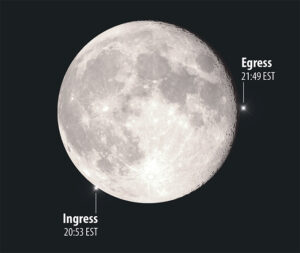
Astronomers and skywatchers can look forward to an exhilarating month filled with lunar events that promise to captivate audiences across the globe. From star occultations to eclipses, the Moon will be playing a starring role in various astronomical phenomena throughout February.
Kicking off the excitement on February 2, stargazers in North America will have the opportunity to witness one of the brightest stars in Leo, Regulus, being obscured by the waning gibbous Moon. The event will unfold at 20:53 EST in New York, where Regulus will disappear behind the lunar disc and re-emerge just under an hour later at 21:49, providing a delightful spectacle for those looking skyward.
On February 14, New Zealand will host a celestial interaction as the Moon, in its diminishing crescent phase, will obscure the star phi Sagittarii. This star is part of the popular ‘Teapot’ asterism in Sagittarius. In Wellington, observers can catch this event at 03:41 NZDT, as the Moon rises and the star vanishes at its bright limb, reappearing at 04:37 when it reaches a notable 20 degrees altitude.
A significant highlight of the month will occur on February 17 with an annular solar eclipse, where a “ring of fire” will be visible. This eclipse will traverse a narrow path from the Southern Ocean down to Antarctica, creating a dramatic lunar silhouette against the Sun. Observers at Concordia Station in Antarctica will see the annular eclipse last for 2 minutes and 5 seconds, peaking at 19:47:43 local time. Meanwhile, a substantial partial eclipse will take place in Mauritius, where around 43.5 percent of the Sun’s face will be concealed by the Moon at 17:34 local time.
February 19 will bring another lunar spectacle as the Moon occult Mercury during daylight hours. This event will be clearly observable from Wellington where Mercury will be obscured from 09:59 until 11:02 NZDT. In Australia, observers will only catch the moment Mercury reappears after being hidden by the Moon. This phenomenon will extend its visibility toward parts of Mexico and into Texas, where the planet will be occulted shortly after sunset.
Concluding February’s astronomical wonders, the Moon will interact with several celestial bodies in the UK. On February 24 at midnight, a nearly first quarter Moon will lie merely 2 degrees from Electra, the westernmost star of the Pleiades. Although the Moon will set before it can occult Electra, upcoming events on February 27 and 28 will allow skywatchers to view the Moon’s proximity to both the Pleiades and the Beehive Cluster. On the night of February 27, binoculars or small telescopes will show the star kappa Geminorum disappearing at the dark limb of a nearly full Moon, with reappearances captured throughout the night.
Overall, the lunar events of February promise rich opportunities for those eager to observe and photograph cosmic interactions. Enthusiasts are encouraged to document their experiences and share images as these occurrences unfold in both social media and scientific communities.










Related Posts


Stay Informed With the Latest & Most Important News
Previous Post
Next Post

Advertisement
-
 01Two Black Holes Observed Circling Each Other for the First Time
 -
 02From Polymerization-Enabled Folding and Assembly to Chemical Evolution: Key Processes for Emergence of Functional Polymers in the Origin of Life
 -
 03Astronomy 101: From the Sun and Moon to Wormholes and Warp Drive, Key Theories, Discoveries, and Facts about the Universe (The Adams 101 Series)
 -
 04True Anomaly hires former York Space executive as chief operating officer
 -
 05Φsat-2 begins science phase for AI Earth images
 -
 06Hurricane forecasters are losing 3 key satellites ahead of peak storm season − a meteorologist explains why it matters
 -
 07Binary star systems are complex astronomical objects − a new AI approach could pin down their properties quickly