
Now Reading: Flare-driven Habitability: Expanding Life’s Potential Around Low-mass Stars
-
01
Flare-driven Habitability: Expanding Life’s Potential Around Low-mass Stars


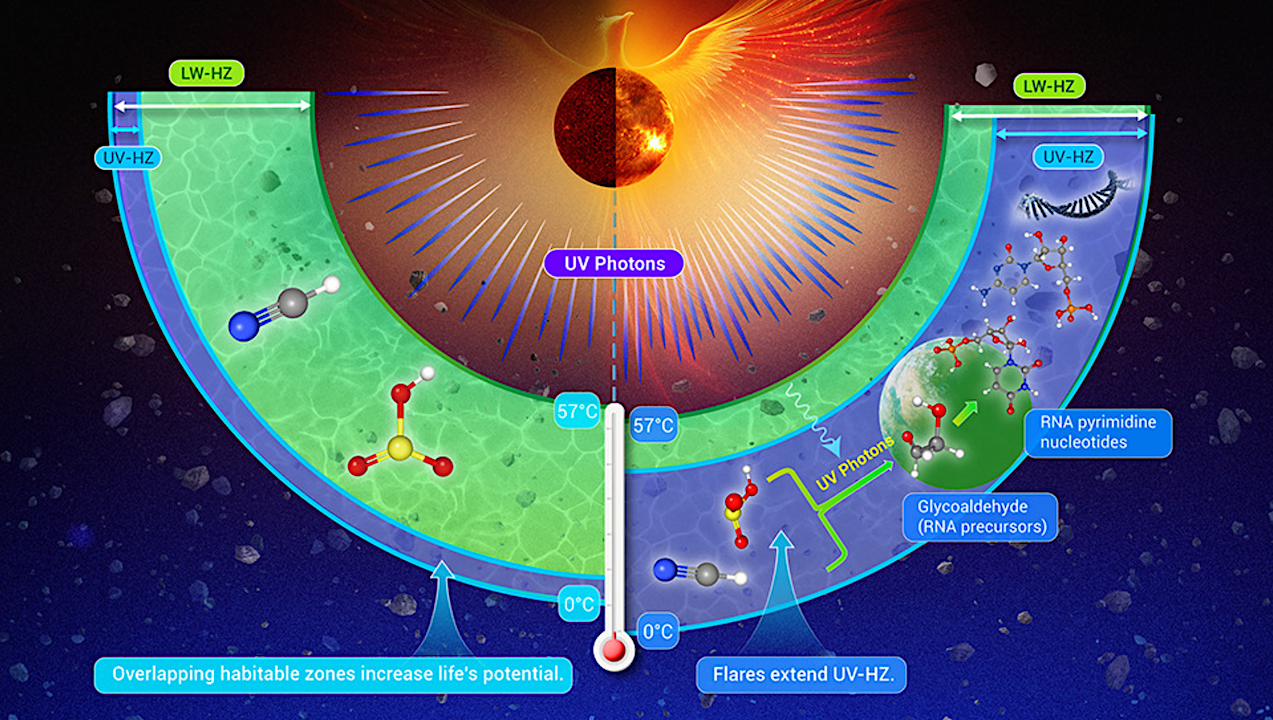
Graphical abstract — The Innovation
The traditional definition of the circumstellar habitable zone (HZ) focuses on liquid water, but neglects the crucial role of ultraviolet (UV) radiation in prebiotic chemistry.
Low-mass stars typically emit insufficient UV radiation for photochemistry throughout the liquid water HZs (LW-HZs) during quiescent states. However, frequent flares can provide substantial UV fluxes, potentially fostering habitable conditions.
We refine the concept of a UV radiation HZ (UV-HZ) by incorporating a temperature-dependent model for RNA precursor synthesis. Furthermore, we explore a parameterized spectral energy distribution model and adopt an empirical flare frequency distribution for flares on different stars to quantify their UV contribution.
Applying this framework to different flaring stars, we find that the UV-HZ around low-mass stars can extend to inner regions and overlap with the traditional HZ in wide ranges. Applying the analysis to 9 planets around Kepler flaring stars, three planets are located within both the refined UV-HZ and the LW-HZ without causing ozone depletion.
Our findings highlight the significant role of flares in expanding the potential for life around low-mass stars, offering a revised perspective on exoplanet habitability criteria.
Flare-driven habitability: Expanding life’s potential around low-mass stars, The Innovation (open access)
Astrobiology,











Related Posts

Stay Informed With the Latest & Most Important News
Previous Post
Next Post

Advertisement
-
 01Two Black Holes Observed Circling Each Other for the First Time
 -
 02From Polymerization-Enabled Folding and Assembly to Chemical Evolution: Key Processes for Emergence of Functional Polymers in the Origin of Life
 -
 03Astronomy 101: From the Sun and Moon to Wormholes and Warp Drive, Key Theories, Discoveries, and Facts about the Universe (The Adams 101 Series)
 -
 04True Anomaly hires former York Space executive as chief operating officer
 -
 05Φsat-2 begins science phase for AI Earth images
 -
 06Hurricane forecasters are losing 3 key satellites ahead of peak storm season − a meteorologist explains why it matters
 -
 07Binary star systems are complex astronomical objects − a new AI approach could pin down their properties quickly