
Now Reading: For the 1st time ever, 8 spacecraft are docked to the International Space Station
-
01
For the 1st time ever, 8 spacecraft are docked to the International Space Station


The space station is feeling like a lot of us in the wake of Thanksgiving — very, very full.
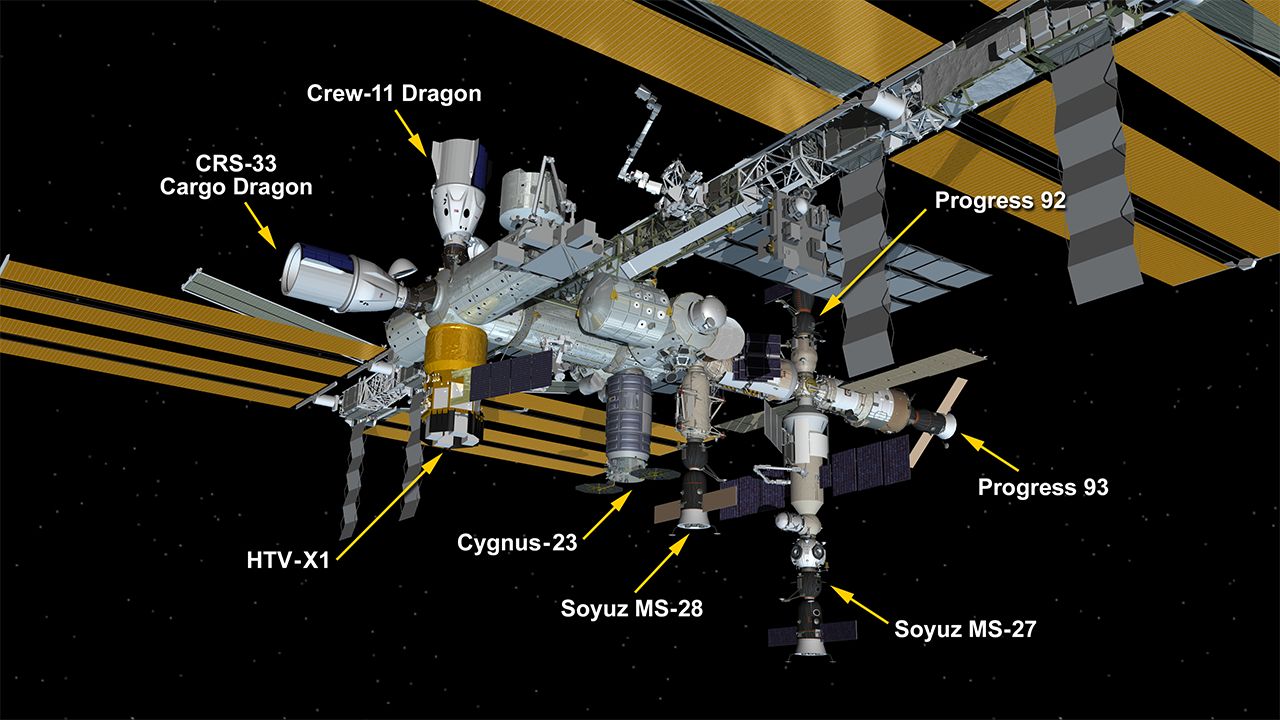
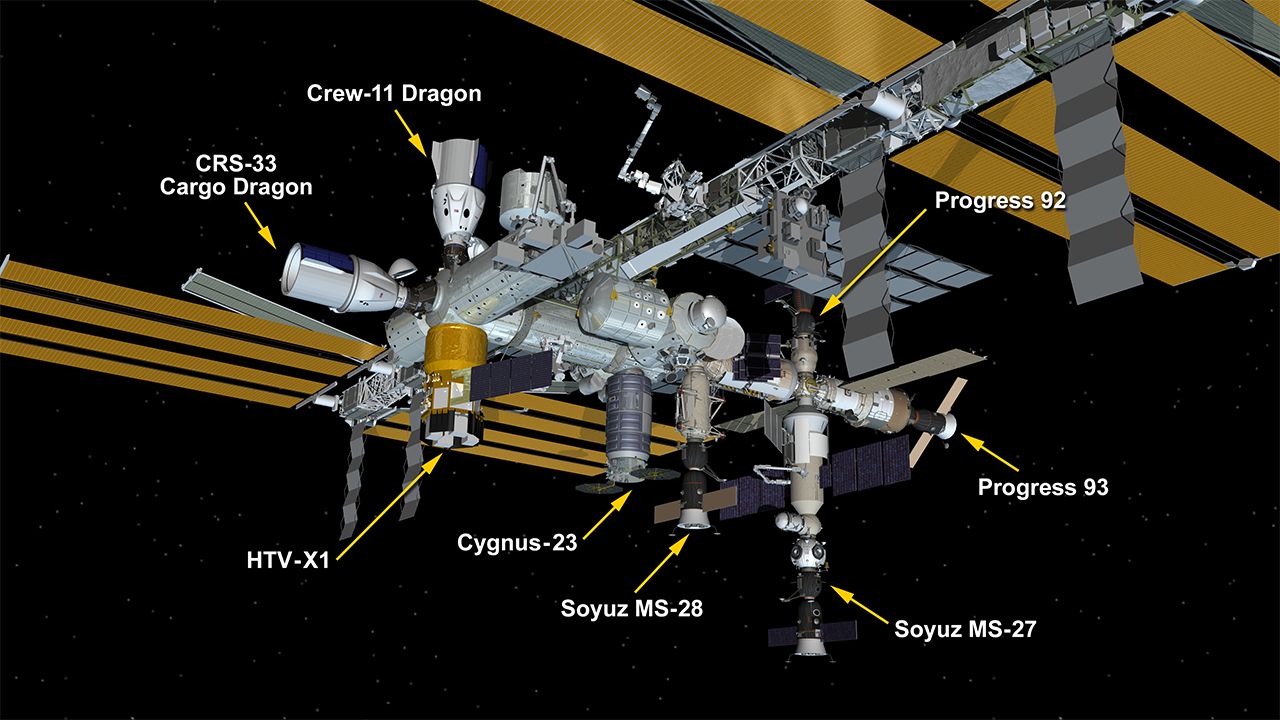
All eight docking ports for spacecraft on the current configuration of the International Space Station (ISS) are fully occupied for the first time in the complex’s history, NASA officials said in a statement on Monday (Dec. 1). (Construction of the ISS began in 1998, but the complex didn’t have that many ports in the beginning.)
Before the Soyuz crew got there, Mission Control at NASA’s Johnson Space Center in Houston used the ISS’ robotic Canadarm2 to move Northrop Grumman‘s Cygnus-23 cargo spacecraft, “to provide appropriate clearance” for the incoming crewed spacecraft, NASA officials stated. Cygnus-23 was then reinstalled at the Earth-facing port of the station’s Unity module. (That’s spacecraft No. 2 of eight, for those of you keeping track.)
There’s another Soyuz vehicle at the ISS as well — Soyuz MS-27, which is installed at the Russian Prichal module. But its orbital stay is coming to and end: Soyuz MS-27 is scheduled to depart the ISS with NASA’s Jonny Kim and Roscosmos cosmonauts Sergey Ryzhikov and Alexey Zubritsky on Dec. 8, for a landing soon thereafter in Kazakhstan.
The remaining five spacecraft at the ISS are the Russian Progress-92 and Progress-93 robotic cargo spacecraft, which reside at the Russian Poisk and Zvezda modules, respectively; the Japanese HTV-X1 cargo craft, berthed at the nadir port of the station’s Harmony Node 2; and two SpaceX Dragon capsules.
These Dragons are at the two other ports on Harmony used for visiting spacecraft. One is the Commercial Resupply Services-33 (CRS-33) robotic cargo capsule, at the Harmony Node 2 forward port. The other is the Crew-11 Dragon, on Harmony’s space-facing port. (Harmony in fact has six ports, but three serve as attachments to the Destiny, Columbus and Kibo ISS modules.)
As its name makes clear, Crew-11 is an astronaut mission. Its crewmembers make up the remainder of the Expedition 73 long-duration astronauts on the ISS: NASA’s Zena Cardman and Michael Fincke, Kimiya Yui from the Japanese Aerospace Exploration Agency (JAXA), and Oleg Platonov from Roscosmos. The quartet will return to Earth sometime in 2026.










Related Posts


Stay Informed With the Latest & Most Important News
Previous Post
Next Post

Advertisement
-
 01Two Black Holes Observed Circling Each Other for the First Time
 -
 02From Polymerization-Enabled Folding and Assembly to Chemical Evolution: Key Processes for Emergence of Functional Polymers in the Origin of Life
 -
 03Astronomy 101: From the Sun and Moon to Wormholes and Warp Drive, Key Theories, Discoveries, and Facts about the Universe (The Adams 101 Series)
 -
 04True Anomaly hires former York Space executive as chief operating officer
 -
 05Φsat-2 begins science phase for AI Earth images
 -
 06Hurricane forecasters are losing 3 key satellites ahead of peak storm season − a meteorologist explains why it matters
 -
 07Binary star systems are complex astronomical objects − a new AI approach could pin down their properties quickly