
Now Reading: FOSSA targets Japan’s defense market as larger smallsats expand capabilities
-
01
FOSSA targets Japan’s defense market as larger smallsats expand capabilities


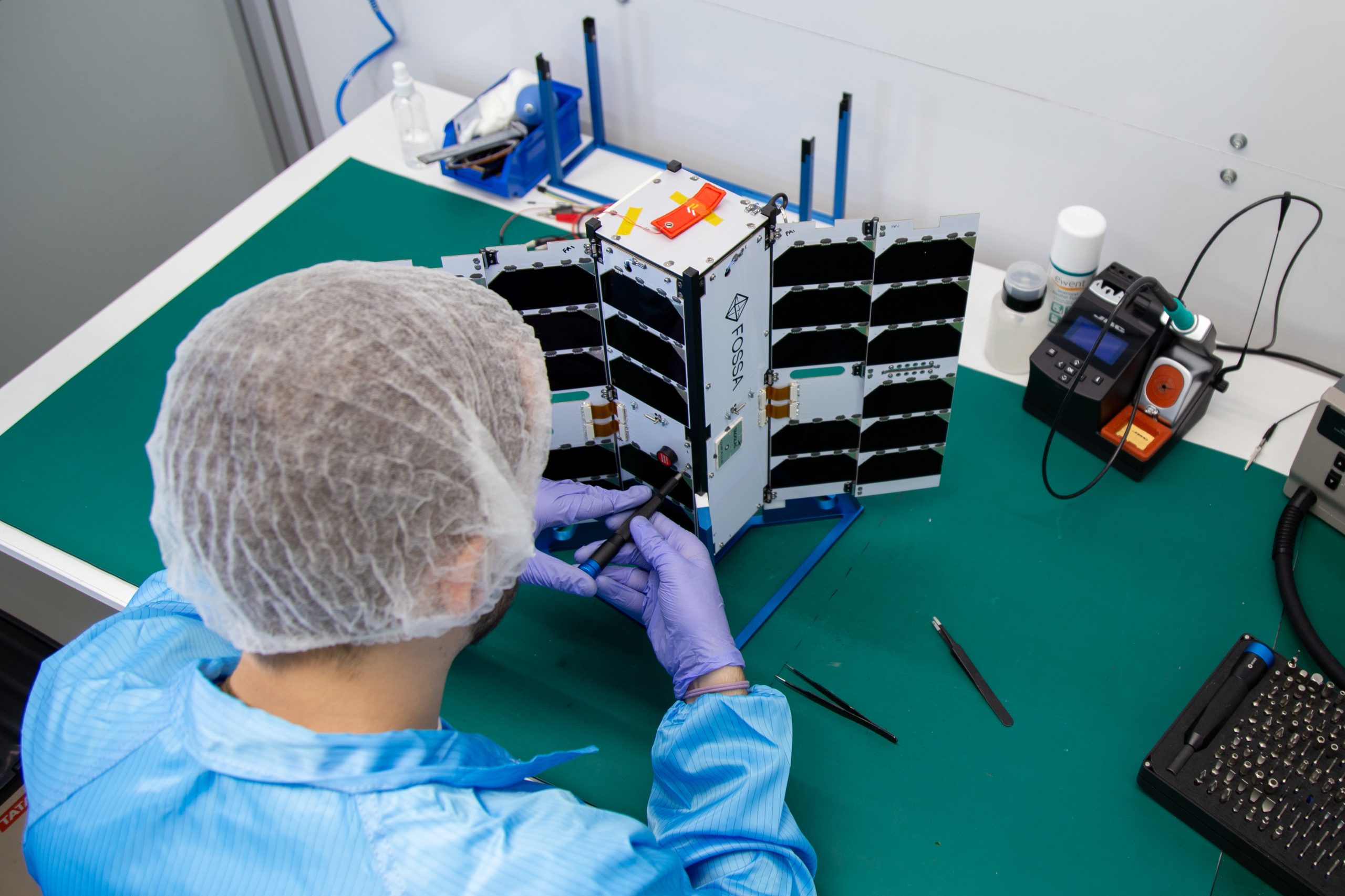

TAMPA, Fla. — Spanish startup FOSSA Systems is pushing into Japan’s defense market after securing a local partner to expand its reach, building on a shift beyond tiny picosatellites used to connect low-power monitoring devices toward larger, more capable spacecraft for broader government applications.
Julián Fernández, FOSSA CEO and cofounder, said the venture has also opened a Tokyo office in its first expansion outside Europe following the distribution agreement with Kanematsu, a conglomerate with a significant presence in Japan’s aerospace and defense market.
FOSSA develops its satellites in-house and was initially focused on spacecraft weighing less than a kilogram to provide connectivity via Long-Range radio (LoRa), a low-power wide-area network protocol used by most Internet of Things (IoT) devices.
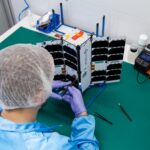
The six-year-old venture deployed 13 picosatellites in low Earth orbit before pivoting to larger 3U cubesats in the nanosatellite class that improve performance and reliability, including software-defined radios for tracking signals from space.
FOSSA has seven 3U cubesats in orbit — each designed to operate for around five years, compared with roughly two years for its earlier picosatellites — and Fernández said some carry dedicated customer payloads for signals intelligence.
The company’s largest satellite yet, a 6U cubesat with propulsion, launched last week on SpaceX’s latest rideshare mission.
Fernández told SpaceNews that FOSSA is also developing a larger 75-150 kilogram microsatellite platform to further expand from Internet of Things (IoT) connectivity to signal intelligence, secure communications and other dedicated missions for defense and national security.
“Picosatellites are a great platform for low TRL technology demonstration and agile access to space,” he said. “FOSSASAT-1 for instance was developed in under 6 months and cost less than $30,000 to build and launch into space.”
However, the company is seeing growing demand for larger platforms that provide stronger signal performance, more advanced payloads and greater reliability.
NATO also recently brought FOSSA into its Defence Innovation Accelerator for the North Atlantic (DIANA) to advance its dual-use commercial and government technologies.
Expansion drive
Today, FOSSA primarily provides connectivity for latency-tolerant instrumentation and tracking applications because the constellation is currently limited to revisit times of roughly twice per day.
“We currently have sensors deployed primarily in International Waters, Spain and Portugal but are expanding worldwide,” Fernández said.
Current data rates range from 300 bits per second to 1 kilobit per second, with message sizes of up to 32 bytes.
“Some of our customers are using our system for mobile-to-mobile communications,” he added.
According to Fernández, FOSSA has grown revenue by 500% and roughly doubled its workforce to 50 people since moving beyond picosatellites in 2023.
As geopolitical tensions mount, the company sees a growing opportunity to expand its focus on national security.
FOSSA’s vertically integrated approach spans satellites, ground stations, payloads and user terminals, which Fernández said enables sovereign capabilities for customers seeking full control over their communications and intelligence infrastructure.
He said FOSSA is currently in the middle of raising funds to expand the constellation, following a 6.3 million euro ($7 million) Series A round in 2024.
“Like last year, we have a launch on nearly every SpaceX rideshare mission in the next 12 months and are still closing out our exact configuration,” he added.
The company has also filed plans to extend the size of the constellation from 80 to 140 satellites.
“FOSSA expects to have a full constellation in orbit in the next 36 months,” he continued, although “many factors will influence this, specifically as we close the constellation, we will need to procure more exit launch opportunities to fill our gaps outside standard rideshare planes.”










Related Posts
Stay Informed With the Latest & Most Important News



Advertisement
-
 01Two Black Holes Observed Circling Each Other for the First Time
 -
 02From Polymerization-Enabled Folding and Assembly to Chemical Evolution: Key Processes for Emergence of Functional Polymers in the Origin of Life
 -
 03Astronomy 101: From the Sun and Moon to Wormholes and Warp Drive, Key Theories, Discoveries, and Facts about the Universe (The Adams 101 Series)
 -
 04True Anomaly hires former York Space executive as chief operating officer
 -
 05Φsat-2 begins science phase for AI Earth images
 -
 06Hurricane forecasters are losing 3 key satellites ahead of peak storm season − a meteorologist explains why it matters
 -
 07Binary star systems are complex astronomical objects − a new AI approach could pin down their properties quickly