
Now Reading: From Earths To Super-Earths: Five New Small Planets Transiting M Dwarf Stars
-
01
From Earths To Super-Earths: Five New Small Planets Transiting M Dwarf Stars


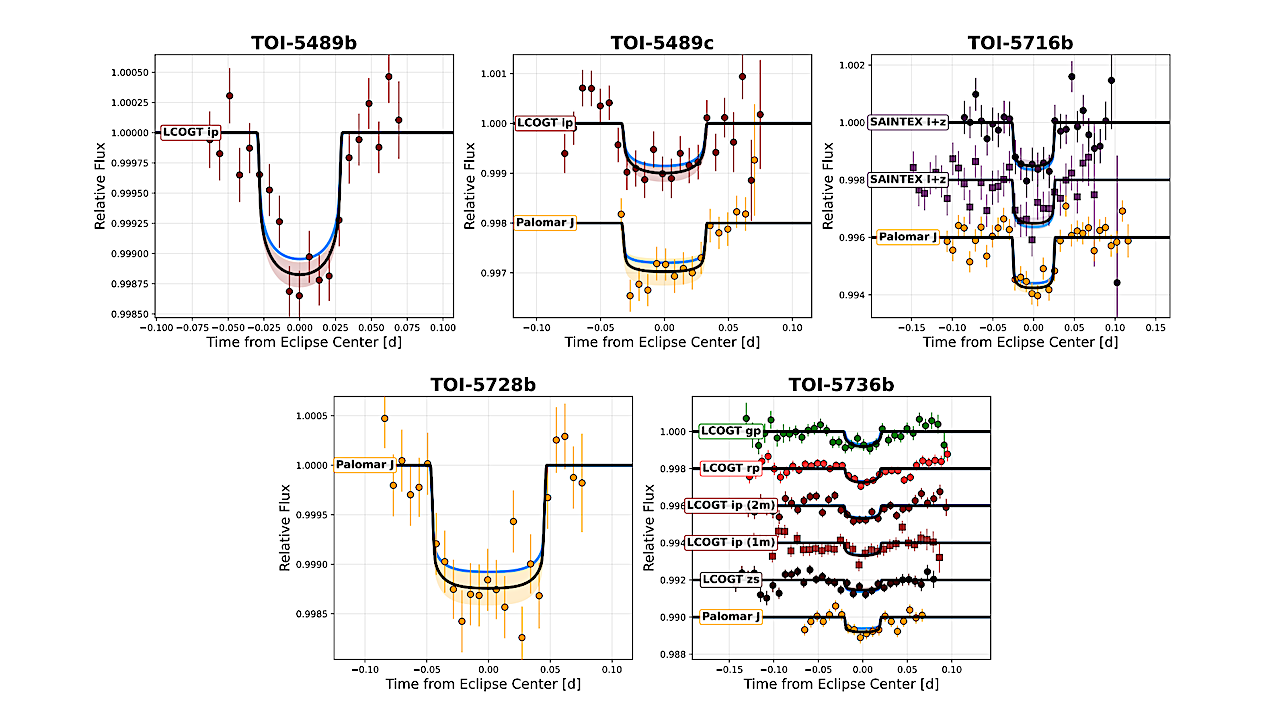
Multi-color ground-based light curves for our five targets. Data points represent 10-minute binned photometry, with light curves obtained using identical filters and exposure times phase-folded together. Black curves show the median transit model derived from the posterior distribution, with colored shading indicating the 68% confidence intervals. Blue curves represent the nominal TESS light curve model projected into the corresponding ground-based filters. — astro-ph.EP
Earth-sized planets transiting M dwarf stars present one of the best opportunities with current facilities for studying the atmospheric and bulk compositions of terrestrial worlds.
Here, we statistically validate five new transiting Earth and super-Earth sized planets orbiting M dwarf stars using a combination of light curves from the Transiting Exoplanet Survey Satellite, multi-color observations from Palomar and Las Cumbres Observatory, high-resolution imaging, and stellar spectroscopy.
The sample includes: TOI-5716 b, an Earth-sized planet (R_p = 0.96 ± 0.05 Rearth) with a 6.766-day orbit around a metal-poor thin-disk star ([Fe/H] = -0.54 ± 0.10); TOI-5728 b, a super-Earth (R_p = 1.31 ± 0.05 Rearth) on an 11.497-day orbit; and TOI-5736 b, a larger planet (R_p = 1.56 ± 0.07 Rearth) with an ultra-short period of just 0.649 days.
We also statistically validate a multi-planet system, TOI-5489, hosting two similarly-sized super-Earths: TOI-5489 b (R_p = 1.40 ± 0.05 R_earth) and TOI-5489 c (R_p = 1.28 ± 0.07 R_earth) with orbital periods of 3.152 and 4.921 days, respectively. Due to their longer orbital periods, TOI-5716 b and TOI-5728 b both have equilibrium temperatures ≤ 400 K, making them useful test cases for studies of atmospheric mass loss.
If TOI-5728 b is confirmed to have an Earth-like bulk composition, it would join the very small sample of rocky planets orbiting mid- to late-M dwarfs that lie below the cosmic shoreline and therefore may have retained high mean molecular weight atmospheres.
Jonathan Gomez Barrientos, Heather A. Knutson, Morgan Saidel, Michael Greklek-McKeon, W. Garrett Levine, Nicholas Saunders, Howard Isaacson, Renyu Hu, Karen A. Collins, David R. Ciardi, Polina A. Budnikova, Dmitry V. Cheryasov, Samuel W. Yee, Diogo Souto, Aida Behmard, Akihiko Fukui, Avi Shporer, Akanksha Khandelwal, Bob Massey, Brice-Oliver Demory, Catherine A. Clark, Chris Stockdale, Emily A. Gilbert, Enric Palle, Francis P. Wilkin, Felipe Murgas, Francis Zong Lang, Ilse Plauchu-Frayn, Jessie L. Christiansen, Jon M. Jenkins, Joseph D. Twicken, Keith Horne, Michaël Gillon, Monika Lendl, Michael B. Lund, Norio Narita, Pam Rowden, Ramotholo Sefako, Richard P. Schwarz, Steven Giacalone, Urs Schroffenegger, Yilen Gómez Maqueo Chew
Comments: 18 pages and 7 figures. Accepted for publication in AJ
Subjects: Earth and Planetary Astrophysics (astro-ph.EP)
Cite as: arXiv:2512.11971 [astro-ph.EP] (or arXiv:2512.11971v1 [astro-ph.EP] for this version)
https://doi.org/10.48550/arXiv.2512.11971
Focus to learn more
Submission history
From: Jonathan Gomez Barrientos
[v1] Fri, 12 Dec 2025 19:00:07 UTC (2,147 KB)
https://arxiv.org/abs/2512.11971
Astrobiology, exoplanet,










Related Posts

Stay Informed With the Latest & Most Important News
Previous Post
Next Post



Advertisement
-
 01Two Black Holes Observed Circling Each Other for the First Time
 -
 02From Polymerization-Enabled Folding and Assembly to Chemical Evolution: Key Processes for Emergence of Functional Polymers in the Origin of Life
 -
 03Astronomy 101: From the Sun and Moon to Wormholes and Warp Drive, Key Theories, Discoveries, and Facts about the Universe (The Adams 101 Series)
 -
 04True Anomaly hires former York Space executive as chief operating officer
 -
 05Φsat-2 begins science phase for AI Earth images
 -
 06Hurricane forecasters are losing 3 key satellites ahead of peak storm season − a meteorologist explains why it matters
 -
 07Binary star systems are complex astronomical objects − a new AI approach could pin down their properties quickly