
Now Reading: From Space Dust To Protocells: Micrometeorites In Early Cellular Evolution
-
01
From Space Dust To Protocells: Micrometeorites In Early Cellular Evolution


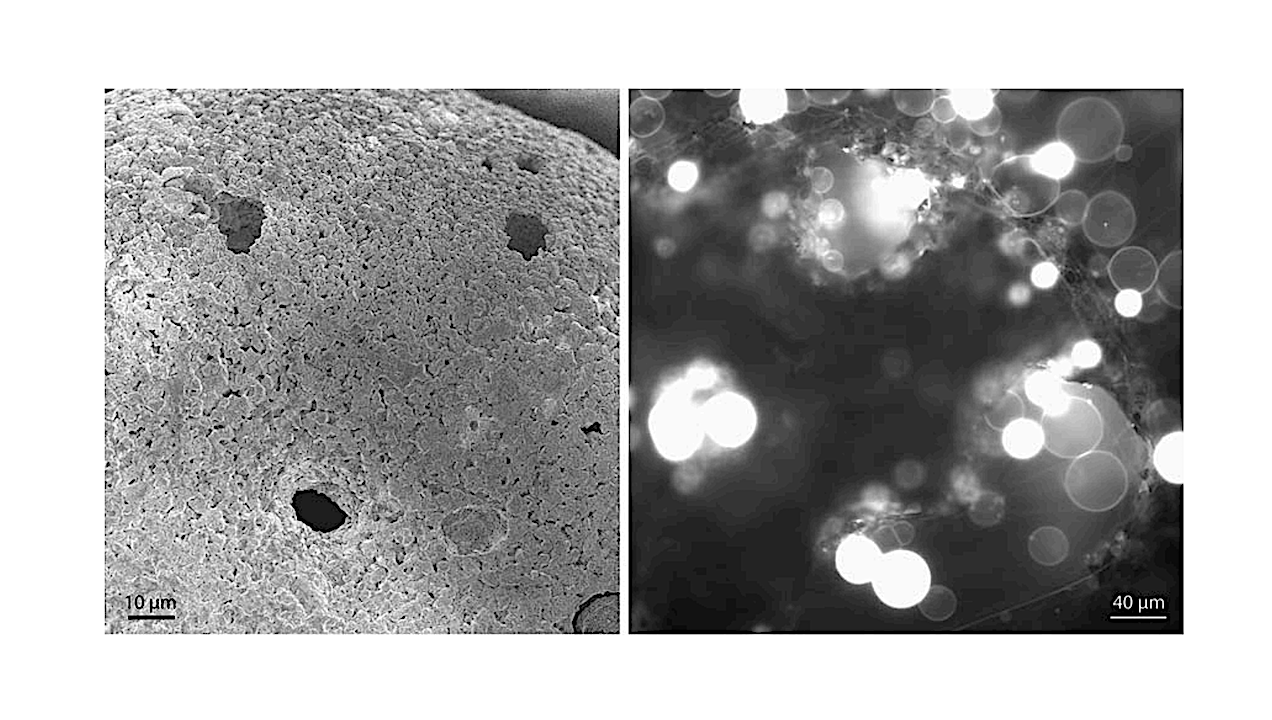

Protocell formation on a scoriaceous micrometeorite. A scanning electron microscope image section of the micrometeorite (left), fluorescence microscope micrograph of protocells on the surface of the micrometeorite (right). Phospholipid membranes in the fluorescence micrograph are composed of Escherichia coli (E.coli) and soybean plant lipids, labeled with 1 wt% ATTO 655-DOPE. Unilamellar vesicles have only a thin fluorescent rim, while multilamellar membrane reservoirs are onion shell vesicles composed of densely packed lipid membranes. — Astrobiology
Solid surfaces have long been considered catalysts in prebiotic chemistry, yet their physical energy has rarely been explored as a driver of protocell assembly.
This opinion article highlights recent experimental advances demonstrating that oxide minerals, Hadean Earth analogs, and martian meteorite specimens autonomously promote the assembly and transformation of lipid protocells without chemical catalysis.
Surface-adhered compartments form mechanically resilient protocell colonies, nanotube-connected protocell networks enabling direct molecular transport, and flat protocells with spontaneous fusion and compositional diversification-capabilities absent in cell-sized free-floating vesicles.
Extending these findings to extraterrestrial materials, new results indicate that micrometeorites, with their freshly generated, rough, and porous surfaces produced during atmospheric entry, efficiently nucleate protocell assembly.
Given the continuous global influx of micrometeorites and growing astrobiological evidence of organics in cosmic dust, I propose that micrometeorites represent previously underappreciated initiators of protocell development, linking early Earth environments with contemporary planetary science and the search for life elsewhere.
Astrobiology,











Related Posts
Stay Informed With the Latest & Most Important News

Advertisement
-
 01Two Black Holes Observed Circling Each Other for the First Time
 -
 02From Polymerization-Enabled Folding and Assembly to Chemical Evolution: Key Processes for Emergence of Functional Polymers in the Origin of Life
 -
 03Astronomy 101: From the Sun and Moon to Wormholes and Warp Drive, Key Theories, Discoveries, and Facts about the Universe (The Adams 101 Series)
 -
 04True Anomaly hires former York Space executive as chief operating officer
 -
 05Φsat-2 begins science phase for AI Earth images
 -
 06Hurricane forecasters are losing 3 key satellites ahead of peak storm season − a meteorologist explains why it matters
 -
 07Binary star systems are complex astronomical objects − a new AI approach could pin down their properties quickly