
Now Reading: Geminid meteor shower 2025 peaks next week. Here’s what you need to know about this year’s best meteor shower
-
01
Geminid meteor shower 2025 peaks next week. Here’s what you need to know about this year’s best meteor shower

Geminid meteor shower 2025 peaks next week. Here’s what you need to know about this year’s best meteor shower

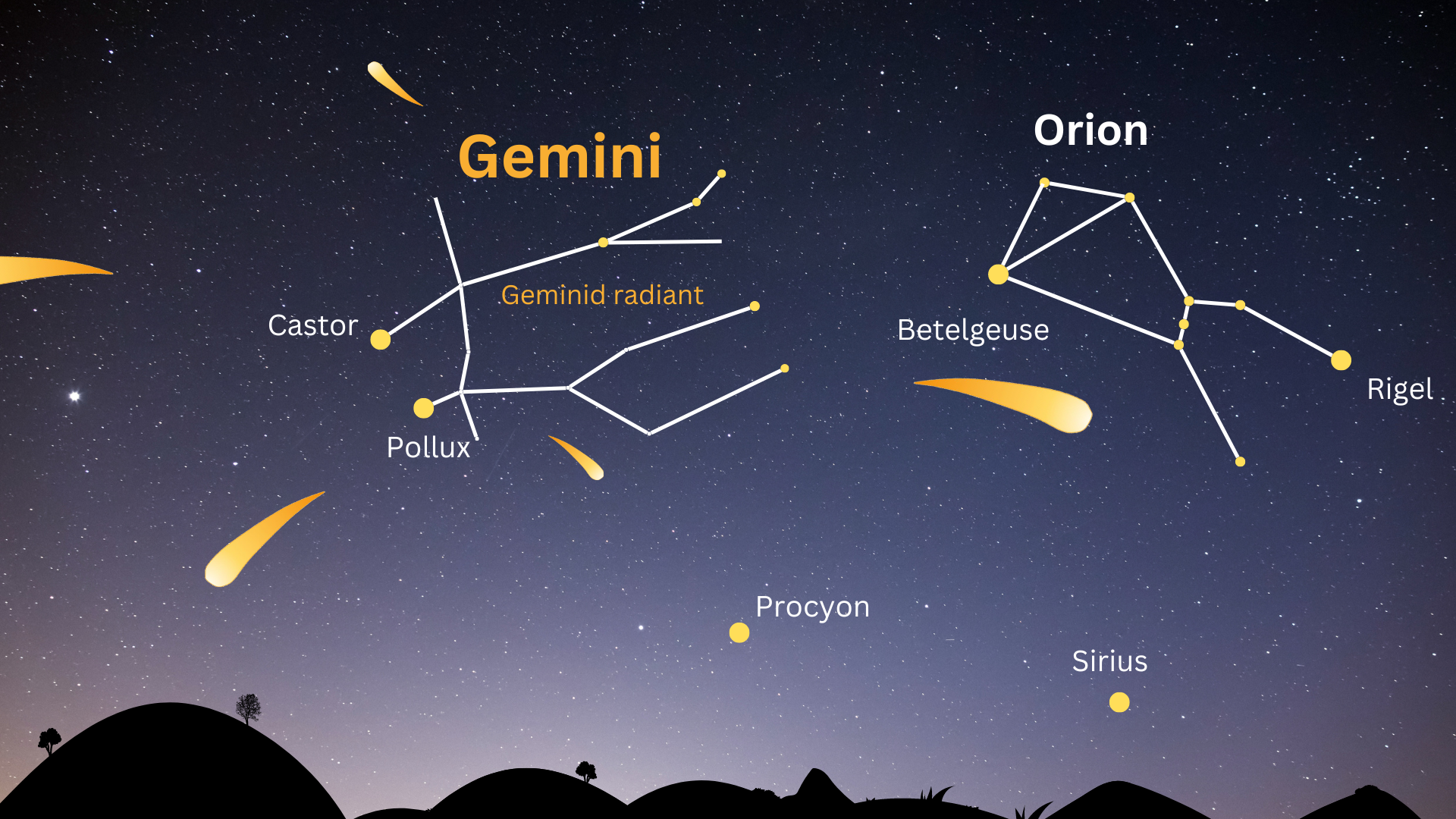
Without question of doubt, near the top of the list of the very best celestial events of 2025 would be the upcoming performance of the Geminid meteor shower. This pre-Christmas display of celestial fireworks is due to reach its peak during the long, dark overnight hours of Saturday, Dec. 13, into the morning hours of Sunday, Dec. 14.
The moon will be a waning crescent that won’t rise until the predawn hours when the Geminid meteor shower should be at its peak. This annual shower is as reliable as the Perseids of August and is now, according to British meteor expert Alastair McBeath, “. . . one of the very best presently seen from the Earth.”
And yet initially, you may not get overly excited about the prospects of spending a night under the stars looking for Geminid meteors. After all, mid-December is a mighty cold time for lying on your back at night and staring up at the sky. But ask most experienced meteor observers which meteor display they would prefer to view and the majority would go with the Geminids — nicknamed the “Gems” — who many now consider to be stronger and more satisfying than their famous midsummer counterpart. The “Gems” are a rich meteor display that is apparently on the rise.
When is the best time to look for Geminids?
You don’t have to wake up to the predawn hours to see the Geminids well displayed. They are among a small minority of showers that are quite good before midnight. Most meteor showers are strongest before the first light of dawn because that’s when your side of the Earth faces forward in our planet’s rush along its orbit and plows through meteor streams head-on. Another way of saying this is that the radiant or emanation point of most meteor showers appears highest in the sky before dawn. In contrast, the Geminid radiant — located near the bright star Castor in Gemini — is already a respectable 30 degrees high in the eastern sky as early as 9 p.m. (as seen from mid-northern latitudes). Your clenched fist held at arm’s length is equal to roughly 10 degrees; so, 30 degrees measures “three fists up” from the horizon. The radiant reaches its highest point — almost directly overhead — around 2 a.m.
When the radiant is anywhere close to overhead — say by midnight — you may see as many as 120 to 150 Geminids per hour under an excellent dark sky.
Please keep in mind, however, that light pollution and tall obstructions will significantly lower your numbers. When the radiant is 30 degrees up, expect about half that number, still roughly one a minute on average.

Catch an Earthgrazer
Generally speaking, depending on your location, Castor begins to come up above the east-northeast horizon right around the time evening twilight is coming to an end. As Gemini is beginning to climb the eastern sky just after darkness falls, there is a fair chance of perhaps catching sight of an “Earth-grazing” meteor or two early on Saturday evening. Dec. 13.
Earthgrazers are long, bright shooting stars that streak overhead from a point near, to even just below the horizon. Such meteors are so distinctive because they follow very long paths nearly parallel to our atmosphere. As Gemini climbs higher into the sky, however, these very long paths will become much shorter.
How fast are Geminid meteors?
Geminids are slower and more graceful than the swift streaks of most shower meteors. Geminids plunge into our atmosphere at 22 miles (35 km) per second. Compare that to 37 miles per second for the swift Perseids, 41 for the very swift Orionids, and 45 for the ultrafast Leonids. This is partly because Earth doesn’t hit the Geminids head-on (rather, they come sideways into Earth’s orbit), and partly because they themselves follow a relatively slow orbit around the sun. Moreover, Geminid meteoroids are physically firmer and more tightly packed — four times denser than the typical cometary dust flakes that supply most meteor showers — so they don’t burn up quite as fast
2025: An exceptional year!
This year, according to the Meteor Shower Calendar of the International Meteor Organization (IMO), the Geminids are ranked as the “Best and most reliable of the major annual showers presently observable.” Indeed, in 2025, observing conditions for the Geminids are almost optimal. The 24½-day old moon is a 27-percent illuminated crescent in Virgo and will not rise until just after 2:00 a.m. local time on Sunday morning, the 14th, and will hardly be more than a minor nuisance for meteor watchers.
In fact, the bright blue star Spica will also be a few degrees nearby, making for a lovely celestial tableau.
The IMO says that this year’s Geminid peak will come at 8:00 UT, which is what is also forecast in the 2025 Observer’s Handbook of the Royal Astronomical Society of Canada (RASC). What this means for those in North America is that the constellation of Gemini (which this year also contains brilliant Jupiter) will be literally soaring up in the east-southeast sky when maximum activity is due, while for those near and along the Atlantic Seaboard, Gemini will be practically overhead! The IMO is forecasting a zenithal hourly rate (the number of meteors a single observer would see under a very dark, clear sky with the radiant directly overhead) of 150, while the RASC suggests a ZHR of 120.
Examination of reliably observed Geminid peak dates in recent years indicates that the highest rates occur within about 2½ hours or so to either side of the predicted times of maximum and that the highest rates persist at only marginally reduced levels for 6 to 10 hours around their peak. So put a big red circle on your calendar for Saturday, December 13th. All through that night (local weather conditions permitting) you’ll be seeing a lot of “falling stars!”

Burned-out comet is the likely source
The Geminids were apparently shed from 3200 Phaethon, an Apollo-class asteroid, which ventures no farther out into space than beyond the orbit of Mars. It is considered by some to be the 3-mile (5 km)-wide denuded core of what was once, in the distant past, a short-period comet. In fact, the 1.52-year orbit of 3200 Phaethon is far shorter than that of any other currently active comet. It passes at only about one-third Mercury‘s distance from the sun, and less than one-tenth of the moon‘s orbit to the Earth. Its associated Geminid meteor stream is calculated to be about 4,700 years old.
And it has only been fairly recently — relatively speaking — that Earth has begun interacting with this asteroid‘s trail of debris.
Unlike the Perseids, which date back nearly two millennia (to 36 A.D. according to ancient Chinese chronicles), the Geminids were not reported until December 1862, when observers in England and America began noticing a few bright meteors per hour darting from the constellation Gemini. By the beginning of the 20th century, skywatchers were reporting hourly rates of about 20 to 25. By the 1940’s and ’50’s, rates had risen to 30 to 60. During the 1960’s they were near 65 and by the end of the 1970’s some were reporting as many as 80 per hour.
And the “Gems” have continued to grow stronger ever since, with rates reaching up to two per minute for those blessed with a wide-open view of a dark, star-filled sky.
Bundle up and “shower” with a friend
Nikon Z8

Want to capture the natural splendor of the Geminid meteor shower for yourself? We rate the Nikon Z8 as the best overall camera out there! Be sure to check out our Nikon Z8 review for a more in-depth look at its capabilities.
However, a Geminid watch is cold! You’re likely going to be outside near the coldest time of the 24-hour temperature cycle. Since you’re (hopefully) going to be under a wide-open, clear sky, radiational cooling chills you even more. And unlike most things you do outside in the cold, meteor observing is motionless.
Astronomer Henry Neely, who for many years served as a popular lecturer at New York’s Hayden Planetarium, once had this to say about watching for the Geminids in his book, A Primer for Stargazers:
“Take the advice of a man whose teeth have chattered on many a winter’s night — wrap up much more warmly than you think is necessary!”
Indeed, expect the ambient air temperature to be far below what your local radio or TV weathercaster predicts. Therefore, make sure you’re warm and comfortable. Heavy blankets, thick sleeping bags, ground cloths, auto cushions, and pillows are essential equipment. Try an electric heating pad inside your coat.
No two observers prepare for a meteor vigil the same way. It helps to have had a late afternoon nap, a shower, and to wear fresh clothing. Hot cocoa, tea or coffee can take the edge off the chill, as well as provide a slight stimulus. It’s even better if you can observe with a companion. That way, you can keep each other awake, as well as cover more sky.
What to expect

The best direction to watch is wherever your sky is darkest, probably straight up. The average brightness of a typical Geminid meteor is around second or third magnitude (as bright as the stars in the Big Dipper). About one in ten reach magnitude zero or brighter and a few can be outstandingly bright fireballs or even bolides (exploding meteors), capable of casting shadows. In their guidebook, “Observe Meteors,” published by the Astronomical League in 1986, authors David H. Levy and Stephen J. Edberg write:
“If you have not yet seen a mighty Geminid fireball arching gracefully across an expanse of sky, then you have not seen a meteor.”
Yet, only about three percent of all Geminids leave persistent incandescent trails in their wake. From years of Geminid watching, I personally liken them to “celestial field mice” skirting through the background stars.
About 65% of all “Gems” appear pure white, 25 percent yellow, and all the rest can appear in a variety of different hues: red, orange, and blue, even green. Some say they seem to appear brighter and more colorful during the pre-midnight hours.
Don’t miss the opening and closing acts
And don’t scorn the nights away from the peak date. The Geminids began to “ramp up” with just a handful of meteors per hour beginning on the night of Dec. 7. On the following nights leading up to the peak night of Dec.13-14, meteor activity slowly begins to build, but relatively faint meteors (third magnitude or dimmer) seem to proliferate. On the night before the peak (December 12-13), rates are about half as many compared to the maximum. After the peak night, rates drop off sharply: On the night of De. 14-15, you may only see one-quarter of the peak rate. However, the meteors that will be visible are decidedly brighter than during the early stages of the display, probably because smaller meteoroids dominate at the beginning, but larger particles trail behind toward the end. You might still catch a few late stragglers on the night of Dec.15-16, but after that, the curtain has lowered and the 2025 performance of the Geminids will be over.
Joe Rao serves as an instructor and guest lecturer at New York’s Hayden Planetarium. He writes about astronomy for Natural History magazine, Sky and Telescope and other publications.
Editor’s Note: If you snap a photo of the Geminid meteor shower and would like to share it with Space.com’s readers, send your photo(s), comments, and your name and location to spacephotos@space.com.










Related Posts

Stay Informed With the Latest & Most Important News
Previous Post
Next Post



Advertisement
-
 01Two Black Holes Observed Circling Each Other for the First Time
 -
 02From Polymerization-Enabled Folding and Assembly to Chemical Evolution: Key Processes for Emergence of Functional Polymers in the Origin of Life
 -
 03Astronomy 101: From the Sun and Moon to Wormholes and Warp Drive, Key Theories, Discoveries, and Facts about the Universe (The Adams 101 Series)
 -
 04True Anomaly hires former York Space executive as chief operating officer
 -
 05Φsat-2 begins science phase for AI Earth images
 -
 06Hurricane forecasters are losing 3 key satellites ahead of peak storm season − a meteorologist explains why it matters
 -
 07Binary star systems are complex astronomical objects − a new AI approach could pin down their properties quickly