
Now Reading: Geminid meteor shower peaks tonight — here’s what to expect from one of the best shooting star shows of the year
-
01
Geminid meteor shower peaks tonight — here’s what to expect from one of the best shooting star shows of the year

Geminid meteor shower peaks tonight — here’s what to expect from one of the best shooting star shows of the year

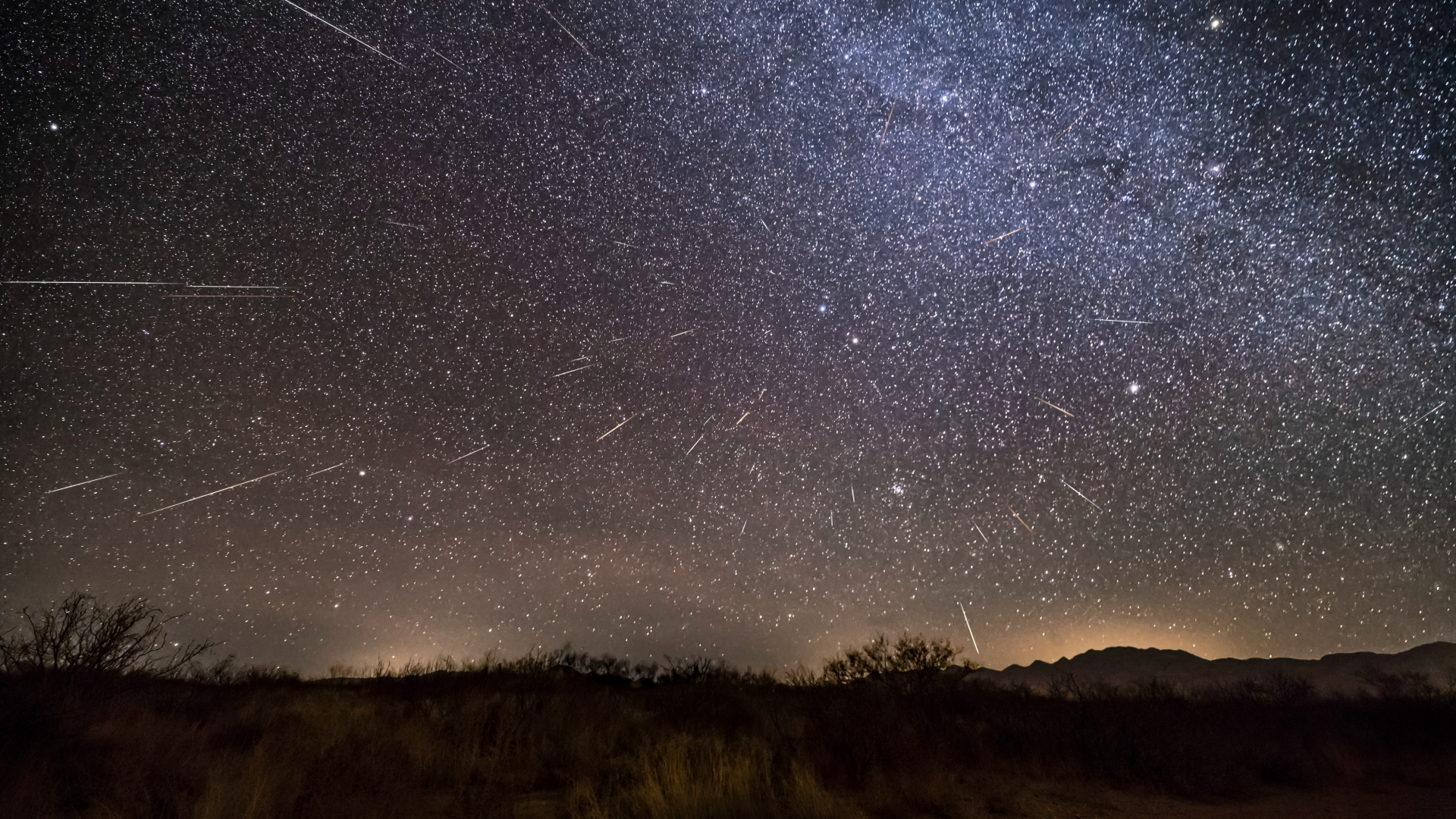

The Geminid meteor shower peaks overnight tonight (Dec. 13-14), bringing with it the potential for a breathtaking display of shooting stars as Earth barrels through the debris trail shed by comet 3200 Phaethon.
Shooting stars appear when particles from ancient comets and asteroids collide with Earth’s atmosphere, burning up in a magnificent display that can be easily visible to the naked eye. A particle no larger than a grain of sand has the potential to create a beautiful, short-lived meteor, while larger fragments that can exceed 1 meter (3 feet) in size create magnificent “fireballs”, which can blaze brighter than the planet Venus during their passage through the night sky.
How to see Geminid meteors
Geminid meteors appear to travel from a point of origin, or radiant, located close to the bright star Castor in the constellation Gemini, which rises above the Northern Hemisphere’s eastern horizon in the hours following sunset on Dec. 13. It is from this constellation that the shower gets its name.
It will be possible to see Geminid meteors as soon as darkness falls and the radiant is above the horizon, though only a few meteors will be visible during this early period passing low in the northern and southern sky, heading westward. “The few meteors that do appear at this time are special in the fact that they just skim the atmosphere rather than penetrate deeply,” said meteor expert Robert Lunsford in a post detailing observing tactics on the AMS website. “This allows them to last for several seconds rather than the normal sub-second duration.”

A greater number of meteors will become visible after 10 p.m. local time, when up to 30 Geminids may be seen under dark sky conditions as the radiant soars higher in the autumn sky.
To see meteors with the longest trails, first locate the radiant by finding Castor with a smartphone astronomy app. If you need help finding it, you can first look for the planet Jupiter, which can be seen shining brightly in the constellation Gemini throughout December. Next, stake out a patch of sky 30-40 degrees above Castor, where the trails of shooting stars will be at their longest. Remember, the width of your clenched first accounts for approximately 10 degrees of sky, so this would be about three or four hand widths above Jupiter.

Nikon Z8

Want to capture the natural splendor of the Geminid meteor shower for yourself? We rate the Nikon Z8 as the best overall camera out there! Be sure to check out our Nikon Z8 review for a more in-depth look at its capabilities.
“As each hour passes, hourly rates will increase reaching maximum near 2 a.m.,” continued Lunsford. “At this hour expect to see up to 60 Geminid meteors from dark rural sites.” Things will get a little trickier when the 25%-lit waning crescent moon rises around 2 a.m. local time. Thankfully, it will still be possible to see many shooting stars brightening the sky around this time by keeping the lunar disk out of your field of view.
When hunting meteors, It’s best to allow 30 minutes to allow your eyes to fully adapt to the dark and to use a red light where possible to preserve your night vision. Remember to dress warmly to make the experience enjoyable, and try to take a reclining chair or sleeping bag that will allow you to lie back and take in as much sky as possible in a comfortable position.
Photographers interested in capturing the shower should read our guide to imaging meteor showers, while those looking to upgrade their gear should read our roundups of the best astrophotography lenses and cameras for capturing the night sky.
Editor’s Note: If you capture an image of a Geminid shooting star and want to share your astrophotography with Space.com’s readers, then please send your photo(s), comments, name and location to spacephotos@space.com.










Related Posts

Stay Informed With the Latest & Most Important News
Previous Post
Next Post



Advertisement
-
 01Two Black Holes Observed Circling Each Other for the First Time
 -
 02From Polymerization-Enabled Folding and Assembly to Chemical Evolution: Key Processes for Emergence of Functional Polymers in the Origin of Life
 -
 03Astronomy 101: From the Sun and Moon to Wormholes and Warp Drive, Key Theories, Discoveries, and Facts about the Universe (The Adams 101 Series)
 -
 04True Anomaly hires former York Space executive as chief operating officer
 -
 05Φsat-2 begins science phase for AI Earth images
 -
 06Hurricane forecasters are losing 3 key satellites ahead of peak storm season − a meteorologist explains why it matters
 -
 07Binary star systems are complex astronomical objects − a new AI approach could pin down their properties quickly