
Now Reading: GEO satellite refueling a priority for national security, commercial markets, new analysis finds
-
01
GEO satellite refueling a priority for national security, commercial markets, new analysis finds

GEO satellite refueling a priority for national security, commercial markets, new analysis finds

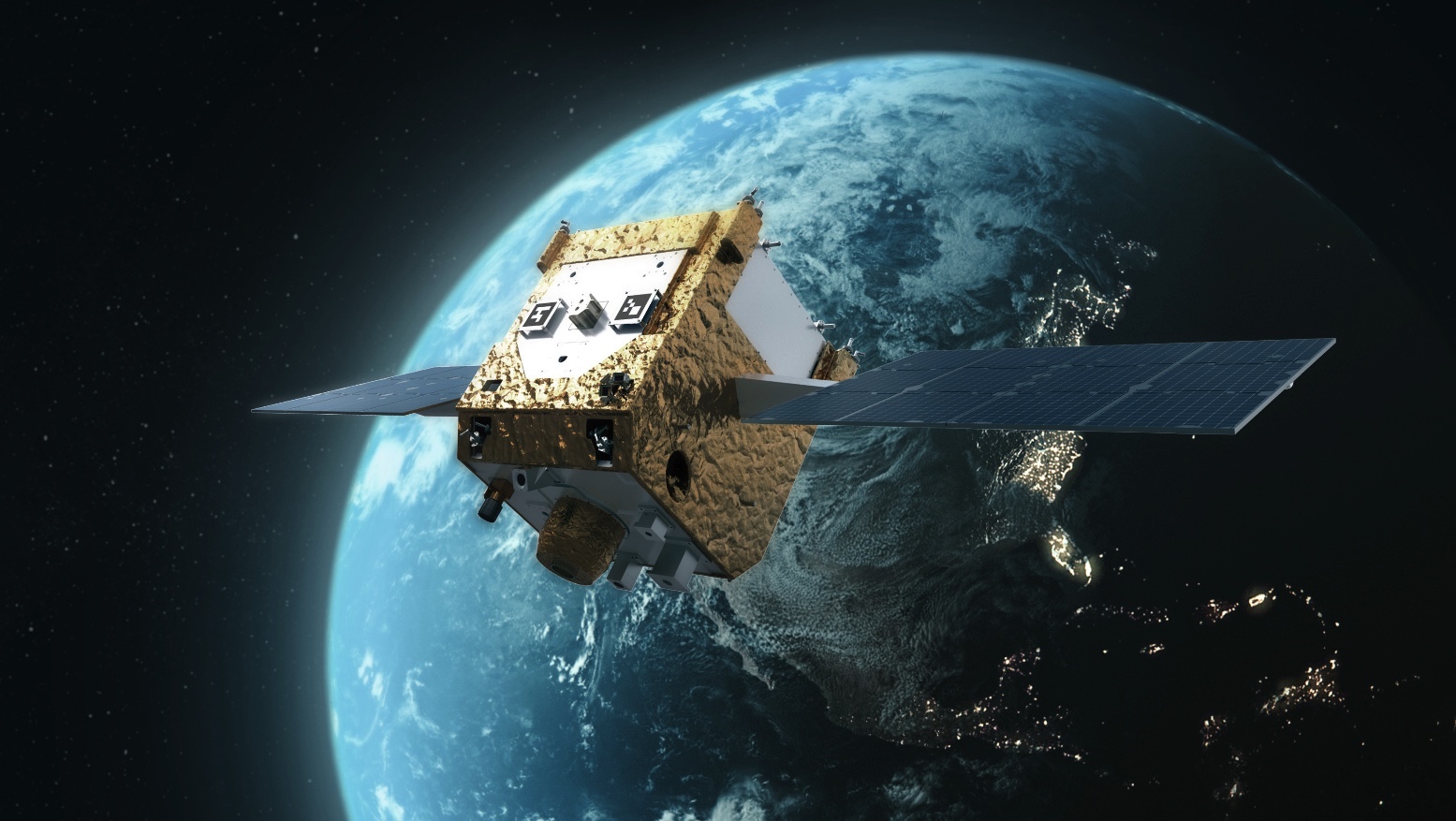

ORLANDO, Fla. — Government and industry analysts have identified the refueling of satellites in geostationary orbit as one of the most practical and immediately valuable applications of on-orbit servicing, recommending focused investment, early demonstrations and coordinated policy work to bring the capability into routine use.
The findings come from a report released Dec. 10 by the Consortium for Space Mobility and ISAM Capabilities, or COSMIC, a NASA-established group formed in 2023 to coordinate U.S. efforts in in-space servicing, assembly and manufacturing. The consortium has grown to more than a thousand members across industry, academia and government and produces shared technical assessments and policy recommendations for services such as refueling, repair and robotic operations.
The report argues that GEO refueling has become a national security need as military and intelligence spacecraft face rising maneuver demands and fixed fuel reserves. Satellites in the 22,300-mile orbit typically maneuver sparingly because each burn shortens service life. COSMIC says refueling would allow operators to extend missions, reduce replacement rates and support more agile concepts of operations.
The group found that key technologies are already in hand. Sensors for rendezvous and proximity operations, docking hardware and propellant-transfer interfaces exist in varying levels of maturity. With targeted testing, the report says, these systems could support commercial and government servicing missions at scale. The market impact could be significant in a sector where a single GEO satellite can cost several hundred million dollars to build and launch.
After assessing multiple ISAM use cases, COSMIC labeled GEO refueling a “critical capability to ensure assets remain viable throughout their project lifespan and unlock novel applications of GEO satellites.”
Although the United States Space Force aims to demonstrate GEO refueling technologies by 2026, and some international demonstrations have occurred, the report stresses that “single demonstration missions do not fully address the necessary infrastructure or regulatory changes required for a robust commercial refueling ecosystem.”
Greg Richardson, COSMIC’s executive director, said the findings underscore a “value proposition for national security.” The Space Force is pursuing “dynamic space operations,” a posture that envisions satellites maneuvering more often to avoid threats or respond quickly to intelligence or operational demands. Refueling, he said, would let national security spacecraft reposition repeatedly and maintain less predictable trajectories, complicating adversary planning.
Richardson said the goal is to give industry, government and academic organizations that are part of COSMIC a common set of recommendations to bring “to the decision makers for investment” as budgets are shaped.
Policy remains one of the largest barriers, the report notes, citing gaps in U.S. regulatory frameworks for new on-orbit servicing missions. Richardson said clearer and more streamlined processes for licensing launch and in-orbit activities would “benefit the entire community.”
He added that much of the needed hardware exists but lacks flight heritage. “What we need now is all the different folks that are working at startup companies, large companies that have a particular design, we need them to get their system up into space to show that it works,” he said.
Space Force demos
The Space Force has begun charting a path. Lt. Gen. Philip Garrant, commander of Space Systems Command, said at the Spacepower conference on Dec. 10 that upcoming demonstrations will help shape requirements and concepts of operations for future refueling programs.
One effort is planned for 2026, when Astroscale intends to refuel two Space Force spacecraft in GEO. Its service vehicle, Astroscale U.S. Refueler, is designed to transfer hydrazine and to refuel itself from an Orbit Fab propellant depot launched on the same mission. “We expect to learn a lot from it,” Garrant said.
He added that the service views maneuverability as a long-term investment. “In a generation, our on-orbit capabilities will inherently have maneuver without regret, and inherently have the ability to dynamically operate,” he said. Still, he noted the cost and logistics of delivering propellant to GEO. “It’s not insignificant to launch a gas tank to GEO… We recognize the need and are looking at what’s the best approach for that five to 15 year timeframe.”
Garrant said more investment is likely once the service has “a better handle on the requirements and technical feasibility.”










Related Posts
Stay Informed With the Latest & Most Important News
Previous Post
Next Post





Advertisement
-
 01Two Black Holes Observed Circling Each Other for the First Time
 -
 02From Polymerization-Enabled Folding and Assembly to Chemical Evolution: Key Processes for Emergence of Functional Polymers in the Origin of Life
 -
 03Astronomy 101: From the Sun and Moon to Wormholes and Warp Drive, Key Theories, Discoveries, and Facts about the Universe (The Adams 101 Series)
 -
 04True Anomaly hires former York Space executive as chief operating officer
 -
 05Φsat-2 begins science phase for AI Earth images
 -
 06Hurricane forecasters are losing 3 key satellites ahead of peak storm season − a meteorologist explains why it matters
 -
 07Binary star systems are complex astronomical objects − a new AI approach could pin down their properties quickly