
Now Reading: Getting to the core of a medicane
-
01
Getting to the core of a medicane



27/03/2026
440 views
11 likes
Everyone knows what a hurricane is, but a lesser-known storm type – a medicane – recently made landfall in Libya. While the arrival of Medicane Jolina, a rare Mediterranean cyclone, brought extreme weather, it also provided scientists with a crucial test case.
Using different types of data from Earth-observing satellites, researchers are gaining new insights into how these storms form and evolve, and therefore, how their impacts can be predicted more accurately.
The term medicane, short for Mediterranean hurricane, was coined just two decades ago to describe tropical cyclone–like storms forming over the Mediterranean Sea. While not typically as common or as powerful as their hurricane cousins, they can still generate destructive winds, severe flooding and dangerous storm surges – posing a significant threat to more than 500 million people living around the Mediterranean basin, as well as leading to substantial economic losses for affected countries.
Currently only occurring up to about three times a year, their rarity makes them difficult to observe and even harder to simulate.
Medicanes are thought to be powered by heat from the sea, much like tropical hurricanes, and they share several similar features. However, new research shows that not all medicanes form in the same way, as some are also influenced by weather processes typical of mid-latitude storms.
Moreover, a big challenge has been the lack of a clear definition of a medicane. Different studies use different criteria, making results hard to compare and causing confusion when issuing weather warnings to the public.
To address this, a team of researchers, led by Italy’s National Research Council’s Institute of Atmospheric Sciences and Climate (CNR-ISAC) and funded through the ESA Earth Observation Science for Society Medicanes Project, recently introduced a standardised definition based on characteristics that can be observed and measured by satellites.
This definition, the subject of a paper published in the Bulletin of the American Meteorological Society, states: a medicane is a mesoscale cyclone that develops over the Mediterranean Sea and displays tropical-like cyclone characteristics – a warm core extending into the upper troposphere, an eye-like feature in its centre with spiral cloud bands around, an almost windless centre surrounded by nearly-symmetric sea-surface wind circulation with maximum wind speed within a few tens of km from the centre.
With a clear definition and Earth observation at the cornerstone of understanding and predicting medicanes, the recent Jolina event provides an important case study, contributing to the identification of patterns and differences essential for advancing our knowledge and improving forecasting capabilities for this class of cyclones.
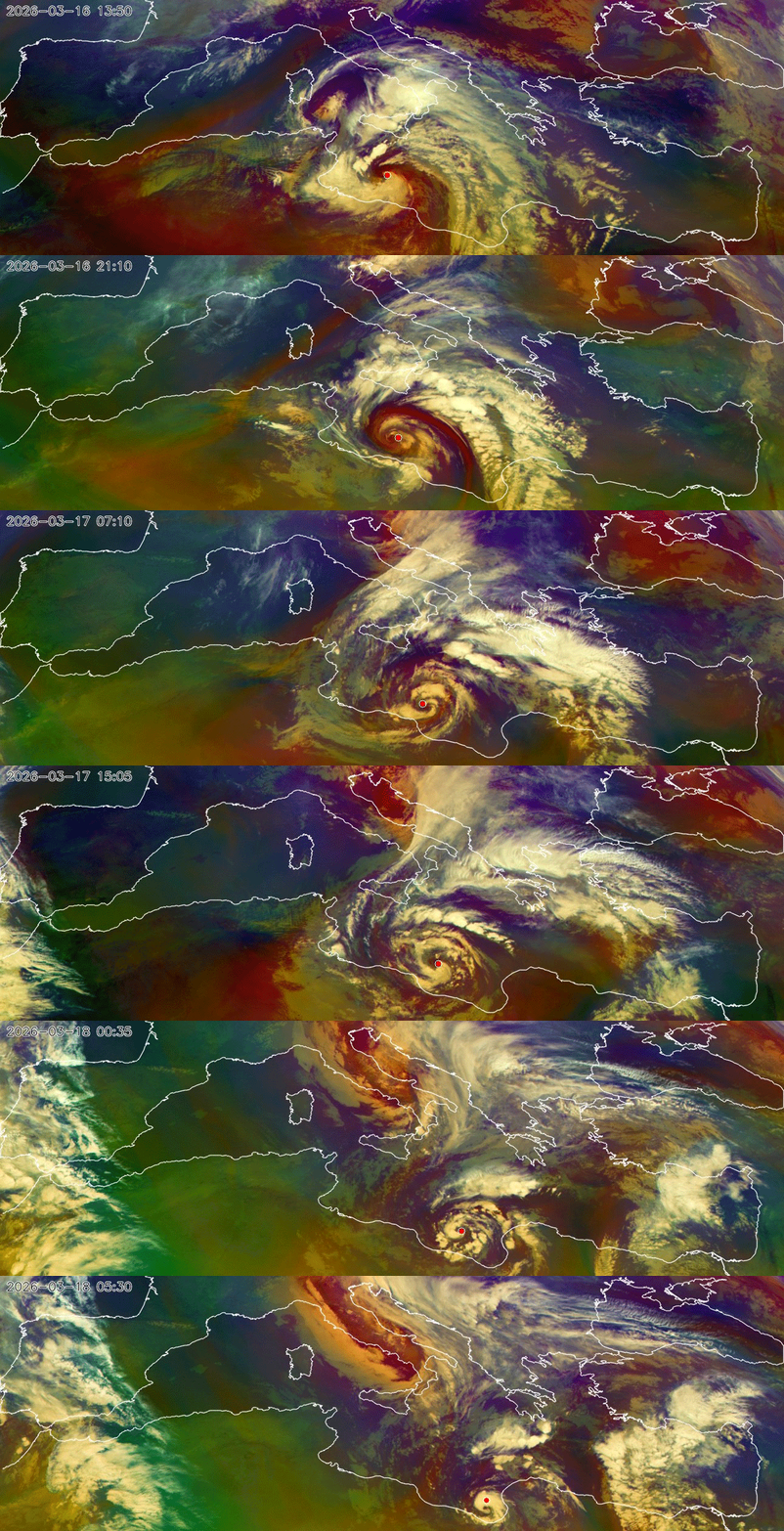
The cyclone, first named Samuel, began as a cold-core, low-pressure area over the western Mediterranean Sea on 14 March. In line with the new definition, it was reclassified as a medicane and renamed Jolina on 17 March as it crossed the Mediterranean and transitioned to a warm-core system – even under relatively cold sea-surface temperatures – with an eye-like windless feature at its centre. It dissipated on 19 March after making landfall in Libya.
Key to classifying the storm as a medicane were images and data from Meteosat Third Generation and Meteosat Second Generation weather missions in geostationary orbit, with a fixed view over Europe and North Africa. Visible and infrared images showed the spiralling cloud structure and the formation of a cloud-less eye-like feature as the storm approached Libya.
Microwave sounders, specifically MetOp-C’s AMSU-A, and NOAA 20 and NOAA 21’s ATMS showed the development of the warm core.
MetOp’s ASCAT and Copernicus Sentinel-1 synthetic aperture radar data were used to identify the formation of a nearly-closed ring of wind near the sea surface, the windless eye-like feature in the centre, as well as to estimate the maximum sustained wind and the radius of maximum wind, which are two key parameters to define cyclone intensity and to identify its transition from development to the mature phase.
Guilia Panegrossi, from CNR-ISAC, said, “The wealth of data we have available from these missions is invaluable for classifying medicanes such as this. And, importantly, we are using these data to unravel why this weather system evolved into a medicane.
“We could see it switch from a cold-core system to a warm-core system because our diagnostics tools that exploit passive microwave temperature sounding channels clearly depict the formation of a warm core. Warm core strength, symmetry and vertical structure can be potentially used as proxies for intensity estimation.
“Being able to detect and characterise warm-core cyclonic systems in the Mediterranean, as well as to track the position of the storm centre in near-real time, is not only relevant to improving tracking of rare storms – but it’s about reducing risk, improving science, and preparing societies in a region that isn’t traditionally equipped for such impactful events.”
Beyond its meteorological significance, Jolina has already demonstrated the socio-economic risks associated with medicanes across the central Mediterranean. During its early stages, severe weather triggered multiple warnings from emergency services in Italy and Libya.
In Italy, several municipalities in Sicily and Calabria closed education centres, while strong winds and heavy rainfall caused damage to buildings in provinces such as Catanzaro and Cosenza, and led to flight cancellations in Catania.
Libya suffered the brunt of Medicane Jolina, where extreme rain caused flooding in urban areas including Tajoura and Zawiya. In Tajoura, a young man tragically lost his life during volunteering activities, highlighting the human cost associated with such events.
These impacts illustrate how medicanes can affect critical infrastructure, disrupt transport and maritime operations, and generate cascading economic effects, while placing additional pressure on emergency response systems. In highly exposed coastal regions, even moderate-intensity systems can result in substantial socio-economic losses.
This case exemplifies the increasing capability of Earth observation systems to monitor the full lifecycle of such events in near-real time. Rather than relying on retrospective classification, scientists can now observe and analyse the physical processes that define medicane formation as they occur.
Medicane Jolina represents one of the clearest realtime tracking examples of medicane development under a robust observational framework, contributing valuable insights for both scientific research and risk management.










Related Posts


Stay Informed With the Latest & Most Important News
Previous Post
Next Post



Advertisement
-
 01Two Black Holes Observed Circling Each Other for the First Time
 -
 02From Polymerization-Enabled Folding and Assembly to Chemical Evolution: Key Processes for Emergence of Functional Polymers in the Origin of Life
 -
 03Astronomy 101: From the Sun and Moon to Wormholes and Warp Drive, Key Theories, Discoveries, and Facts about the Universe (The Adams 101 Series)
 -
 04True Anomaly hires former York Space executive as chief operating officer
 -
 05Φsat-2 begins science phase for AI Earth images
 -
 06Hurricane forecasters are losing 3 key satellites ahead of peak storm season − a meteorologist explains why it matters
 -
 07Binary star systems are complex astronomical objects − a new AI approach could pin down their properties quickly