
Now Reading: Golden Dome is forcing the Pentagon to confront missile defense economics
-
01
Golden Dome is forcing the Pentagon to confront missile defense economics


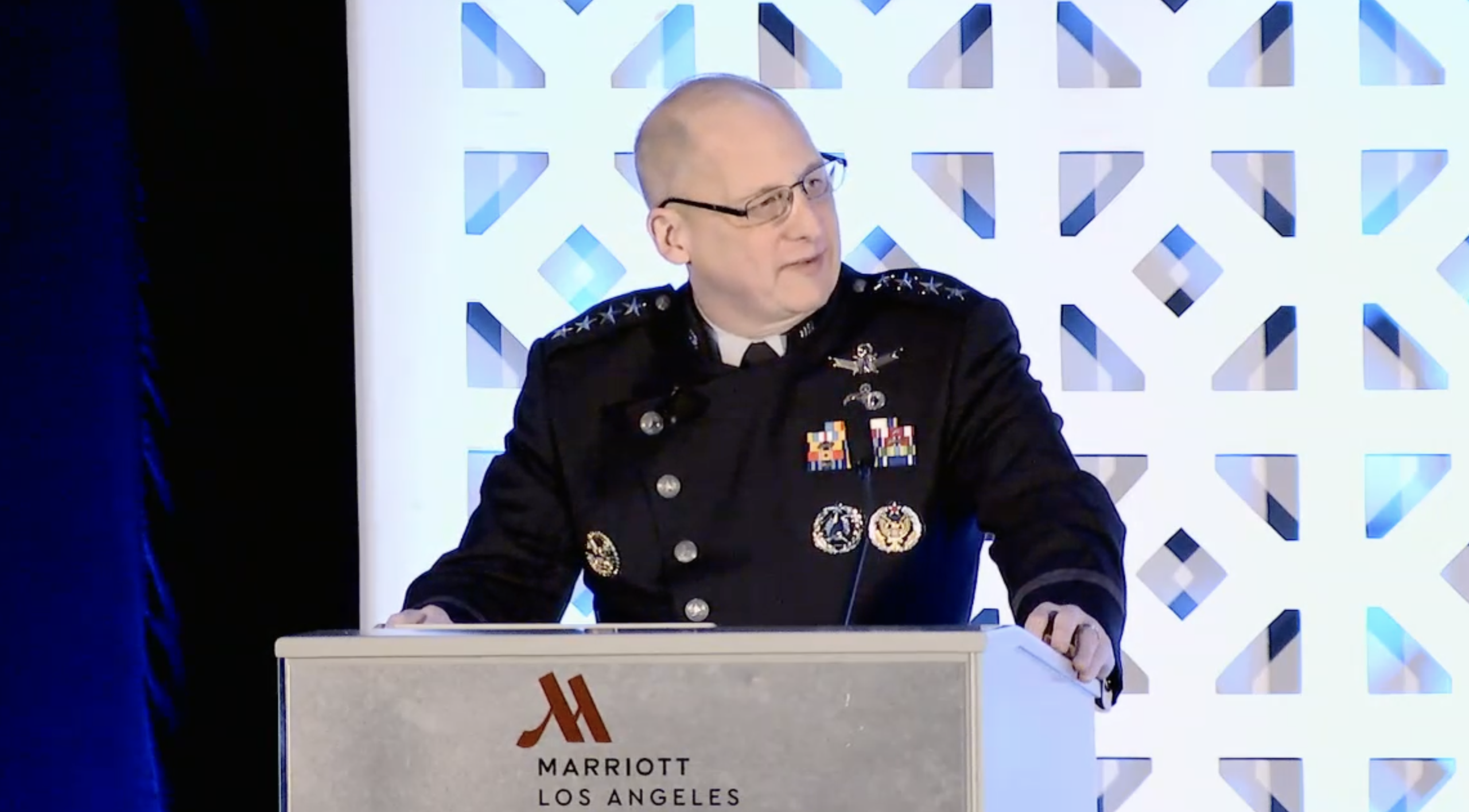

WASHINGTON — Gen. Michael Guetlein, head of the Golden Dome missile defense program, said the success of this effort depends on the ability to field defenses that are both scalable and affordable, including new directed-energy and other non-kinetic technologies aimed at lowering the cost of intercepting missiles.
Speaking Jan. 23 at the AFCEA Space Industry Days conference in Los Angeles, Guetlein said the program’s central challenge is the economics of missile defense, specifically how the cost of each intercept limits how many interceptor shots the United States can afford to keep on hand.
He described this as an issue of “magazine depth,” a term that refers to the number of interceptors available to respond to an attack. Missile defense systems with limited magazines can be exhausted quickly if an adversary launches multiple weapons or employs decoys. The thinking is that a system that can only handle a small number of intercepts does not provide credible deterrence.
The “cost per kill” has to come down, said Guetlein. Current U.S. missile defense interceptors, which were designed for regional or limited homeland defense missions, cost millions of dollars apiece and are used to defeat much lower-cost weapons. Analysts have pointed out that this imbalance invites adversaries to overwhelm defenses through volume.
“We have the most exquisite capabilities on the planet, with a high probability of kill. They do not miss but they take forever to build. They’re exceptionally expensive, and as a result, I have very small magazine depths, because the cost per kill is so high,” said Guetlein. “I have to flip that equation.”
Golden Dome is the Defense Department’s effort to design a next-generation homeland missile defense architecture capable of countering advanced threats such as hypersonic glide vehicles, modern ballistic missiles and fractional orbital bombardment systems. Unlike existing missile defense programs that rely largely on ground- and sea-based interceptors, Golden Dome envisions a multi-layered system that integrates space-based sensors, communications and interceptors into a unified framework.
Pressure to scale production
Guetlein told the AFCEA conference that what the Pentagon needs immediately from industry is the ability to scale production and deliver lower-cost ways to defeat missiles, including non-kinetic options. Analysts say space-based interceptors capable of maneuvering on orbit could be effective but would also be among the most expensive elements of any future architecture.
Directed energy systems, including lasers and neutral particle beams, are among the concepts Guetlein has highlighted as potential ways to drive down the cost per shot while increasing magazine depth. Neutral particle beams, which remain largely experimental, would theoretically operate at near-light speed and damage targets by disrupting electronics or generating heat.
Guetlein also pointed to “left of launch” defenses, a phrase used to describe efforts to stop missile threats before a launch occurs. That can include intelligence and surveillance activities that detect preparations, as well as non-kinetic actions that complicate or delay an adversary’s ability to fire. The goal here is to reduce the number of missiles that ever need to be intercepted.
“Because when you’re trying to defend something the size of the United States, I can’t do it the way we’ve done it overseas. I have to have a new way of doing it,” he said.
The urgency to scale production and lower costs has already shaped Pentagon investment decisions. The Defense Department recently announced plans to directly invest in the production of interceptor missiles built by Lockheed Martin and solid rocket motors produced by L3Harris Technologies.
While not labeled as Golden Dome funding, those investments align directly with the program’s emphasis on deeper magazines and lower per-unit costs. They also speak to Guetlein’s broader argument that Golden Dome is less a technology challenge than an industrial one.
“We’re accelerating private capital investment, and we’re taking private equities’ view of the defense industrial base,” Guetlein said, adding that he regularly meets with investment bankers to help stabilize demand signals as companies seek capital to expand capacity.
That emphasis on economics was echoed in the National Defense Strategy released Jan. 23, which identifies defense of the homeland as the Pentagon’s top priority. “The Department will prioritize efforts to develop President Trump’s Golden Dome for America, with a specific focus on options to cost-effectively defeat large missile barrages and other advanced aerial attacks,” the document states.
Architecture to remain secret
Guetlein said details of the Golden Dome architecture will remain classified. He said conversations with industry are occurring almost exclusively through one-on-one engagements, rather than open forums.
After his confirmation as Golden Dome program manager in July, Guetlein said foreign actors began cyber targeting the defense industrial base, prompting senior officials to clamp down on public discussion. “We have been quiet,” he said. “I have not been talking to industry consortiums. I’ve not been talking to the press. I’ve not been talking to the think tanks, and it wasn’t until September I was allowed to even start talking to the Hill.”
That secrecy has begun to draw scrutiny. In a defense spending bill for fiscal year 2026 approved by the House last week, appropriators said they support Golden Dome but faulted the administration for failing to provide sufficient detail on how $23 billion in mandatory funding has been allocated. The bill directs the Pentagon to submit more detailed plans and justifications.
Guetlein said the program is on track to meet the administration’s timeline. “By the summer of ‘28 we will be able to defend the entire nation against ballistic missiles as well as other generation aerial threats,” he said, calling Golden Dome an “unprecedented challenge.”
As program director, Guetlein reports to the deputy secretary of defense and has been granted unusually broad authorities. “I have budget authority, contract authority, hiring authority, technical authority, security authority to get after protecting the homeland.”
The Golden Dome office, Guetlein said, currently has 52 staff and expects to grow to about 100, even though he is authorized to reach 300. Requirements are set centrally, but procurement is decentralized across the services and agencies.
“I’ve got the Space Force buying SBIs. I’ve got the Army buying munitions and sensors. I’ve got the Navy buying munitions. I’ve got the Missile Defense Agency buying next generation interceptors, glide phase interceptors, and a whole host of other capability,” Guetlein said. He also works closely with the Space Development Agency’s low Earth orbit sensor and transport network.
Guetlein noted that the Missile Defense Agency’s SHIELD procurement vehicle is not part of Golden Dome, despite recent headlines about the large number of vendors selected to compete under the contract. SHIELD, he said, is simply “a tool that I can reach in and use if I need to.”
Command-and-control layer
One of the most demanding pieces of the program, he said, is the command-and-control layer that connects sensors, decision-makers and interceptors across services and classification levels. That software “glue layer” must be demonstrated this summer, integrated with interceptors in 2027, and shown operating against credible threats in 2028.
To speed that effort, the Golden Dome office formed a command-and-control consortium of six companies working side by side, an arrangement Guetlein described as a departure from traditional contracting approaches.
Beyond technology, Guetlein said entrenched culture and organizational behavior pose daily obstacles. He criticized what he described as a compliance-driven mindset that prioritizes risk elimination over speed and integration.
“We cannot keep doing business as usual,” he said. “That’s really what our challenge is going to be.”
While President Trump has floated the idea of international involvement in Golden Dome, Guetlein said he has not yet been authorized to engage allies. “Everything we are doing is allied by design,” he said, adding that planning already assumes future integration of partner capabilities and access to overseas territory for sensors.
Golden Dome has figured into a broader geopolitical dispute over Greenland, where Trump has said expanded U.S. access would be “vital” to the program, including for radar and interceptor deployment.










Related Posts



Stay Informed With the Latest & Most Important News
Previous Post
Next Post





Advertisement
-
 01Two Black Holes Observed Circling Each Other for the First Time
 -
 02From Polymerization-Enabled Folding and Assembly to Chemical Evolution: Key Processes for Emergence of Functional Polymers in the Origin of Life
 -
 03Astronomy 101: From the Sun and Moon to Wormholes and Warp Drive, Key Theories, Discoveries, and Facts about the Universe (The Adams 101 Series)
 -
 04True Anomaly hires former York Space executive as chief operating officer
 -
 05Φsat-2 begins science phase for AI Earth images
 -
 06Hurricane forecasters are losing 3 key satellites ahead of peak storm season − a meteorologist explains why it matters
 -
 07Binary star systems are complex astronomical objects − a new AI approach could pin down their properties quickly