
Now Reading: Ground-based Atmospheric Characterization of Super-Earth L 98-59 d at High Spectral Resolution
-
01
Ground-based Atmospheric Characterization of Super-Earth L 98-59 d at High Spectral Resolution

Ground-based Atmospheric Characterization of Super-Earth L 98-59 d at High Spectral Resolution

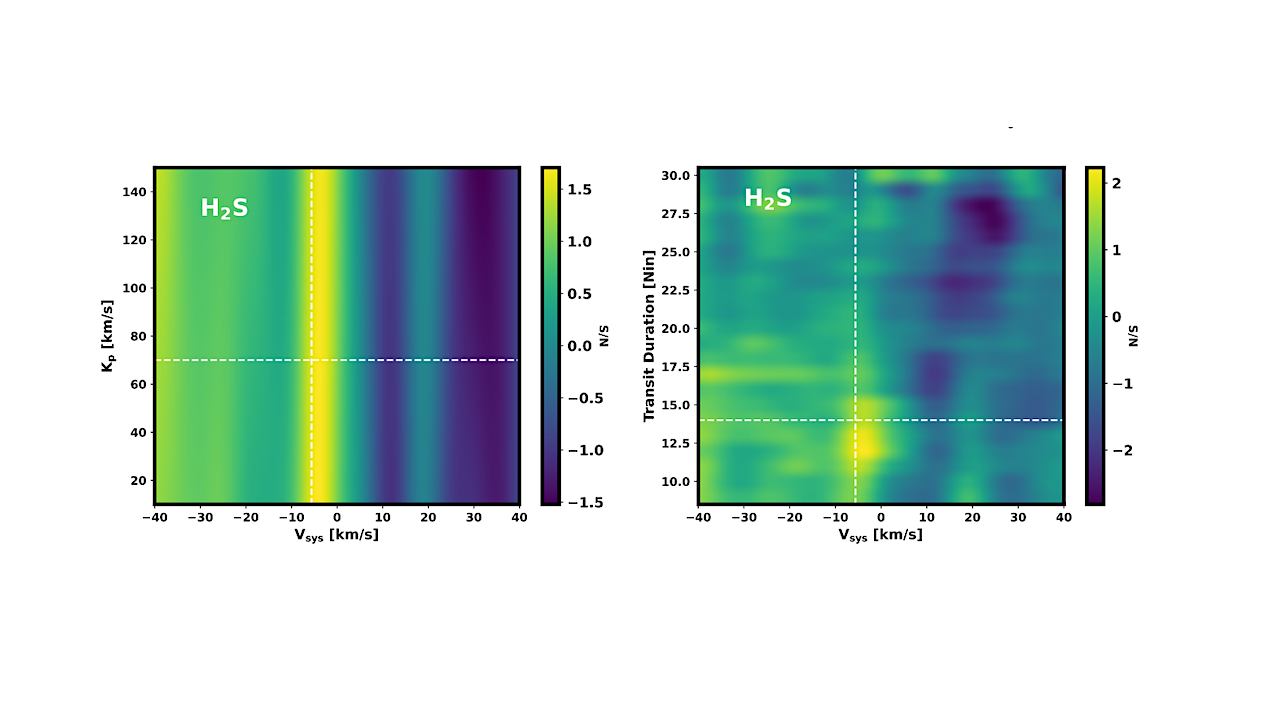

Additional analysis for the tentative cross-correlation signal observed for H2S. We show the cross-correlation S/N as a function of the orbital parameters of the planet. In each case, the expected parameters are marked with crosshairs. Left: The S/N is shown as a function of planetary velocity space, parameterised by 𝐾p and 𝑉sys, reproduced from the top panel of Figure 3 but with a more zoomed in colorscale. A tentative peak with a S/N of 1.7 is observed at the expected systemic velocity. Right: the time duration of the observed H2S cross-correlation signal is constrained with a value that is consistent with the literature value for the transit duration of the planet. This is measured by varying the number of spectra considered to be in-transit (𝑁in) when calculating the cross-correlation S/N, with 𝐾p fixed to that expected for this planet. — astro-ph.EP
Atmospheric characterization of exoplanets using ground-based high-resolution transmission spectroscopy has traditionally focussed on large and close-in planets, such as hot Jupiters.
In this work, we aim to extend this technique to smaller and more temperate planets by studying the atmospheric composition of the temperate super-Earth planet L 98-59 d (∼1.5R⊕; ∼1.9M⊕).
Using high-resolution transmission spectra obtained using IGRINS on the Gemini-South telescope, we demonstrate the feasibility for atmospheric characterization of super-Earths using ground-based facilities, and confirm the previous tentative JWST inference of hydrogen sulfide (H2S) in the atmosphere of L 98-59 d at ≲3.9σ (B∼390).
This is the first ground-based inference of a molecular species in the atmosphere of a super-Earth planet, and reveals the sensitivity of spectrographs on 8,m-class telescopes to the atmospheric characterization of such planets.
By exploring a grid of atmospheric models, we find that the data favors a cloud-free atmosphere with an abundance of H2S corresponding to ∼1-10 × solar metallicity. We additionally place constraints on the atmospheric abundances of other molecular species. Assuming cloud-free models, super-solar abundances for CH4 and NH3 are ruled out at 3.6σ and 4.6σ, respectively.
Our results are consistent with previous suggestions that L 98-59 d is a super-Earth with possible disequilibrium production of H2S driven by volcanic outgassing from the surface. Future studies combining multiple observations with different facilities may be able to further constrain the atmospheric composition of this planet. This work underscores the promise of atmospheric characterization of super-Earth exoplanets using high-resolution spectroscopy with ground-based facilities.
Connor J. Cheverall, Nikku Madhusudhan, Savvas Constantinou, Peter R. McCullough
Subjects: Earth and Planetary Astrophysics (astro-ph.EP)
Cite as: arXiv:2603.02209 [astro-ph.EP] (or arXiv:2603.02209v1 [astro-ph.EP] for this version)
https://doi.org/10.48550/arXiv.2603.02209
Focus to learn more
Submission history
From: Connor Cheverall
[v1] Mon, 2 Mar 2026 18:59:34 UTC (1,053 KB)
https://arxiv.org/abs/2603.02209
Astrobiology,











Related Posts

Stay Informed With the Latest & Most Important News
Previous Post
Next Post





Advertisement
-
 01Two Black Holes Observed Circling Each Other for the First Time
 -
 02From Polymerization-Enabled Folding and Assembly to Chemical Evolution: Key Processes for Emergence of Functional Polymers in the Origin of Life
 -
 03Astronomy 101: From the Sun and Moon to Wormholes and Warp Drive, Key Theories, Discoveries, and Facts about the Universe (The Adams 101 Series)
 -
 04True Anomaly hires former York Space executive as chief operating officer
 -
 05Φsat-2 begins science phase for AI Earth images
 -
 06Hurricane forecasters are losing 3 key satellites ahead of peak storm season − a meteorologist explains why it matters
 -
 07Binary star systems are complex astronomical objects − a new AI approach could pin down their properties quickly