
Now Reading: Gulf Of Mexico Blue Hole Harbors High Levels Of Novel Microbial Lineages
-
01
Gulf Of Mexico Blue Hole Harbors High Levels Of Novel Microbial Lineages


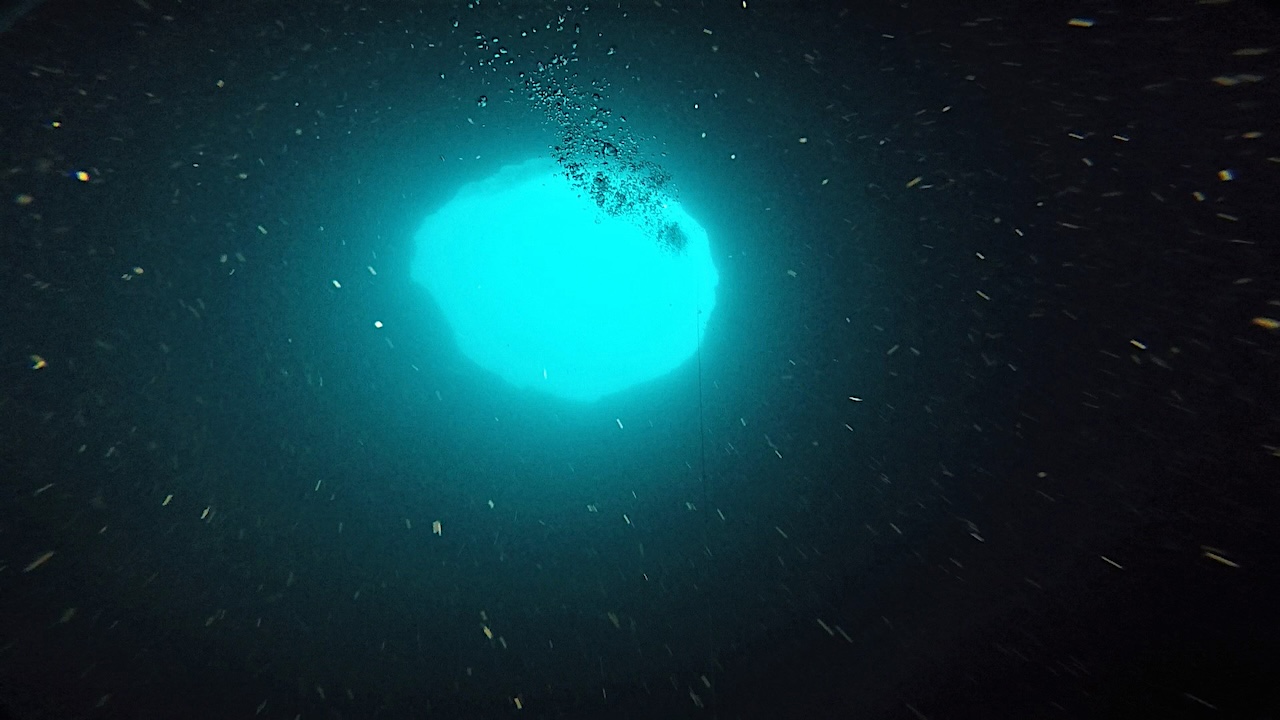
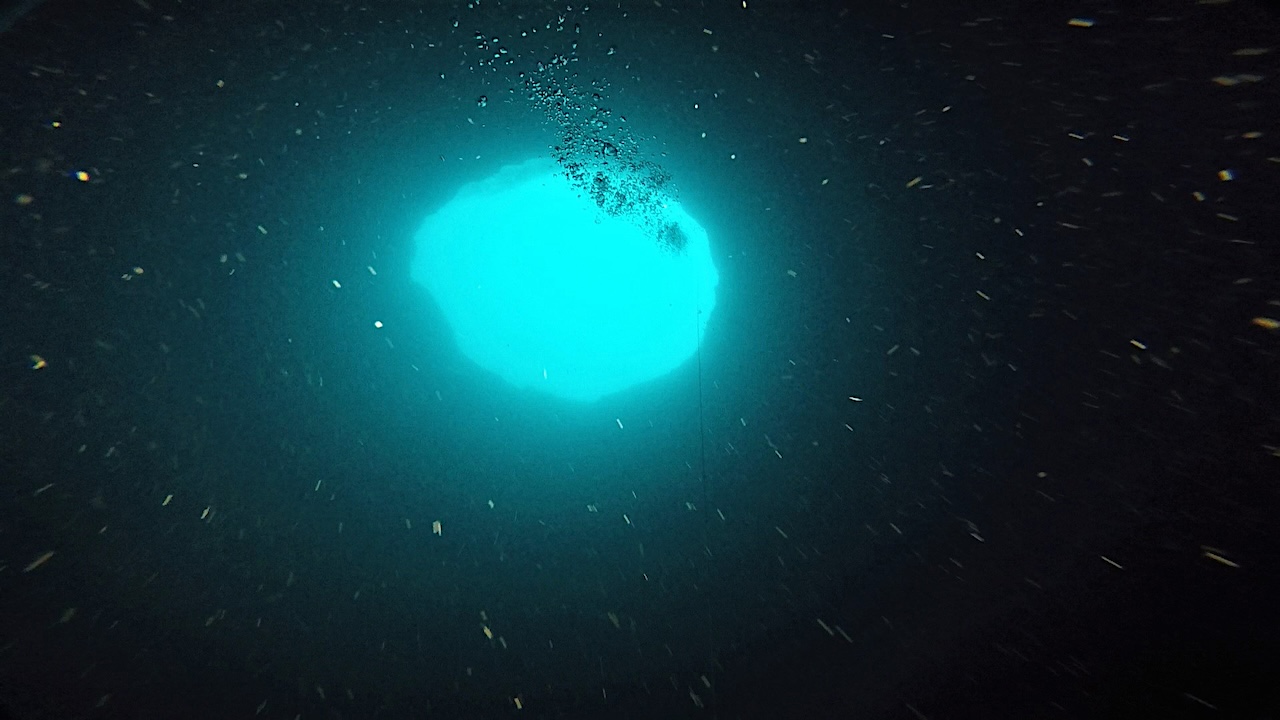
A diver’s view looking up to the opening of Amberjack Hole. Image courtesy of Mote Marine Laboratory via NOAA.
Exploration of oxygen-depleted marine environments has consistently revealed novel microbial taxa and metabolic capabilities that expand our understanding of microbial evolution and ecology.
Marine blue holes are shallow karst formations characterized by low oxygen and high organic matter content. They are logistically challenging to sample, and thus our understanding of their biogeochemistry and microbial ecology is limited. We present a metagenomic and geochemical characterization of Amberjack Hole on the Florida continental shelf (Gulf of Mexico).
Dissolved oxygen became depleted at the hole’s rim (32 m water depth), remained low but detectable in an intermediate hypoxic zone (40–75 m), and then increased to a secondary peak before falling below detection in the bottom layer (80–110 m), concomitant with increases in nutrients, dissolved iron, and a series of sequentially more reduced sulfur species.
Microbial communities in the bottom layer contained heretofore undocumented levels of the recently discovered phylum Woesearchaeota (up to 58% of the community), along with lineages in the bacterial Candidate Phyla Radiation (CPR). Thirty-one high-quality metagenome-assembled genomes (MAGs) showed extensive biochemical capabilities for sulfur and nitrogen cycling, as well as for resisting and respiring arsenic.
One uncharacterized gene associated with a CPR lineage differentiated hypoxic from anoxic zone communities. Overall, microbial communities and geochemical profiles were stable across two sampling dates in the spring and fall of 2019. The blue hole habitat is a natural marine laboratory that provides opportunities for sampling taxa with under-characterized but potentially important roles in redox-stratified microbial processes.
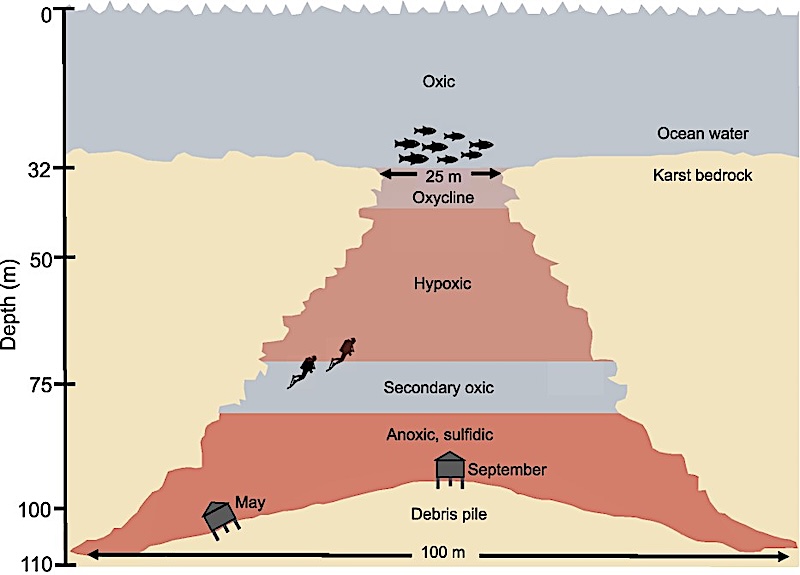
The benthic lander positions are shown for the May 2019 and September 2019 sampling expeditions, and those depths also correspond to the deepest collected water samples for microbial community analysis (106 m in May, 95 m in September). — The ISME Journal
Astrobiology, Microbiology, Oceanography,











Related Posts
Stay Informed With the Latest & Most Important News
Previous Post
Next Post

Advertisement
-
 01Two Black Holes Observed Circling Each Other for the First Time
 -
 02From Polymerization-Enabled Folding and Assembly to Chemical Evolution: Key Processes for Emergence of Functional Polymers in the Origin of Life
 -
 03Astronomy 101: From the Sun and Moon to Wormholes and Warp Drive, Key Theories, Discoveries, and Facts about the Universe (The Adams 101 Series)
 -
 04True Anomaly hires former York Space executive as chief operating officer
 -
 05Φsat-2 begins science phase for AI Earth images
 -
 06Hurricane forecasters are losing 3 key satellites ahead of peak storm season − a meteorologist explains why it matters
 -
 07Binary star systems are complex astronomical objects − a new AI approach could pin down their properties quickly