
Now Reading: Habitability Of Exoplanets Orbiting Flaring Stars
-
01
Habitability Of Exoplanets Orbiting Flaring Stars


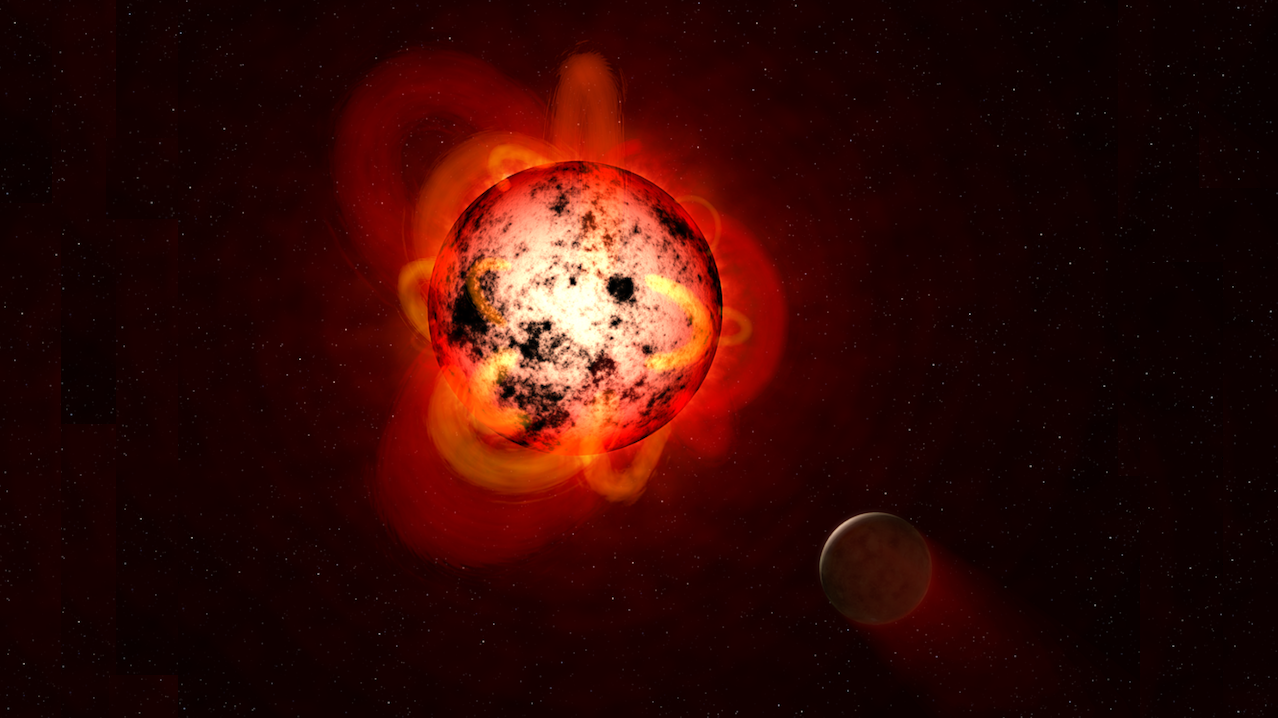

As of late 2025 there are about 70 exoplanets that meet the formal criterion of having equilibrium temperatures allowing the presence of liquid water and about 50 of them orbit M-stars, known for their strong chromospheric activity.
Most of these stars are close to the Sun and the planet-to-star mass and luminosity ratios are advantageous, allowing for a more detailed follow-up than of planets orbiting hotter and more massive stars. Many more planets orbiting late-type stars are expected to be discovered by Gaia and PLATO in the following years.
However, the lingering question remains whether the UV and X-ray emission, associated with the stellar activity, allows for complex life. A comprehensive study focused on properties of flaring exoplanet hosts and their activity, on a much larger scale than these few tens (soon to become hundreds) of stars with habitable planets is called for, to answer the question if such stars can harbor habitable planets. The proposed Wide Field Survey telescope is well suited for this study.
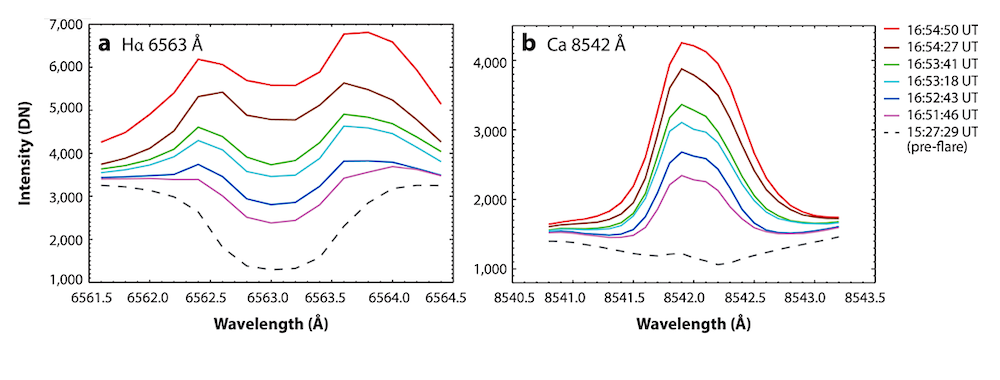
Temporal evolution of Hα and Ca 8542 in a solar flare spectrum (Kuridze et al., 2015). The
duration of this flare is of the order of minutes. Some flares may continue for tens of minutes to hours. — astro-ph.IM
Rebecca Szabó (1), Valentin D. Ivanov (2), M. Švanda (1) ((1) Astronomický ústav Univerzity Karlovy, Czech Republic, (2) European Southern Observatory, Germany)
Comments: This contribution was submitted as a White Paper for the ESO Expanding Horizon initiative. Details of the call here this https URL
Subjects: Instrumentation and Methods for Astrophysics (astro-ph.IM); Earth and Planetary Astrophysics (astro-ph.EP); Solar and Stellar Astrophysics (astro-ph.SR)
Cite as: arXiv:2512.21357 [astro-ph.IM] (or arXiv:2512.21357v1 [astro-ph.IM] for this version)
https://doi.org/10.48550/arXiv.2512.21357
Focus to learn more
Submission history
From: Michal Švanda
[v1] Tue, 23 Dec 2025 02:48:38 UTC (442 KB)
https://arxiv.org/abs/2512.21357
Astrobiology,











Related Posts
Stay Informed With the Latest & Most Important News
Previous Post
Next Post


Advertisement
-
 01Two Black Holes Observed Circling Each Other for the First Time
 -
 02From Polymerization-Enabled Folding and Assembly to Chemical Evolution: Key Processes for Emergence of Functional Polymers in the Origin of Life
 -
 03Astronomy 101: From the Sun and Moon to Wormholes and Warp Drive, Key Theories, Discoveries, and Facts about the Universe (The Adams 101 Series)
 -
 04True Anomaly hires former York Space executive as chief operating officer
 -
 05Φsat-2 begins science phase for AI Earth images
 -
 06Hurricane forecasters are losing 3 key satellites ahead of peak storm season − a meteorologist explains why it matters
 -
 07Binary star systems are complex astronomical objects − a new AI approach could pin down their properties quickly