
Now Reading: HATPI Pre-Perihelion Time-series Photometry of the Interstellar Comet 3I/ATLAS
-
01
HATPI Pre-Perihelion Time-series Photometry of the Interstellar Comet 3I/ATLAS


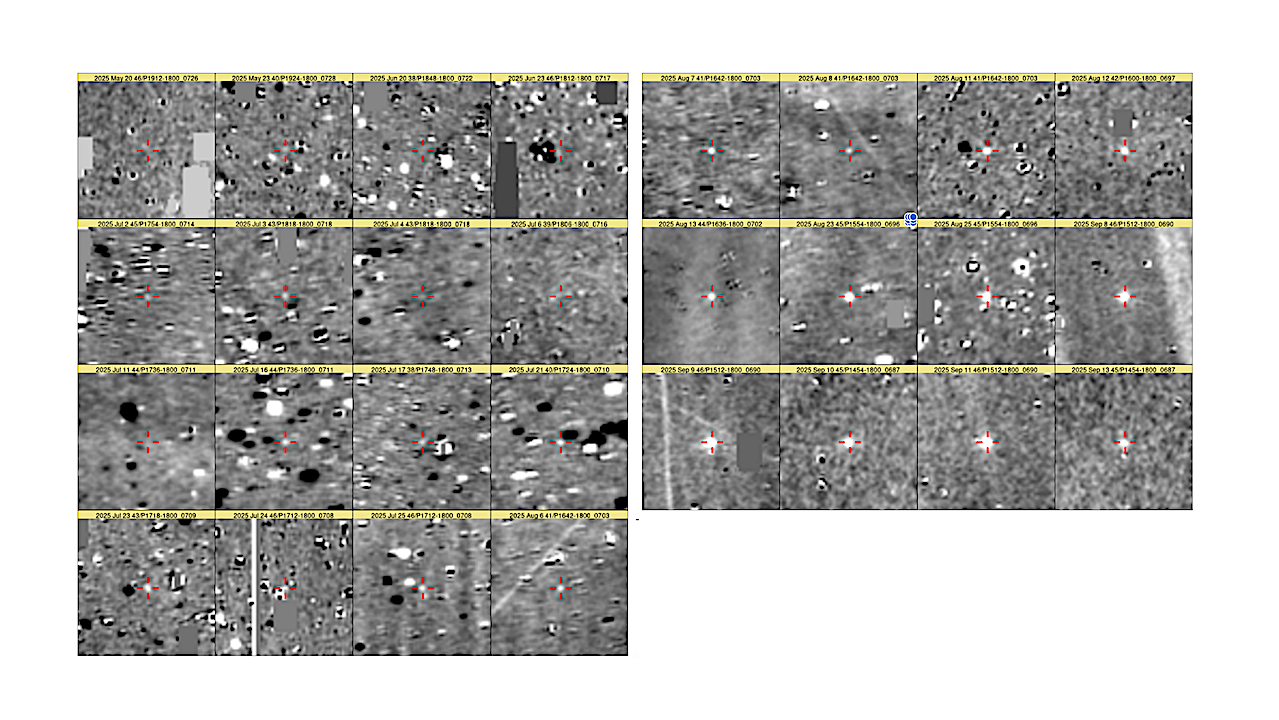
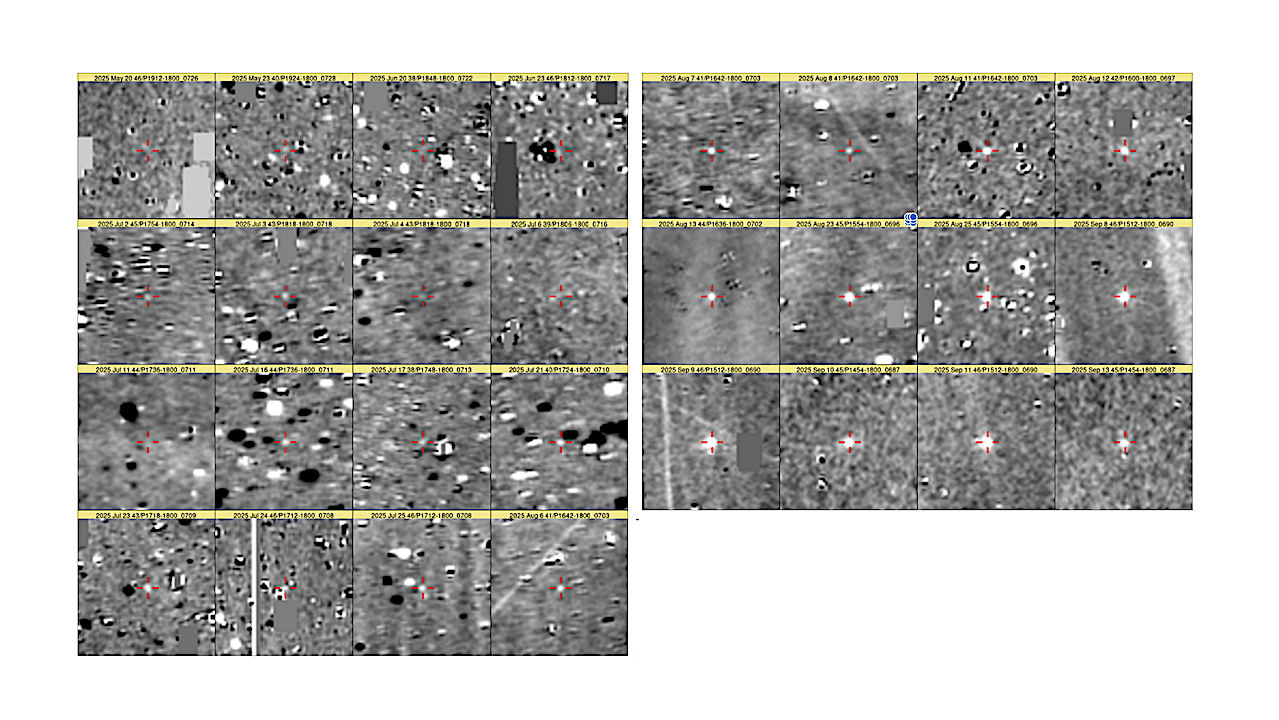
One hour stacked HATPI subtracted images of 3I/ATLAS from each of the nights on which 3I/ATLAS is formally detected with 3σ confidence in the full night binned light curve (nights corresponding to blue points in Fig. 4(c)). Individual 45s exposures that are flagged as problematic (Sec 2.5) are excluded from the stacking. Each image stamp is 21′×21′, displayed with North up and East to the left. The red lines indicate the position of the nucleus of 3I/ATLAS in the center of each stamp. Grey rectangular regions are masked from the image subtraction process due to the presence of saturated stars. Other sources are variable objects, residual Poisson noise from bright stars, or other systematic residuals from poor subtractions (typically most notable for bright stars). Because 3I/ATLAS was at low Galactic latitude, the density of such objects is high in these stacked subtracted images. Individual 45s exposures are aligned on the position of 3I/ATLAS before stacking, causing background variable star sources (which can be either positive or negative) to show trails. For each night, we show a single IHU/Field as indicated in the labels after the date, while additional IHU/Fields may be available and included in the full night binned light curves. Note that the stacked images are for display purposes only. The photometry is performed on the individual 45 s exposures, and binning is then performed on the photometric measurements rather than the images. The detections on May 20, May 23, June 20, June 23, July 6, July 11, and July 21 are likely affected by contamination from neighboring variable sources, and are excluded from the analysis. The first night on which we consider the recovery of 3I/ATLAS to be reliable is 2025 Jul 2. Additional stamps are shown in Fig. 2. — astro-ph.EP
HATPI is a recently commissioned time-domain facility at Las Campanas Observatory, Chile, that uses 64 wide-angle, 9.6 cm diameter lenses and back-illuminated CCDs, yielding a mosaic field-of-view of 7,100 square arcdegrees, observing the night sky at a cadence of 45s and a spatial scale of 19.7 arcsec pixel−1.
In this paper, we present moving object time-series photometry with this facility, focusing on the interstellar comet 3I/ATLAS. 3I/ATLAS was first robustly recovered by HATPI on the night of 2025 July 2 (one night after its discovery) at a Gaia G-band magnitude of G=17.796±0.082 mag (±0.030 mag systematic uncertainty).
The comet then increased in brightness to G=14.071±0.073 mag ±0.030 mag by 2025 Sep 13, after which it became unobservable by HATPI as it approached perihelion. Before 3I/ATLAS achieved a brightness of G=16.396±0.029 mag ±0.030 mag on 2025 Aug 6, it could be detected when stacking all HATPI observations from a single night, while after this date it is sufficiently bright to detect in individual 45s exposures.
We do not detect evidence for significant short-time-scale variations in the brightness of 3I/ATLAS after Aug 6. Compared to other light curves in the literature, the HATPI photometry exhibits a somewhat steeper rise in brightness with decreasing heliocentric distance, rH.
The HATPI magnitudes are well-fit as a power law function of rH, with an exponential index of n=5.167±0.095, over the range 2.14 AU <rH<4.44 AU, compared to n=3.94±0.10 when fitting together with other literature observations. We find that the phase function is constrained to β=0.0552±0.0032 mag deg−1.
Joel D. Hartman, Gáspár Á. Bakos, Andrés Jordán, Sarah Thiele, Zoltán Csubry, Geert Jan Talens, Attila Bódi, Sándor Pigai, István Domsa, Anthony Keyes, Vincent Suc, Adriana Gaitan, Antoine Thibault
Comments: 18 pages, 7 figures, accepted for publication in AJ
Subjects: Earth and Planetary Astrophysics (astro-ph.EP); Astrophysics of Galaxies (astro-ph.GA)
Cite as: arXiv:2602.21586 [astro-ph.EP] (or arXiv:2602.21586v1 [astro-ph.EP] for this version)
https://doi.org/10.48550/arXiv.2602.21586
Focus to learn more
Submission history
From: Joel Hartman
[v1] Wed, 25 Feb 2026 05:16:44 UTC (9,244 KB)
https://arxiv.org/abs/2602.21586
Astrobiology,










Related Posts

Stay Informed With the Latest & Most Important News


Advertisement
-
 01Two Black Holes Observed Circling Each Other for the First Time
 -
 02From Polymerization-Enabled Folding and Assembly to Chemical Evolution: Key Processes for Emergence of Functional Polymers in the Origin of Life
 -
 03Astronomy 101: From the Sun and Moon to Wormholes and Warp Drive, Key Theories, Discoveries, and Facts about the Universe (The Adams 101 Series)
 -
 04True Anomaly hires former York Space executive as chief operating officer
 -
 05Φsat-2 begins science phase for AI Earth images
 -
 06Hurricane forecasters are losing 3 key satellites ahead of peak storm season − a meteorologist explains why it matters
 -
 07Binary star systems are complex astronomical objects − a new AI approach could pin down their properties quickly