
Now Reading: High Nitrogen And Carbon Isotopic Ratios In The Interstellar Comet 3I/ATLAS
-
01
High Nitrogen And Carbon Isotopic Ratios In The Interstellar Comet 3I/ATLAS


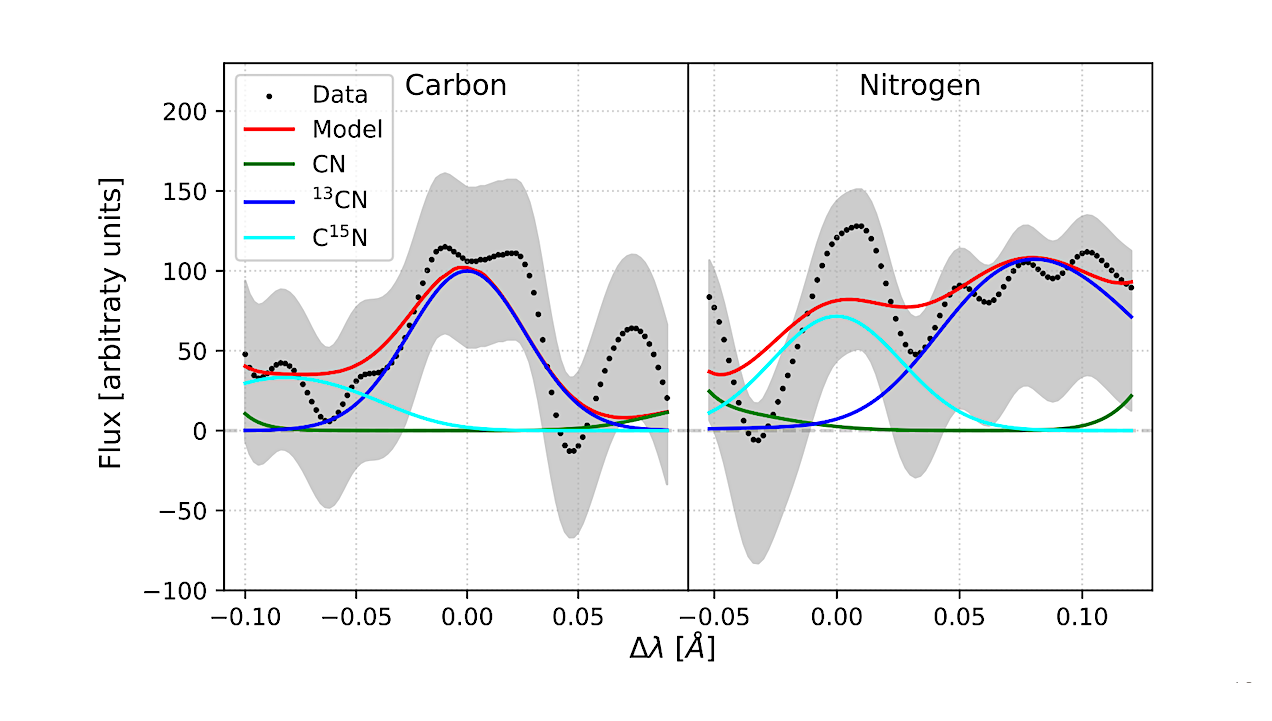
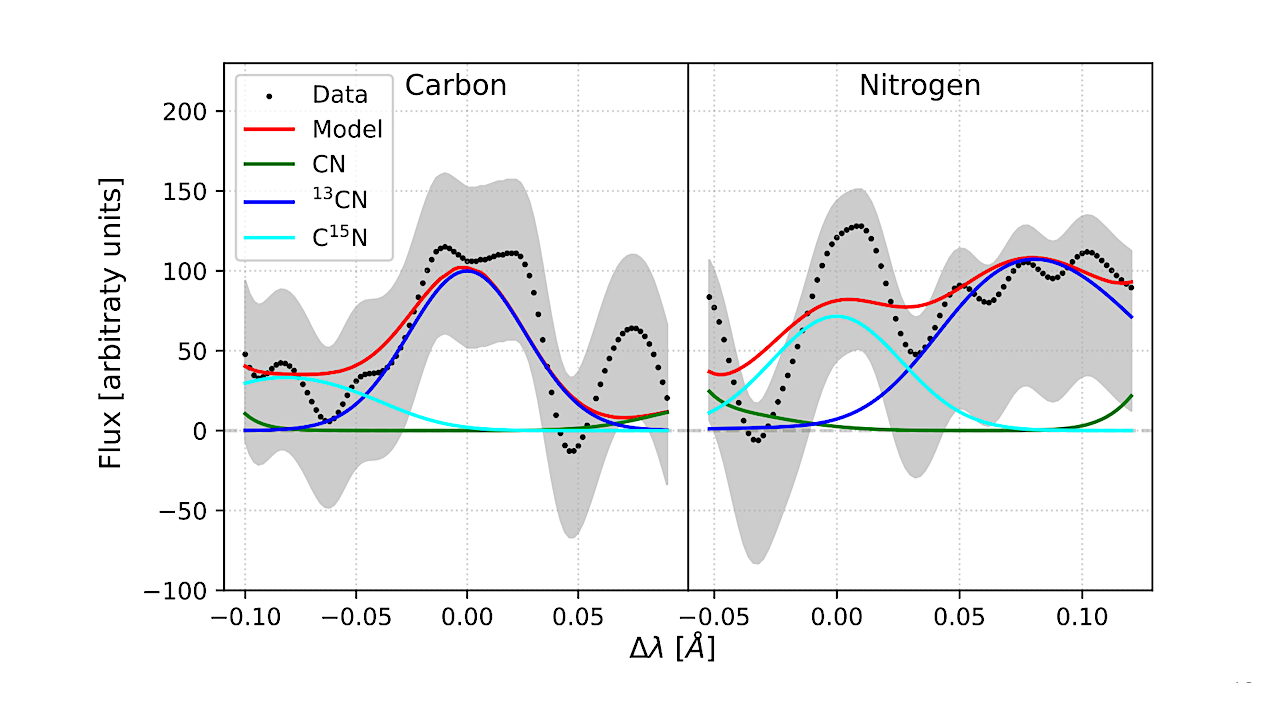
Co-added observed spectra of 3I with best-fit model Observed and modelled 13CN centred (left) and 15CN-centred (right) line profiles. The shaded region represents the uncertainty of the profile resulting from the combination of the different lines, estimated from the MCMC fitting. — astro-ph.EP
Interstellar objects provide a unique opportunity to further our understanding of the planetary formation process by studying in detail material formed around another star. Their ices contain precious clues about the environment and conditions prevailing in their home system.
As fractionation processes can be sensitive to the temperature and radiation environment, isotopic ratios are powerful tracers of the origin and evolution of different species. While isotopic ratios have been measured in solar system comets, previously detected interstellar objects have been too faint to measure isotopic ratios. Here we report the measurement of two ratios in 3I/ATLAS from observations of the CN molecule: 12C/13C and 14N/15N.
We report 12C/13C=147+87−40 and 14N/15N=343+454−124. The 14N/15N is higher than the value of ∼~150 usually measured for solar system comets, close to the values measured in the interstellar medium, pre-stellar phases or the outside of protoplanetary discs.
The 12C/13C is marginally higher than the values usually measured for solar system comets and in the interstellar medium. These measurements could indicate an origin of 3I in the outer disc around an older low-metallicity star.
C. Opitom, J. Manfroid, D. Hutsemékers, E. Jehin, M. M. Knight, K. Aravind, L. Ferellec, D. Bodewits, V. V. Guzmán, M. Cordiner, R. C. Dorsey, F. La Forgia, M. Lippi, B. P. Murphy, C. Snodgrass, M. Bannister
Comments: Submitted for publication to Nature
Subjects: Earth and Planetary Astrophysics (astro-ph.EP); Astrophysics of Galaxies (astro-ph.GA)
Cite as: arXiv:2603.07187 [astro-ph.EP] (or arXiv:2603.07187v1 [astro-ph.EP] for this version)
https://doi.org/10.48550/arXiv.2603.07187
Focus to learn more
Submission history
From: Cyrielle Opitom
[v1] Sat, 7 Mar 2026 12:58:22 UTC (295 KB)
https://arxiv.org/abs/2603.07187
Astrobiology, Astrochemistry,










Related Posts
Stay Informed With the Latest & Most Important News

Advertisement
-
 01Two Black Holes Observed Circling Each Other for the First Time
 -
 02From Polymerization-Enabled Folding and Assembly to Chemical Evolution: Key Processes for Emergence of Functional Polymers in the Origin of Life
 -
 03Astronomy 101: From the Sun and Moon to Wormholes and Warp Drive, Key Theories, Discoveries, and Facts about the Universe (The Adams 101 Series)
 -
 04True Anomaly hires former York Space executive as chief operating officer
 -
 05Φsat-2 begins science phase for AI Earth images
 -
 06Hurricane forecasters are losing 3 key satellites ahead of peak storm season − a meteorologist explains why it matters
 -
 07Binary star systems are complex astronomical objects − a new AI approach could pin down their properties quickly