
Now Reading: Honoring a career opening doors for the commercial space sector
-
01
Honoring a career opening doors for the commercial space sector


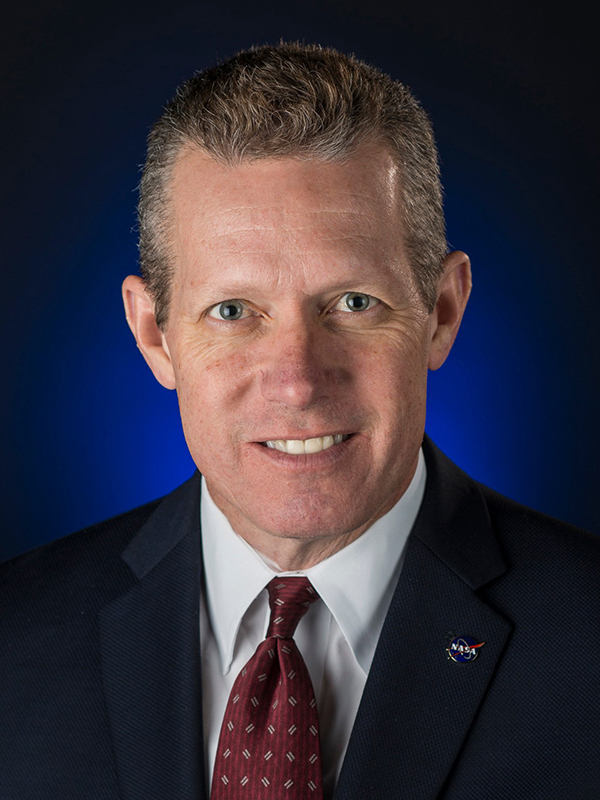

Each year, SpaceNews selects the people, programs and technologies that have most influenced the direction of the space industry in the past year. Started in 2017, our annual celebration recognizes outsized achievements in a business in which no ambition feels unattainable. This year’s winners of the 8th annual SpaceNews Icon Awards were announced and celebrated at a Dec. 2 ceremony hosted at the Johns Hopkins University Bloomberg Center in Washington, D.C. Congratulations to all of the winners and finalists.
As a champion of public-private partnerships, Phil McAlister helped NASA save tens of billions of dollars, restore the United States’ ability to transport astronauts to and from the International Space Station and seed a thriving domestic commercial space transportation industry.
For pursuing business models that contrasted starkly with traditional government contracting methods, McAlister was praised for his vision and leadership. He was also, at times, vilified. A 2014 Aerospace Safety Advisory Panel report publicly accused McAlister of a lack of transparency and failure to communicate that led to the Challenger and Columbia Space Shuttle tragedies.
Through it all, McAlister remained firmly committed to the idea that NASA should chart a new course by marrying the rapid innovation of the burgeoning commercial space sector with the space agency’s extensive resources, infrastructure and expertise.
His commitment was evident during many battles to garner and maintain NASA and congressional support for public-private partnerships like Commercial Orbital Transportation Services, NASA’s program to deliver cargo to the space station, and the Commercial Crew Program.
In addition to defending those partnerships, McAlister helped ensure competition for the Commercial Crew Program by convincing his superiors that funding should be awarded to both Boeing and SpaceX to build vehicles to transport astronauts to and from the ISS.
At the time, many in NASA viewed Boeing as the safest bet for ending NASA’s reliance on Russia’s Soyuz vehicles for space station transportation.
McAlister went to work for NASA in 2005 after 20 years in the private sector as a research physicist at the nonprofit Analytical Services Inc., TRW program manager and Futron Corp. division chief. With that background in the commercial industry, McAlister helped ensure that public-private partnerships had appropriate incentives and milestones for participating companies and their investors.
A few years into his NASA career, McAlister served as executive secretary of the Review of United States Human Space Flight Plans Committee led by former Lockheed Martin CEO Norm Augustine. It was a demanding role since McAlister was NASA’s main liaison to the panel that ultimately determined NASA’s Constellation program was too far behind schedule and over budget to meet its goals. The Committee also encouraged NASA to lean more heavily on the commercial space sector, particularly in low Earth orbit.
“It was clear back then, in 2010, this nascent commercial space industry was something that NASA needed to give more support and potentially some contracts to,” McAlister said in a recent interview. “Seeing that emboldened me to say, ‘This really is going to take some effort, but it’s going to be worth it.’”
This article first appeared in the December 2025 issue of SpaceNews Magazine.










Related Posts

Stay Informed With the Latest & Most Important News
Previous Post
Next Post





Advertisement
-
 01Two Black Holes Observed Circling Each Other for the First Time
 -
 02From Polymerization-Enabled Folding and Assembly to Chemical Evolution: Key Processes for Emergence of Functional Polymers in the Origin of Life
 -
 03Astronomy 101: From the Sun and Moon to Wormholes and Warp Drive, Key Theories, Discoveries, and Facts about the Universe (The Adams 101 Series)
 -
 04True Anomaly hires former York Space executive as chief operating officer
 -
 05Φsat-2 begins science phase for AI Earth images
 -
 06Hurricane forecasters are losing 3 key satellites ahead of peak storm season − a meteorologist explains why it matters
 -
 07Binary star systems are complex astronomical objects − a new AI approach could pin down their properties quickly