
Now Reading: How the Space Force trains Guardians for the future of warfare
-
01
How the Space Force trains Guardians for the future of warfare


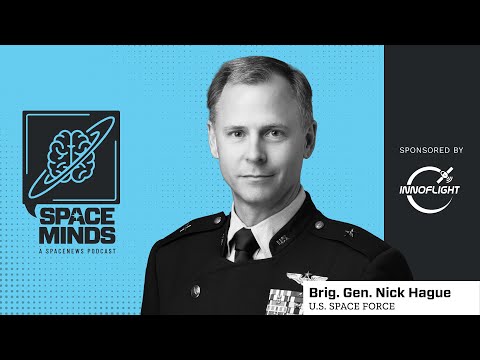

In this episode of Space Minds, host Sandra Erwin sits down with former NASA astronaut and Space Force leader Brig. Gen. Nick Hague for a wide-ranging conversation on how the U.S. Space Force is shaping its culture, training Guardians, and preparing for future conflict in space.
Hague reflects on his journey from the International Space Station to the Pentagon, where he now helps oversee operations, readiness, and policy for America’s newest military service. The discussion explores what “test” really means in the Space Force, how risk and speed are balanced, and why continuous learning is essential to maintaining space superiority.
The episode also dives into the Guardian spirit—from the grueling Guardian Arena competition to AI innovation challenges—and how the service is trying to cultivate resilient, multidisciplinary teams capable of operating at the pace of modern threats. Along the way, Hague shares insights on warfighting culture, career development, new training pipelines, and the realities of building a combat-ready force with limited resources.
sponsored by

Innoflight has been a trusted space avionics supplier for more than 20 years. Innoflight is AS9100D and ISO 9001 certified, and develops innovative, radiation tolerant by design, and integrated cyber secure space avionics solutions, suited for space vehicle buses and payloads. Innoflight’s cutting-edge and mission critical communications, networking, cyber security, processing, and integrated electronics solutions support the most advanced space missions. Innoflight continues to revolutionize the space industry and excels in modular, high performance, and low Size Weight and Power (SWaP) hardware and software solutions with successful flight heritage in multiple orbits.
Show notes and transcript
Click here for Notes and Transcript
Time Markers
00:00 – Introduction and Nick Hague’s background
01:25 – From NASA astronaut to Space Force leadership
02:34 – Hague’s current role at Space Force headquarters
04:01 – Redefining “test” as continuous learning and risk management
06:09 – Connecting acquisition and operations through testing
07:45 – Guardian Arena and forging the Guardian spirit
10:37 – Physical, mental, and team resilience
12:46 – AI Challenge and Guardian-built solutions
14:41 – What “Guardian spirit” looks like in practice
17:03 – Warfighting culture vs. engineering culture
18:27 – Organizational changes and Combat Forces Command
19:05 – Multidisciplinary Guardians and new officer training
21:06 – Lifelong learning and adapting to rapid technology change
22:44 – Six years of Space Force growth and milestones
23:41 – Challenges of being a small service
25:46 – Career advice and space test training opportunities
27:59 – Final thoughts and message to Guardians
Transcript – Brig. Gen. Nick Hague Conversation
This transcript has been edited-for-clarity.
Sandra Erwin – Welcome everyone. I’m Sandra Erwin. I’m senior staff writer at SpaceNews, and I have the pleasure to be chatting today with Brigadier General Nick Hague, Assistant Deputy Chief of Space Operations for Operations at the headquarters of the U.S. Space Force at the Pentagon.
So we’re going to be talking about the culture of the Space Force, the Guardian spirit, and other topics. But before we get into that, I should highlight a little bit about his background. For those of you who have not heard of Nick Hague, he just recently retired from the NASA astronaut corps.
When he was in the Air Force, he was selected in 2013 as part of the 21st class of astronauts for NASA, and he flew to the International Space Station twice in 2019 and then again as commander of the SpaceX Crew-9 in September 2024, and returning in March 2025. And I’m also told that last year, I think it was last year when they did the 10k here for the Space Force, that you did that in space.
Brig. Gen. Nick Hague – I did, I did.
Sandra Erwin – Easier when you’re weightless.
Brig. Gen. Nick Hague – Yeah, yeah, absolutely.
Sandra Erwin – But that’s amazing. That’s amazing. So, and then after joining the Space Force, of course, he has a very impressive résumé as Director of Test and Evaluation. And so I’d like to maybe, General Hague, tell us about what you’re doing now and how things evolved in the Space Force since you joined.
Brig. Gen. Nick Hague – Yeah. Thanks, Chief, thanks, sir. Appreciate you coming by and supporting. So, Sandra, you said it. I’m the Assistant Deputy Chief of Space Operations for Operations. That’s a mouthful. So the deputy CSO is right over there, Lieutenant General Shef. So essentially I am General Shef’s deputy for operations.
We at the headquarters level — my position is really focused on developing policy to promote space power, and that’s in all forms, whether it’s current operations, the sustainment or readiness of those operations, as well as nuclear matters. And so there’s a lot going on, and we could spend an hour just talking about current operations and not even get to the future operations.
But effectively, we’re trying to give all the field commands, the service components that are in the combatant commands, the resources and the guidance that they need to be able to do the missions that our nation needs Guardians to do, to essentially underpin the joint force and all the things that the joint force needs to be able to do to protect our nation and maintain space superiority, because that’s why the Space Force exists.
Sandra Erwin – So how does your background in testing equip you for this particular position? I mean, what are some of the lessons that you bring from your testing background, and maybe what are some things that you want to do to help the Space Force improve in that area?
Brig. Gen. Nick Hague – Yeah, I think fundamentally. So I’ll just take a big step back. Let’s talk about what test means. I hear it brought up a lot when people are up on the stage. It’s always combined — you know, operational test and training infrastructure. You might hear OT TI, you hear test and training.
Test, to too many people, means I have to pass an exam. I think we revert back to what we experienced in school. And, you know, it’s about that time of year where everybody’s getting ready for finals and they’re taking tests and it’s a pass-fail thing. And so you cram for the test, you pass it. If you get a bad grade, you fail, and you have to do it all over again.
And that’s not test as the service needs it. The test we need is not a physical organization. It is not a physical milestone. It is a competency that the service has — to be able to look forward far enough into operations to understand when we’re developing things, how are we going to evaluate them and continually learning?
Test is all about learning. We heard Secretary Muncie talk about risk management. Test is how you inform risk management. I don’t have to test anything, but if I don’t, then I’m putting all the risk onto the operator. I’m putting all the risk into the mission. And it may or may not work.
And so test is how we help our leaders understand: Are we balancing risk, speed, going fast and learning? And are we improving as we go? Test is how I’m informing all of that. It’s a mindset. It’s a philosophy of continual improvement and continual learning.
So that did not answer your question, but I think it’s important to try to understand what test is, because that one word elicits a lot of different understandings depending on who you ask.
Sandra Erwin – Yeah, I think maybe it’s related to what Secretary Muncie and General Saltzman talked about — being experts, about Guardians having to be experts in their weapon systems and understanding what they have to do and how things operate. And perhaps there’s something — there’s still gaps in that area. So how are you going to maybe contribute to solve that problem?
Brig. Gen. Nick Hague – So if we look at test and what it does for the service, I have acquisitions on one side, I have operations on the other. And if you think of a Venn diagram — and I’ve got a lot of engineers in the room, so they all know what a Venn diagram is — that overlap, that’s where test happens.
And when I say test, it’s not necessarily contractor test or developmental test or operational test. It’s the process of trying to learn what performance and capability I’m able to deliver and how does that measure up against what I need to deliver. And so that is a continually improving process.
And so it’s completely in line with that approach and that thinking in terms of: How do I rapidly deliver something that is good enough and then continually improve it? I still need to make sure I assess it so that I know it’s good enough so it doesn’t cause a problem when we field it. But I’m going to get it out there, and then I’m going to keep that same organization, that same process, that same collective of operators and acquirers and engineers working the problem and continuing to spirally improve it.
That’s the vision that I’ve heard laid out on the stage, and that’s how test can enable it.
Sandra Erwin – Yeah, yeah. And you mentioned performance, and we’ve been hearing a lot about the Guardian Arena event. So personally, I don’t know too much about it, but perhaps you can fill the audience in on what’s been going on with that?
Brig. Gen. Nick Hague – Yeah, Guardian Arena — an amazing event. So I’ve got the Guardian Arena patch on. Who in the audience was a Guardian Arena participant? Raise your hands. I got… come on, one, one guy, right there. All right, two. So most of them are able to walk again. Some of them, they’re still mending.
But Guardian Arena — it’s a physical challenge, but it’s also a mental challenge. So imagine different stations laid out over the course of or all around Patrick Space Force Base. The distance to get between each of these obstacles adds up to a half marathon. So just getting to and from the places where you need to do these very stressful, strenuous things takes you a half marathon.
And then you get into these locations, and you have to do something that is extremely physically demanding — maybe lift 200 pounds and walk with that 200 pounds 30 yards, and then come back and do that 10 times. But then at the same time, we’re challenging your mental capacity as well, and we’re quizzing you on orbital dynamics and how to do EW and establish SATCOM, how to look at a cyber report and understand if you’re being hacked or not, or to look at the data logs and understand what happened.
So all of that — the physical and the mental — combined together, and you have to do it as a team of three. And that’s the key part, is that you’re doing it as a team of three. And so we’re challenging, and we’re forging the Guardian spirit in this crucible, and that is this idea that it’s not being the best at a physical task or a mental task or that teamwork aspect, that social aspect. But we have to be good at all of those.
And together, when we’re good at all of those, that’s the resilience that we need. That’s what we need our combat-ready force to be able to do. And so this is the showcase of those qualities.
There were 35 teams out there, day and a half. First day, shorter day — hour-long exam and then a physical test. And then the second day, there were 14 different stations. And I think they were going for eight hours straight, exerting themselves and competing to see who, you know, who best represented. But in the end, it was all about completing it, because it was such a demanding task. It was a thrill to be out there.
Sandra Erwin – So what does the winner get? What does the winning team get?
Brig. Gen. Nick Hague – I think they get some recognition tonight, and they get bragging rights, yeah, to take into next year. Now I don’t know how many repeats of competitors we have year after year. But for those that didn’t raise their hand because they weren’t competitors in Guardian Arena, I challenge you next year to do it.
Sandra Erwin – So who comes up with all the challenges? Who decides what they have to do?
Brig. Gen. Nick Hague – So one of the things that we do within the Space Force — we have Guardian resilience teams. And so collectively, we’re able to leverage those teams that look at human performance and the balance of human performance, holistic human performance, every day, and support our operational units and make sure that everyone is getting the support they need.
They’re the source of knowledge that we leverage to pull together something as challenging as this.
Sandra Erwin – Can you think of an anecdote or something that stands out to you about something that Guardians have been able to do during these Arena events?
Brig. Gen. Nick Hague – The best symbol of it is the last event. It was a bracketed, single elimination, see-who-wins-this-last event. And it was the final heat — a heat of three.
And watching these Guardians who had been punishing themselves physically over and over and over all day, and then do this through multiple heats of this bracket — come down to this final heat of three. You know, the winners came by, and everybody was cheering for the winning team, and then the second place team came in, and the third place team.
I mean, you’re watching people dig deep, really deep, to try to get across the finish line and finish the task. And it was awesome to watch the entire collective competitor and cadre group gather around and cheer them on and help motivate them to get across the finish line. That’s the coming together. That’s the Guardian spirit.
Sandra Erwin – Yeah, that’s super fascinating. And it speaks to what the Space Force is trying to do on, you know, building esprit de corps. And we also heard from General Saltzman today about the AI challenge. I think he said 29 teams. I mean, what do you think of that?
Brig. Gen. Nick Hague – I think it’s an awesome opportunity to be able to highlight the ingenuity and creativity and the raw talent that’s resident within our Guardian force — officer, enlisted, civilian. We have an amazing service. And whether it’s Guardian Arena or AI challenge, these are just little stages where we can highlight that.
You know, being part of the Space Force is pretty special, and you’re joining a group of really capable and talented folks.
Sandra Erwin – I believe he said the winning team developed an app for onboarding Guardians when they join, which sounds really interesting. And he also said that, or I believe it was the Secretary also that said, you know, don’t just hire contractors to do all that. You know, learn AI, learn how to do it. Learn large language models. Is that kind of what we’re going to see more in the Space Force — developing more expertise and more learning?
Brig. Gen. Nick Hague – I mean, I hope that every Guardian feels empowered to make a change. You know, getting back to that winner, anybody that’s PCS knows that that is a challenge in and of itself. And having done 16 PCS myself, I welcome AI helping me solve that challenge of who to talk to and who to call and how to get reimbursed in time.
Sandra Erwin – Yeah, I’m sure. So I wanted to get a little bit into what they mean by the Guardian spirit. So you’ve talked about the Guardian spirit that shaped the service from its early days. From your perspective, what does that look like in practice, in training and operations, in testing, how Guardians approach risk? What does that mean for you?
Brig. Gen. Nick Hague – You know, if I was going to boil it down to it, you know, we’ve got the core values. Fundamentally, Guardians figure out how to get it done. And that involves working together to figure out the best way to do it.
It’s been amazing to watch the six-year arc that we’ve been on since the establishment of the Space Force, and to see all of the tasks that have been put on to Guardian shoulders to establish something that didn’t exist before in so many different dimensions. And I need you to do it yesterday, and I need you to do it with half of the resources you probably need to do it, and half the people you probably need to do it — and they figure out how to get it done.
And that’s the kind of courage to take a risk and do something the first time. That’s the kind of commitment to just grinding it out. And, you know, we’re doing it together in such a connected way. It just really gets to the heart of the character that every one of the Guardians wearing the uniform has.
Sandra Erwin – Is it different building a Guardian culture, when you have members that are coming in, new members, or members that are coming from the Air Force? Is there a difference? Or do you see a difference?
Brig. Gen. Nick Hague – Well, I think there’s a distinct difference in culture, but I think that those different perspectives make us stronger. Every team — when I think about teams that I’ve been on over the course of years — every team that I’ve been on has been stronger when we have more diversity of thought, more diversity of experience. And we put all of that to a particular problem, we usually come up with better answers and better solutions.
And so bringing in folks from the other service, the interservice transfers, bringing in different perspectives, really embracing the perspectives of our civilians, and bringing that into the warfighter ethos — all that, all that perspective, just makes it stronger.
Sandra Erwin – Yeah, yeah. And, of course, another part of the culture is what you call the warfighting culture. And we hear different opinions about, you know, whether the Space Force leans more towards warfighting culture or a technical engineering-centric culture. How do you see those threads coming together?
Brig. Gen. Nick Hague – What we do is demanding. It is demanding of you mentally. It is demanding of you physically. It may not be lifting a 200-pound weight over your head, but it’s doing shift work day in and day out for the course of months, and the grind associated with that. It’s working together in this close, cohesive group.
So I’d say that those don’t have to be opposed to each other. The Guardians I know are some of the smartest people I know. They’re technically with it. They’re able to handle those technically tough challenges — the whole “space is hard” thing. But they’re also warfighters, and they know that every day, the things that they do underpin the joint service and make it possible for us to protect national interests on the ground through the joint service and enable us to maintain space superiority to protect our interests.
Sandra Erwin – Yeah, one of the reorganization moves was to change Space Operations Command to Combat Forces Command. Is that, I mean, that’s a rebranding, but is that also a more substantial change in how things would be done in that command?
Brig. Gen. Nick Hague – I think the name helps bring focus to the focus that’s in the field command itself. That is where our combat forces come from. They generate them, they present them to the joint force. They are singularly focused on making sure that the forces they provide are combat ready.
Sandra Erwin – Yeah, yeah. And I also wanted to ask you about this idea that Guardians have to be multi-faceted. And let me read a quote from General Saltzman this morning. He said, “We need a new category of Guardians, multidisciplinary, critical thinkers, ready to deliver combat wins at the pace of the threat.” I mean, that’s a lot to put on one person. Is that realistic?
Brig. Gen. Nick Hague – I think the important aspect is what he continued to clarify when he was on stage: I’m not expecting that from one individual. We don’t, we don’t achieve success by ourselves singularly, right? He’s expecting that from the service and from our units.
And so I need some people that are very focused in and technical experts in a particular area. But I also need those where their expertise is at the macro level, able to integrate across multiple mission areas. And then together, collectively, we have the depth and breadth we need to be effective.
Sandra Erwin – Yeah, there’s a new officer training program that kind of wants to, you know, to bring in that multidisciplinary approach. Have you met with the graduates, or have you talked to anyone? I mean, is this going to be kind of a game changer type of program for the Space Force?
Brig. Gen. Nick Hague – Absolutely, and I’ve had the chance to talk with some of the graduates. It gives them the exposure that they need to understand: This is the Space Force mission. And then when they go out into operations for that first assignment, they understand: This is how I fit into the big picture.
I can tell you I benefit from, you know, a lot of years in service, so I understand how all these pieces come together, but it took me decades in order to build that perspective. And so I think we’re doing our young Guardians — we’re giving them a true benefit — by giving them that exposure at the beginning so they don’t have to spend 10 years figuring out how all the pieces fit together.
Sandra Erwin – I mean, you have a very strong academic background, having earned a degree from MIT. So when you look at the way that Guardians today study engineering and space mechanics and whatnot, what is changing that you think is notable?
Brig. Gen. Nick Hague – What hasn’t changed? Yeah, if I think about what I studied at MIT 25 years ago, I mean that is, that is simple child’s play compared to today’s technology and all the advances. And so serving in the Space Force, just like anyone living life, is a lifelong learning endeavor, and Guardians have that singular focus on, you know, learning their craft and bringing that to bear for national security.
Sandra Erwin – Yeah, I mean, technology is moving very quickly, and I think that was one of the other themes that we heard, is that the service has to adapt more quickly. So is the Space Force perhaps better equipped to do that than the Air Force or the larger services? I mean, everyone talks about how they’re, you know, because being a new service means that they can actually do things differently. So is that helpful?
Brig. Gen. Nick Hague – I think the Space Force has proven how nimble it is and responsive it is, and how it’s been able to take shape as rapidly as it has within the last six years. So, yeah.
Sandra Erwin – So the sixth anniversary is coming up. What — I mean, General Saltzman gave us a long list of accomplishments today that the Space Force has achieved in the last year. But then going back six years, what are the highlights for you?
Brig. Gen. Nick Hague – Transferring over, obviously. Being able to represent the Space Force when I was launching off SLC-40 over at the Cape was a highlight — just to be able to hopefully draw a little more spotlight to what Guardians are doing around the globe that enable so many things that everyday life depends on.
But Guardians need to know that what they do enables us to explore deep into space. So, you know, the Artemis II missions — going to launch here in a couple months, hopefully — and Guardians make that possible. So it’s, it was fun to be able to draw attention to that.
Sandra Erwin – Can you maybe identify any challenges that you see going forward as you get into your new year, and look at all the demands and the requirements that are being piled on and being a small service — what challenges do you face?
Brig. Gen. Nick Hague – I think you just, you just illuminated the challenge. Yeah, we’re a small service. We have limited resources. We’ve got limited personnel, and the nation demands a lot out of us. What gives me hope is every Guardian that I meet is up to the task and is excited to get after it.
Sandra Erwin – In this — I mean, you’ve only been in this job just a few weeks, right?
Brig. Gen. Nick Hague – Three months.
Sandra Erwin – Three months?
Brig. Gen. Nick Hague – Feels like three years. That’s how the Space Force works.
Sandra Erwin – Yeah. What — what are some goals, some targets that you have for the coming year?
Brig. Gen. Nick Hague – Coming into the S3, looking at operations, some things that I’m focused on. One is we’re establishing our service components going out to the combatant commands, and so that’s a process that we have to continue to follow through. That’s going to allow Guardians to represent fully within the joint force and be more combat effective. So that’s the force presentation.
There’s new missions that we have to define, and so we’re getting after that. And then, you know, kind of the third area that I’ve got to focus on is just, how are we — getting back to that test and where my experience base is at — how are we organizing so that we can support that rapid delivery and continual improvement? How are we organizing so that we can institutionalize that idea that test is a mindset and it’s a process of learning, and making sure that we are doing the learning that we need?
Sandra Erwin – A lot of young Guardians are always looking for career opportunities. And when you talk to Guardians that maybe want to follow in your footsteps, what are some of the developmental opportunities that you would recommend to them?
Brig. Gen. Nick Hague – So it all starts with a solid education. So get your bachelor’s, get your master’s, get that education that’s going to help fuel your career. You know, I get the question a lot about how do you follow in my footsteps. For a while, you couldn’t if you were a Guardian, but we got after it, and we fixed one of the problems.
So I’m a test pilot school graduate. When we stood up our own service, we didn’t have our own course for test pilot or — you know, at the test pilot school. So we’ve established a Space Test Course out at the Test Pilot School. There’s a flight test course and there’s a space test course, and we just graduated our first four graduates in the year-long course to have and earn an accredited master’s degree.
So you can go to TPS just like your airmen brethren and get a master’s degree in test, learning how to test space systems to create the professionals that we’re going to need to lead our test organizations. So that’s an opportunity. I don’t think many Guardians understand that.
But we just didn’t copy what the Air Force did and just replace aircraft with spacecraft. We broadened it. We said, “Hey, instrumental to our Guardians are the officer, enlisted, and civilian components.” And so we are graduating enlisted Guardians out of the Test Pilot School — something a year-long program, something that the Air Force doesn’t do. We’ve got positions in there for civilians, and a higher representation than the Air Force ever did with their test pilot school course, the flight test course.
And so we’re trying to make the smart changes so that that’s an opportunity for everybody. So if you want to apply, every year we’re taking in more people. I highly recommend it.
Sandra Erwin – So we are almost out of time, but any closing comments or thoughts for the Guardians in the audience from you?
Brig. Gen. Nick Hague – For those that are standing in front of me, it’s just great to see you, to be here with you, and to know that I’m serving shoulder to shoulder with each of you. There are a lot of really hard problems we’re going to have to figure out, and we’re only going to do it if we work together and collaborate and bring out the best in all of us. Thank you.
Sandra Erwin – Thank you very much, General Hague, and please join me in a round of applause.
About Space Minds
Space Minds is a new audio and video podcast from SpaceNews that focuses on the inspiring leaders, technologies and exciting opportunities in space.
The weekly podcast features compelling interviews with scientists, founders and experts who love to talk about space, covers the news that has enthusiasts daydreaming, and engages with listeners. Join David Ariosto, Mike Gruss and journalists from the SpaceNews team for new episodes every Thursday.
Watch a new episode every Thursday on SpaceNews.com and on our YouTube, Spotify and Apple channels.
Be the first to know when new episodes drop! Enter your email, and we’ll make sure you get exclusive access to each episode as soon as it goes live!
Space Minds Podcast
“*” indicates required fields
Note: By registering, you consent to receive communications from SpaceNews and our partners.










Related Posts

Stay Informed With the Latest & Most Important News
Previous Post
Next Post




Advertisement
-
 01Two Black Holes Observed Circling Each Other for the First Time
 -
 02From Polymerization-Enabled Folding and Assembly to Chemical Evolution: Key Processes for Emergence of Functional Polymers in the Origin of Life
 -
 03Astronomy 101: From the Sun and Moon to Wormholes and Warp Drive, Key Theories, Discoveries, and Facts about the Universe (The Adams 101 Series)
 -
 04True Anomaly hires former York Space executive as chief operating officer
 -
 05Φsat-2 begins science phase for AI Earth images
 -
 06Hurricane forecasters are losing 3 key satellites ahead of peak storm season − a meteorologist explains why it matters
 -
 07Binary star systems are complex astronomical objects − a new AI approach could pin down their properties quickly