
Now Reading: Hubble Spies an Active Spiral
-
01
Hubble Spies an Active Spiral


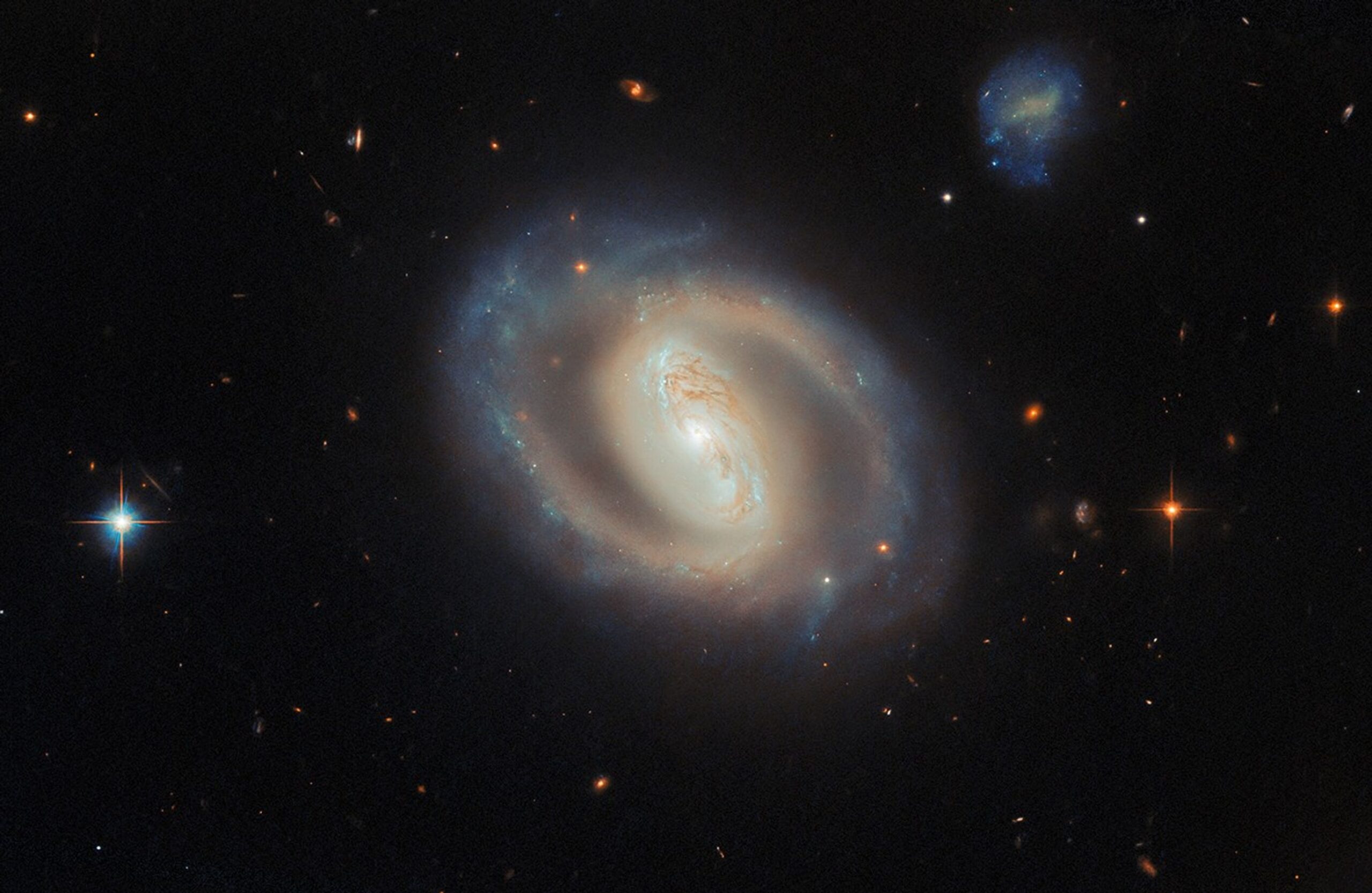
Hubble Spies an Active Spiral

ESA/Hubble & NASA, M. J. Koss, A. J. Barth
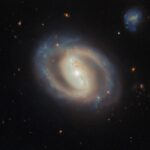
A luminous swirl set against the deep black of space, the barred spiral galaxy IC 486 glows with a soft, ethereal light in this new NASA Hubble Space Telescope image.
IC 486 lies right on the edge of the constellation Gemini (the Twins), around 380 million light-years from Earth. Classified as a barred spiral galaxy, it features a bright central bar-shaped structure from which its spiral arms unfurl, wrapping around the core in a smooth, almost ring-like pattern.
Hubble’s keen eye reveals subtle variations in color across the galaxy. The pale, luminous center is dominated by older stars, while faint bluish regions in the surrounding disk trace pockets of more recent star formation. Wisps of dust thread through the galaxy’s structure, gently obscuring light and tracing regions of increased molecular gas where new stars are likely to form.
At the galaxy’s center a noticeable white glow outshines the starlight around it. This is light from IC 486’s active galactic nucleus (AGN), which is powered by a supermassive black hole more than 100 million times the mass of the Sun. Every sufficiently large galaxy hosts a supermassive black hole at its center, but some of these black holes are particularly ravenous, assembling vast amounts of gas and dust into swirling accretion disks from which they feed. The intense heat generated by the orbiting disk of material generates intense radiation, including X-rays, which can outshine the entire rest of the galaxy. In these cases, the galaxy is known as an active galaxy, with an AGN at its center.
The data used to make this image comes from two separate observing programs — #17310 (PI: M. J. Koss) and #15444 (PI: A. J. Barth) — with similar aims: to survey nearby active galaxies like IC 486 and record detailed, high-quality images of their central black holes and the stars near the core of the galaxy. By combining Hubble’s sharp imaging capabilities with large comprehensive samples, these programs enable detailed comparisons of how stars, gas, dust, and black holes interact in galaxy centers.

A key goal of this work is to understand how galaxies grow by linking their large-scale structures, such as bars and spiral arms, to activity in their nuclei. To achieve this, the research teams leverage both expert classifications and citizen science through Galaxy Zoo, with datasets they will ultimately release to the public. In parallel, researchers are using the same images to test how well large language models and other machine learning techniques can reproduce or extend human classifications, offering a new way to scale galaxy morphology studies to the largest surveys that telescopes like Euclid and the Vera Rubin Observatory are preforming, and NASA’s Roman Space Telescope will perform.
Beyond IC 486, distant background galaxies and foreground stars pepper the image. Some stars appear with characteristic diffraction spikes, while the more diffuse, reddish smudges are far more distant galaxies scattered across the cosmos.
Though it may appear calm and orderly, IC 486 is a dynamic system shaped by gravity and stellar evolution. Over millions of years, its structure will continue to evolve as stars are born, age, and fade, contributing to the ongoing story of galactic life in the universe.
Media Contact:
Claire Andreoli
NASA’s Goddard Space Flight Center, Greenbelt, MD
claire.andreoli@nasa.gov











Leave a reply
You must be logged in to post a comment.
Related Posts
Stay Informed With the Latest & Most Important News
Previous Post
Next Post


Advertisement
-
 01Two Black Holes Observed Circling Each Other for the First Time
 -
 02From Polymerization-Enabled Folding and Assembly to Chemical Evolution: Key Processes for Emergence of Functional Polymers in the Origin of Life
 -
 03Astronomy 101: From the Sun and Moon to Wormholes and Warp Drive, Key Theories, Discoveries, and Facts about the Universe (The Adams 101 Series)
 -
 04True Anomaly hires former York Space executive as chief operating officer
 -
 05Φsat-2 begins science phase for AI Earth images
 -
 06Hurricane forecasters are losing 3 key satellites ahead of peak storm season − a meteorologist explains why it matters
 -
 07Binary star systems are complex astronomical objects − a new AI approach could pin down their properties quickly