
Now Reading: Hubble Telescope sees baby stars hard at work | Space photo of the day for Jan. 16, 2025
-
01
Hubble Telescope sees baby stars hard at work | Space photo of the day for Jan. 16, 2025

Hubble Telescope sees baby stars hard at work | Space photo of the day for Jan. 16, 2025

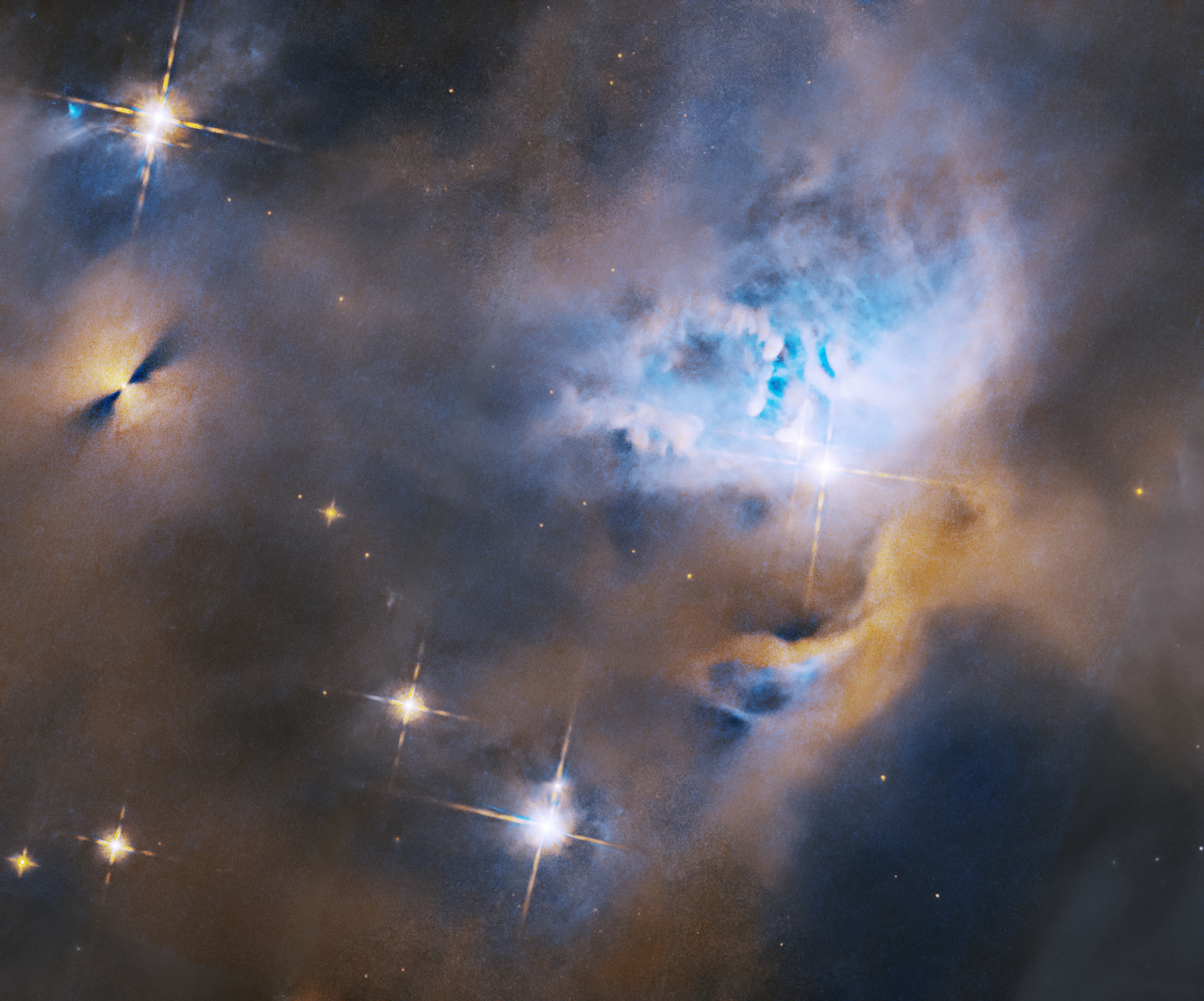
Stars don’t start out fully formed. Instead, they begin when clouds of diffuse gas and dust clump together, becoming denser than their surroundings. Gravity does the rest, pulling material inward until a collapsing knot becomes a compact, warming core: a protostar, still feeding on the cloud that created it.
That’s exactly what was seen in a recent image from NASA’s and the European Space Agency‘s (ESA) Hubble Space Telescope, as the star-forming region known as NGC-1333 hosts a protostar as well as other young stellar objects.
What is it?
Protostars are messy and dynamic, gulping down material in spurts and fits and ejecting powerful outflows of wind and jets that punch into the surrounding clouds. The result is a constant push-and-pull between growth and disruption as the star accretes from its disk while simultaneously blasting material away, carving cavities and shaping the environment that neighboring stars and planets will inherit.
In places where the starlight leaks out and bounces off dust grains, it can illuminate a cloud in phenomenon known as a reflection nebula, as two dark stripes flank the bright point of the growing star. According to Hubble researchers, the stripes are the signature of a protoplanetary disk and the disk’s shadow cast across the larger envelope of material that still surrounds the young star.
Where is it?
The star-forming region of NGC 1333 is found in the Perseus molecular cloud, roughly 950 light-years away from Earth.

Why is it amazing?
Regions like NGC 1333 are key for astronomers to better understand the nitty-gritty details of star formation. By mapping these areas in both infrared and visible wavelengths of light, different aspects of this scientific process are revealed. Recent work in the broader NGC 1333 area has used high-resolution observation of protostellar jets to read outbursts like “time stamps,” which help astronomers connect bursts of activity to changes in the flow of material, showing that star growth is episodic rather than smooth.
Ultimately, understanding how stars form is inseparable from understanding our own beginnings. Every rocky planet, ocean or atmosphere has begun with the same ingredients: gas, dust, gravity and time. Images like this don’t just show how stars can form but also reveal how their dynamics help shape the universe around us.
Want to learn more?
You can learn more about stellar nurseries and the Hubble Space Telescope.










Related Posts

Stay Informed With the Latest & Most Important News
Previous Post
Next Post
Advertisement
-
 01Two Black Holes Observed Circling Each Other for the First Time
 -
 02From Polymerization-Enabled Folding and Assembly to Chemical Evolution: Key Processes for Emergence of Functional Polymers in the Origin of Life
 -
 03Astronomy 101: From the Sun and Moon to Wormholes and Warp Drive, Key Theories, Discoveries, and Facts about the Universe (The Adams 101 Series)
 -
 04True Anomaly hires former York Space executive as chief operating officer
 -
 05Φsat-2 begins science phase for AI Earth images
 -
 06Hurricane forecasters are losing 3 key satellites ahead of peak storm season − a meteorologist explains why it matters
 -
 07Binary star systems are complex astronomical objects − a new AI approach could pin down their properties quickly