
Now Reading: Hubble unexpectedly catches comet breaking up
-
01
Hubble unexpectedly catches comet breaking up



18/03/2026
274 views
7 likes
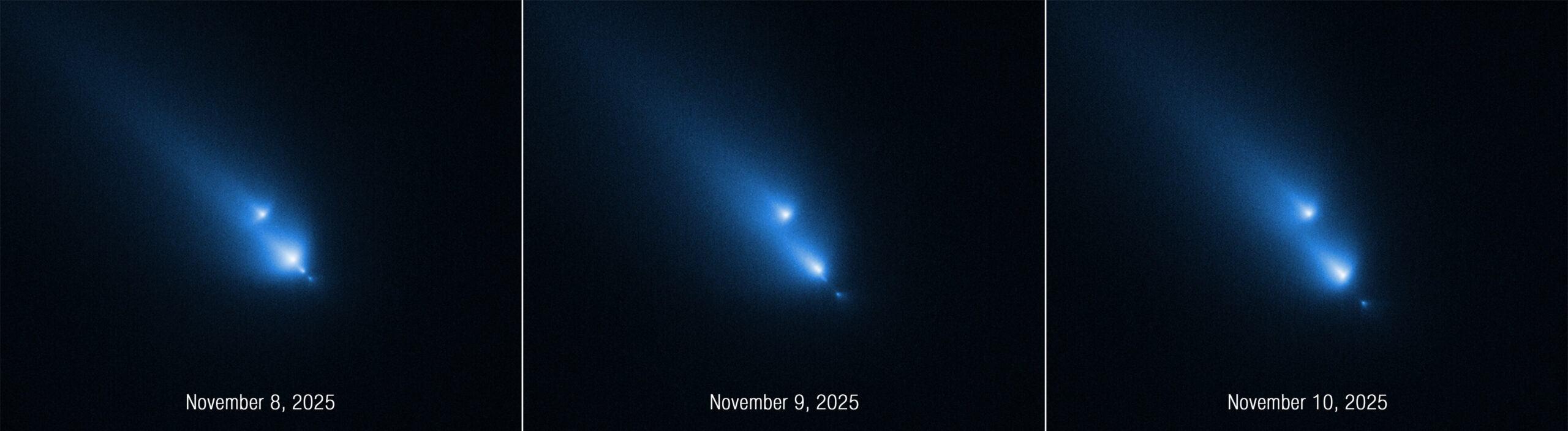
Comet K1, whose full name is Comet C/2025 K1 (ATLAS), had just passed its closest approach to the Sun and was heading out of the Solar System. Though it had been intact just days before, K1 fragmented into at least four pieces while the NASA/ESA Hubble Space Telescope was watching. The odds of that happening while Hubble viewed the comet are extraordinarily miniscule.
Comet K1, whose full name is Comet C/2025 K1 (ATLAS) – not to be confused with interstellar comet 3I/ATLAS – was not the original target of a recent Hubble study. The findings were published today in the journal Icarus.
“Sometimes the best science happens by accident,” said co-investigator John Noonan, a research professor in the Department of Physics at Auburn University in Alabama in the United States. “This comet got observed because our original comet was not viewable due to some new technical constraints after we won our proposal. We had to find a new target – and right when we observed it, it happened to break apart, which is the slimmest of slim chances.”
John didn’t know K1 was fragmenting until he viewed the images the day after Hubble took them. “While I was taking an initial look at the data, I saw that there were four comets in those images when we only proposed to look at one,” said John. “So we knew this was something really, really special.”
This is an experiment the researchers always wanted to do with Hubble. They had proposed many Hubble observations to catch a comet breaking up. Unfortunately, these are very difficult to schedule, and they were never successful.
“The irony is now we’re just studying a regular comet and it crumbles in front of our eyes,” said principal investigator Dennis Bodewits, also a professor in Auburn University’s Department of Physics.
“Comets are leftovers of the era of Solar System formation, so they’re made of ‘old stuff’ – the primordial materials that made our Solar System,” explained Dennis. “But they are not pristine – they’ve been heated, they’ve been irradiated by the Sun and by cosmic rays. So, when looking at a comet’s composition, the question that we always have is, ‘Is this a primitive property or is this due to evolution?’ By cracking open a comet, you can see the ancient material that has not been processed.”
Hubble caught K1 fragmenting into at least four pieces, each with a distinct coma, the fuzzy envelope of gas and dust that surrounds a comet’s icy nucleus. Hubble cleanly resolved the fragments, but to ground-based telescopes, at they time they only appeared as barely distinguishable blobs.
Hubble’s images were taken just a month after K1’s closest approach to the Sun, called perihelion. The comet’s perihelion was inside Mercury’s orbit, about one-third the distance of the Earth from the Sun. During perihelion, a comet experiences its most intense heating and maximum stress. Just past perihelion is when some long-period comets like K1 tend to fall apart.
Before it fragmented, K1 was likely a bit larger than an average comet, probably around 8 km across. The team estimates the comet began to disintegrate eight days before Hubble viewed it. Hubble took three 20-second images, one on each day from 8 November through 10 November 2025. As it watched the comet, one of K1’s smaller pieces also broke up.
Because Hubble’s sharp vision can distinguish extremely fine details, the team could trace the history of the fragments back to when they were one piece. That allowed them to reconstruct the timeline. But in doing so, they uncovered a mystery: Why was there a delay between when the comet broke up and when bright outbursts were seen from the ground? When the comet fragmented and exposed fresh ice, why didn’t it brighten almost instantaneously?
The team has some theories. Most of a comet’s brightness is sunlight reflected off of dust grains. But when a comet cracks open, it reveals pure ice. Maybe a layer of dry dust needs to form over the pure ice and then blow off. Or maybe heat needs to get below the surface, build up pressure, and then eject an expanding shell of dust.
“Never before has Hubble caught a fragmenting comet this close to when it actually fell apart. Most of the time, it’s a few weeks to a month later. And in this case, we were able to see it just days after,” said John. “This is telling us something very important about the physics of what’s happening at the comet’s surface. We may be seeing the timescale it takes to form a substantial dust layer that can then be ejected by the gas.”
As exciting as these findings are, the best is yet to come. The team is looking forward to finishing the analysis of the gases to come from the comet. Already, ground-based analysis shows that K1 is chemically very strange – it is significantly depleted in carbon, compared with other comets. Spectroscopic analysis from Hubble’s STIS (Space Telescope Imaging Spectrograph) and COS (Cosmic Origins Spectrograph) instruments is likely to reveal much more about the composition of K1 and the very origins of our Solar System.
The comet K1 is now a collection of fragments about 400 million km from Earth. Located in the constellation Pisces, it is heading out of the Solar System, not likely to ever return. Astronomers see that long-period comets such as K1 are more likely to fragment than their short-period cousins, such as 67P/Churyumov-Gerasimenko that was visited by ESA’s Rosetta mission, but it is not known why. Launching towards the end of the decade, ESA’s Comet Interceptor will be the first mission to visit a long-period comet. “Hubble’s chance observation of K1 will help us understand why some long-period comets split apart and give us a first view of their interiors,” said co-author Prof. Colin Snodgrass of the University of Edinburgh in Scotland and an Interdisciplinary Scientist for the Comet Interceptor mission. “These new results will complement the detailed view of a long-period comet that we will obtain from Comet Interceptor, as well as helping astronomers to select the mission’s target.”










Related Posts

Stay Informed With the Latest & Most Important News
Previous Post
Next Post
Advertisement
-
 01Two Black Holes Observed Circling Each Other for the First Time
 -
 02From Polymerization-Enabled Folding and Assembly to Chemical Evolution: Key Processes for Emergence of Functional Polymers in the Origin of Life
 -
 03Astronomy 101: From the Sun and Moon to Wormholes and Warp Drive, Key Theories, Discoveries, and Facts about the Universe (The Adams 101 Series)
 -
 04True Anomaly hires former York Space executive as chief operating officer
 -
 05Φsat-2 begins science phase for AI Earth images
 -
 06Hurricane forecasters are losing 3 key satellites ahead of peak storm season − a meteorologist explains why it matters
 -
 07Binary star systems are complex astronomical objects − a new AI approach could pin down their properties quickly