
Now Reading: Hydration Features on Near-Earth Objects: Integrating New Data with Prior Results
-
01
Hydration Features on Near-Earth Objects: Integrating New Data with Prior Results


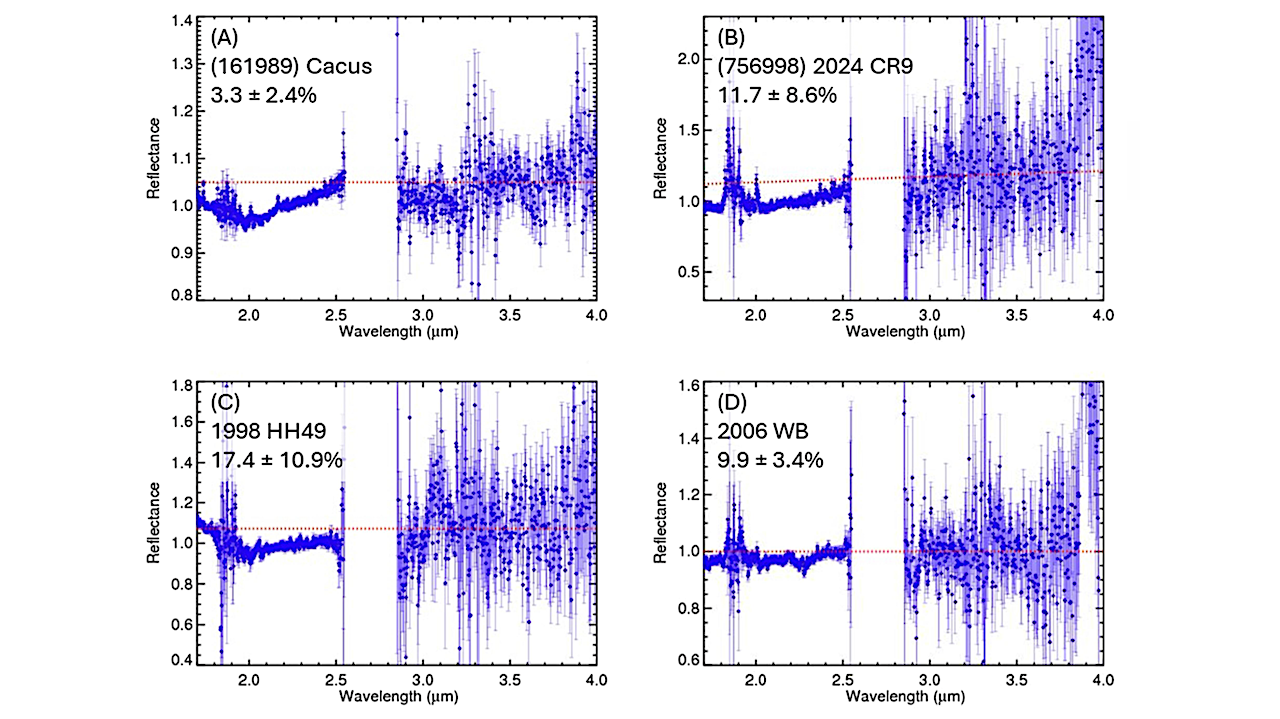
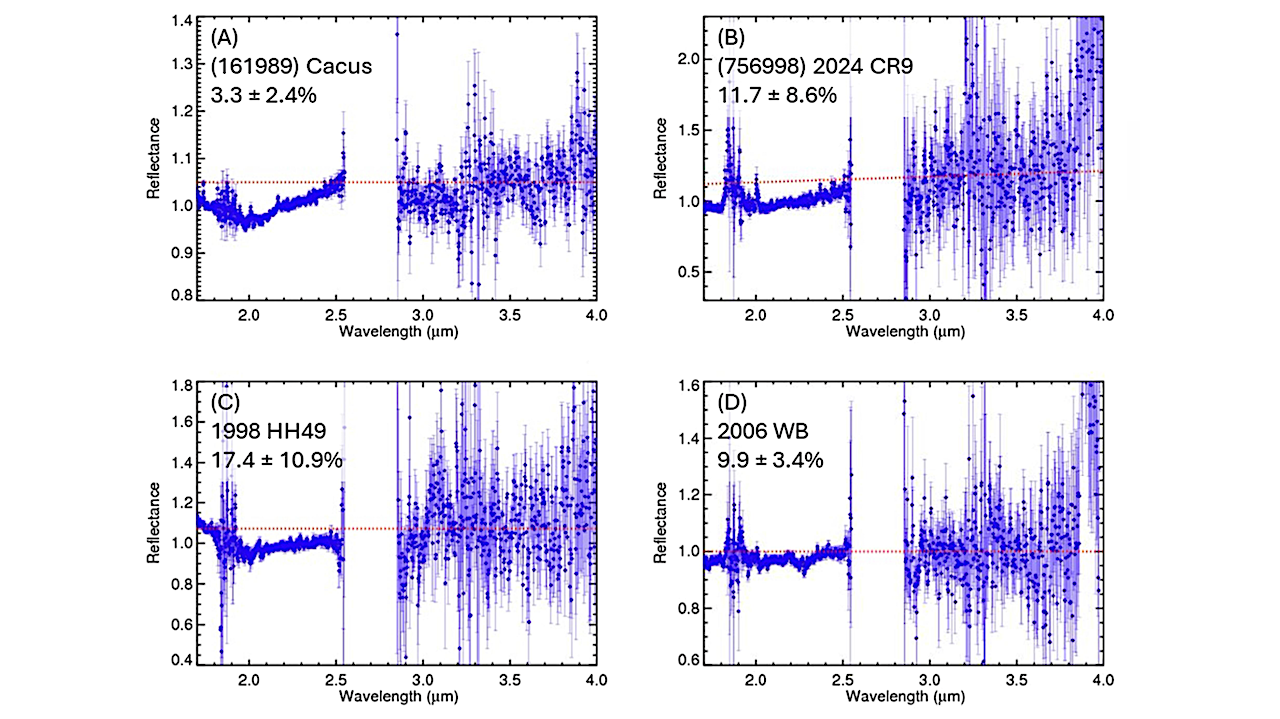
Spectra of NEOs with (potential) 3 μm absorption features. (A) Spectrum of (161989) Cacus as observed on 2022 September 3 and 4. (B) (756998) 2024 CR9 as observed on 2024 June 9. (C) 1998 HH 49 as observed on 2023 October 19. (D) 2006 WB as observed on 2024 November 27. The blue points represent the reflectance spectra (thermal component removed) and the red dashed lines are the reflected continua. — The Planetary Science Journal via X-mol.net
Near-Earth objects (NEOs) are excellent laboratories for testing processes that affect airless bodies, as well as informing us about solar system history.
Though most NEOs are nominally anhydrous because they formed inside the solar system frost line and their surface temperatures are high enough to remove volatiles, a 3 μm feature typically indicative of OH/H2O has been identified on several such bodies. Possible sources for OH/H2O on these bodies include carbonaceous chondrite impactors or interactions with protons implanted by solar wind.
The MIT-Hawaii Near-Earth Object Spectroscopic Survey (or MITHNEOS) began its 3 μm observation campaign of NEOs in 2022 and has obtained spectral data of 15 predominantly nominally anhydrous (i.e., mostly S-complex or V-type) targets using NASA’s Infrared Telescope Facility’s near-infrared spectrometer, SpeX. Spectra were collected using both prism (0.7–2.52 μm) and long-wavelength cross-dispersed short (LXD_short; 1.67–4.2 μm) modes to accurately characterize asteroid spectral type and the 3 μm region.
Four of the 15 NEOs observed exhibit a 3 μm feature, exhibiting band shapes similar to those identified in a previous NEO survey, which found a trend between hydration band presence and large aphelion (i.e., Q > 2.06 au).
Combining our new observations with the preexisting database of NEO 2–4 μm data revealed that band depth increases with decreasing orbital inclination and that all NEOs with hydration bands have i < 27°, with most having i < 14°. We find that NEOs with low inclinations and large aphelia are the most likely bodies in near-Earth space to possess surficial OH/H2O.
Astrobiology, Astrogeology,











Related Posts


Stay Informed With the Latest & Most Important News
Previous Post
Next Post



Advertisement
-
 01Two Black Holes Observed Circling Each Other for the First Time
 -
 02From Polymerization-Enabled Folding and Assembly to Chemical Evolution: Key Processes for Emergence of Functional Polymers in the Origin of Life
 -
 03Astronomy 101: From the Sun and Moon to Wormholes and Warp Drive, Key Theories, Discoveries, and Facts about the Universe (The Adams 101 Series)
 -
 04True Anomaly hires former York Space executive as chief operating officer
 -
 05Φsat-2 begins science phase for AI Earth images
 -
 06Hurricane forecasters are losing 3 key satellites ahead of peak storm season − a meteorologist explains why it matters
 -
 07Binary star systems are complex astronomical objects − a new AI approach could pin down their properties quickly