
Now Reading: Hydrolyzed Hazes on Water-rich Exoplanets: Optical Constants and Detectability
-
01
Hydrolyzed Hazes on Water-rich Exoplanets: Optical Constants and Detectability


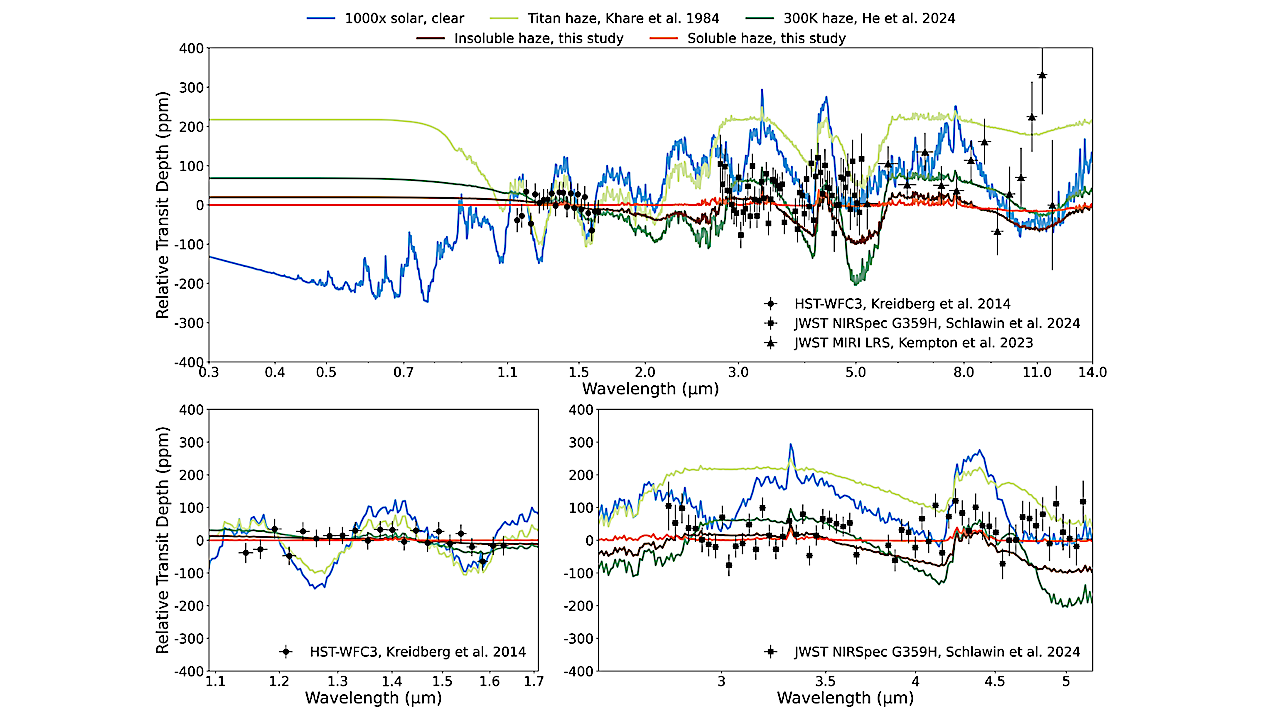

Model transmission spectra comparing several haze compositions on a GJ 1214b-like planet with a temperate waterrich atmosphere. We model a clear atmosphere as well as atmospheres with Titan-like hazes, water-rich exoplanet hazes, and the insoluble and soluble fractions of water-rich exoplanet hazes. Existing Hubble and JWST data of GJ 1214b are also plotted for reference. The top panel displays the full modeled wavelength range of 0.3 to 14.0 µm, and the bottom panels zoom into the wavelength regions with observational data. — astro-ph.EP
Observations of temperate sub-Neptunes suggest active chemical environments, finding evidence of both water vapor and photochemical hazes in their atmospheres.
Hazes formed in water-rich atmospheres are chemically complex, containing molecules relevant to prebiotic chemistry, and their strong optical opacity obscures sought-after gaseous molecular absorption features.
While many studies have investigated haze formation and properties across diverse atmospheric conditions, little is known about the evolution of these hazes in their environment once formed. In particular, interactions with water can drive hydrolysis reactions that alter haze composition and optical behavior, affecting our interpretations of habitability and observational spectroscopy.
Here, we perform hydrolysis experiments on haze analogs of temperate water-rich exoplanets and measure their optical properties. Transmittance measurements from 0.4 to 28.5 μm reveal changes in key functional groups after hydrolysis, along with an overall increase in sample absorbance. We report the derived optical constants for use in observational and modeling studies.
Through synthetic atmospheric spectra, we demonstrate the need for physically informed haze optical properties in models, consistent with expected planetary conditions. The increased absorptivity and high imaginary refractive index of hydrolyzed hazes almost completely flatten features in model spectra, presenting critical consequences for atmospheric characterization of water-rich sub-Neptunes.
Cara Pesciotta, Sarah M. Hörst, Michael J. Radke, Sarah E. Moran, Chao He, Véronique Vuitton
Comments: 19 pages, 6 figures, accepted in ApJ
Subjects: Earth and Planetary Astrophysics (astro-ph.EP)
Cite as: arXiv:2604.07498 [astro-ph.EP] (or arXiv:2604.07498v1 [astro-ph.EP] for this version)
https://doi.org/10.48550/arXiv.2604.07498
Focus to learn more
Related DOI:
https://doi.org/10.3847/1538-4357/ae5b99
Focus to learn more
Submission history
From: Cara Pesciotta
[v1] Wed, 8 Apr 2026 18:35:50 UTC (5,248 KB)
https://arxiv.org/abs/2604.07498
Astrobiology, Astrochemistry,










Related Posts
Stay Informed With the Latest & Most Important News


Advertisement
-
 01Two Black Holes Observed Circling Each Other for the First Time
 -
 02From Polymerization-Enabled Folding and Assembly to Chemical Evolution: Key Processes for Emergence of Functional Polymers in the Origin of Life
 -
 03Astronomy 101: From the Sun and Moon to Wormholes and Warp Drive, Key Theories, Discoveries, and Facts about the Universe (The Adams 101 Series)
 -
 04True Anomaly hires former York Space executive as chief operating officer
 -
 05Φsat-2 begins science phase for AI Earth images
 -
 06Hurricane forecasters are losing 3 key satellites ahead of peak storm season − a meteorologist explains why it matters
 -
 07Binary star systems are complex astronomical objects − a new AI approach could pin down their properties quickly