
Now Reading: ‘I loved thinking about how to make science possible for America and for the world’
-
01
‘I loved thinking about how to make science possible for America and for the world’

‘I loved thinking about how to make science possible for America and for the world’


In 2025, more than 322,000 civil servants left jobs voluntarily or were dismissed out of a workforce of roughly 2.4 million. The 13% drop in staffing is the largest single-year decline since the end of World War II. In total, more than 5,000 people who were part of the federal space workforce left their positions. Senior executives with decades of experience retired alongside younger staffers whose posts were eliminated or who sought opportunities in the private sector or academia. This is one of eight conversations with some of the remarkable people who recently left the federal workforce.
Kartik Sheth
Last position: NASA Associate Chief Scientist
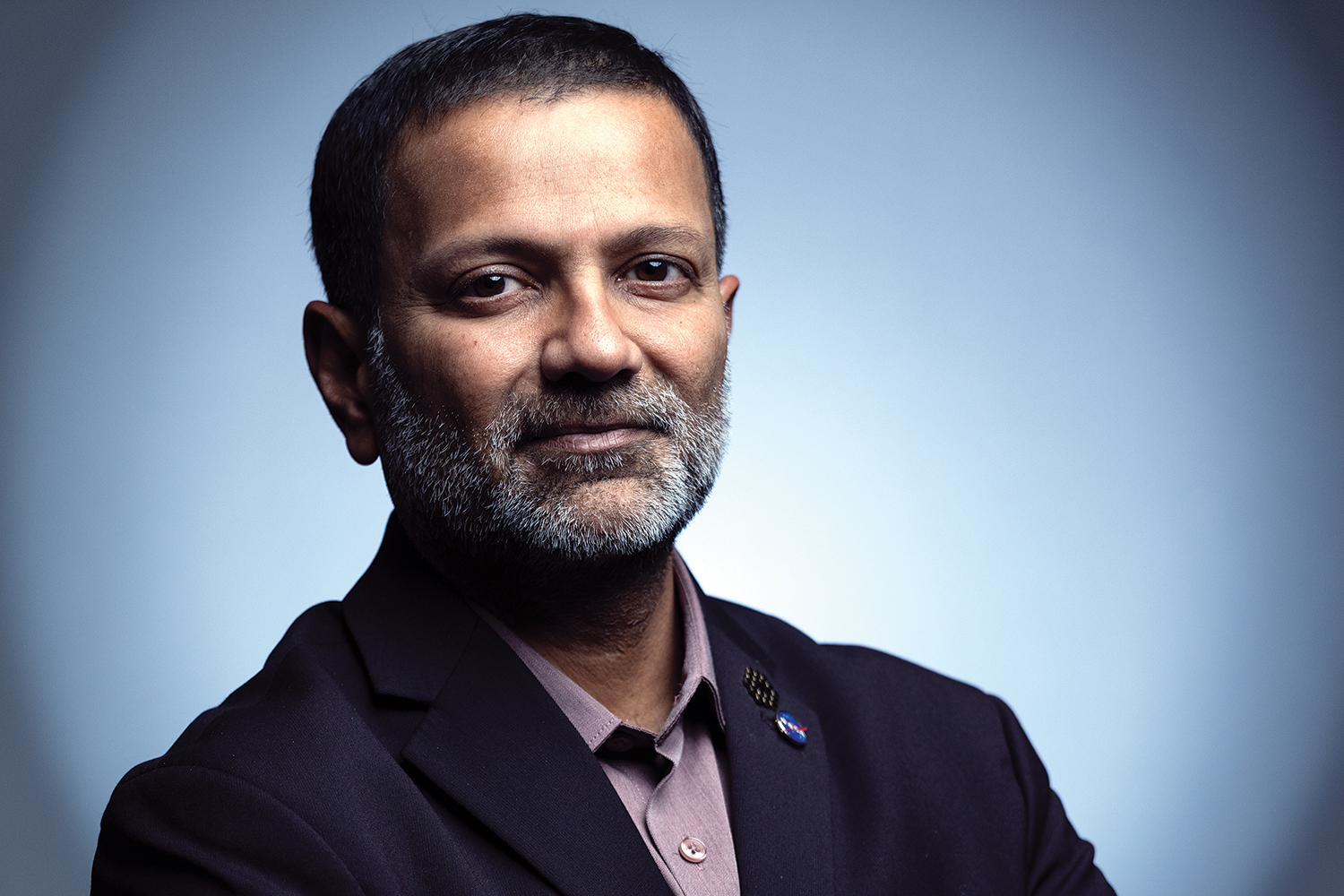
Kartik Sheth is well known for managing infrared observatories like the James Webb Space Telescope (JWST) and Spitzer Space Telescopes. He’s equally adept at conveying the importance of scientific exploration and technological innovation.
Sheth attributes his communications skills in part to his liberal arts education at Grinnell College in Iowa, where he earned a bachelor’s degree. He went on to obtain master’s degrees in physics at the University of Minnesota and a master’s and a PhD at the University of Maryland. Postdoctoral research and a permanent staff position at the California Institute of Technology followed.
After nearly nine years at Caltech, Sheth worked for the National Radio Astronomy Observatory as the commissioning and science verification liaison for North America for the Atacama Large Millimeter/submillimeter Array (ALMA). He also ran a research group and earned his tenure there.
Sheth resigned in 2015 to work at NASA headquarters in the Science Mission Directorate. White House jobs followed. Sheth was the assistant director for research infrastructures and science equity in the Office of Science and Technology Policy (OSTP) and later, the Office of Management and Budget (OMB) program examiner for the Department of Energy Office of Science’s $8.5 billion budget. In 2024, Sheth returned to NASA headquarters as associate chief scientist.
Why were you interested in government work?
My desire to be in public service and work in science policy started in graduate school at the University of Maryland. My adviser encouraged me to apply for an American Association for the Advancement of Science Fellowship. But at the time, you had to have a PhD to apply. So, I ended up doing a postdoc at Caltech and staying in academia because I was doing cutting-edge science.
After nine years at Caltech with multiple ground-breaking discoveries, I ended up at the National Radio Astronomy Observatory working on the ALMA telescope, which we were building in the Atacama Desert. It was an incredible experience to live in Chile on and off for two and a half years building this amazing facility that is like JWST, except at millimeter wavelengths.
When did you begin working in the federal government?
In my 40s, after a full academic career. I was at the top of my field. I had just earned tenure. I had a research group. I was in charge of two major astrophysics surveys and part of another foundational survey. But I wanted to contribute to the science and technology infrastructure in the country. Compared to other scientists, I have a set of skills that may be unique in terms of being able to take complex information and transmit it easily.
In 2013, I was invited to serve on a committee to lay out NASA’s 30-year vision in the field of astrophysics. We came up with a report to convince stakeholders in the White House and Congress that there was so much amazing science waiting to be discovered that they shouldn’t take the money away from JWST and move it to something else. The report, “Enduring Quests, Daring Visions,” became the roadmap for astrophysics until the next decadal survey.
I loved thinking about how to make science possible for America and for the world. In 2015, I interviewed with NASA and the National Science Foundation. I was offered both positions. I ended up working for NASA and it was one of the best choices I made. It was an amazing way to use my scientific and technical knowledge to look at the big picture, to ask, “How can we use the funds that the American public so kindly gives us to do transformational science?”
What are some highlights of your professional career?
I was a postdoc at Caltech when we launched the Spitzer Space Telescope. I was a user of that telescope and an instrument scientist. I had two legacy surveys with Spitzer. Then, when I came to NASA Headquarters, I managed Spitzer. Even towards the end of its life, we used Spitzer to find the TRAPPIST system, an amazing system of seven planets.
Being the deputy program scientist for JWST was amazing because we had so many issues. Getting it through the finish line made me proud of being part of that team.
SOFIA [the Stratospheric Observatory for Infrared Astronomy] was a difficult mission to manage, but almost everything I learned about leadership comes from trying to get the most science out of that mission.
I’m forever grateful to NASA for giving me an amazing 10 years. After four to five years in astrophysics, I was able to go to Earth Science. A highlight for me was managing a team of economists assessing the societal benefits from Earth observations. I’m very proud of that work that we did.
Serving at the White House was another career highlight. Working at OSTP and OMB as well as doing work for the National Space Council will always be something I cherish. I felt like a true public servant.
What were your plans for 2025?
People often ask, “Why does NASA need an Office of the Chief Scientist when you have a Science Mission Directorate?” I tell them, “The Science Mission Directorate focuses on Earth sciences and space sciences. Science happens across the agency in the Aeronautics and Space Technology and Exploration [Mission Directorates].
The Office of the Chief Scientist provided unbiased, data-driven advice to the administrator on all aspects of science and technology.” We didn’t have a budget. We didn’t have a dog in the fight. We were looking out for the agency as a whole.
We were going to implement the Public Access Plan, a policy to make sure that research that the American public paid for was available without a paywall. Every scholarly publication that used NASA data was going to have to allow anybody to access the results and the underlying data. That was going to be a heavy lift, because there are different subcultures in different parts of NASA disciplines and mission directorates.
I was also excited about the Artificial Intelligence Strategic Working Group. We were working on a long-term strategy to implement AI to make NASA more productive.
And because I’m a good public speaker, I wanted to use that skill to talk about science across NASA, across the U.S. and across the world.
I was looking forward to working with the new administrator. We knew the new administration would have more of a focus on the moon and moon-to-Mars. We were set to provide unbiased information. Budgets are always tight. How do we make sure that the administrator has the right information to make choices?
Why was your work in the Office of the Chief Scientist important?
I chose to work in the Office of the Chief Scientist in the NASA Administrator’s suite because, given my work at OMB and OSTP, I had experience that allowed me to connect the dots across the agency and with science and technology stakeholders at the highest level.
Another thing that I managed was the NASA Science Council. Every month, the Office of the Chief Scientist brought together the chief scientists from each of the NASA centers. I was excited about building cohesion across NASA. Oftentimes, because our centers are in different places, centers A and B might be having an issue that centers C and D already solved. We were trying to tie the science activities together.
What happened to your office?
On March 10, we were all given a letter saying that the Office of the Chief Scientist and Office of Technology Policy and Strategy were being eliminated. We had 30 days and then we were separated from the agency. We asked whether we could go to other parts of NASA because all of us had extensive experience across the agency and we loved working for NASA. They said, “We’re not making any lateral transfers.”
What are you doing now?
I am a strategic advisor for a new American company called Max Space, which seeks to put extendable habitats in orbit around the Earth, moon and Mars. I’m also teaching a class at Georgetown in their new space studies concentration. And serving as an advisor for the Lunar Development Cooperative.
I’m chairing the Singapore Space & Technology Think Tank. It’s working in the private sector to help mainstream and internationalize space in Southeast Asia.
There’s a project I’m working on with the University of Chicago, Caltech and universities in Morocco. We’re seeing if we can move a telescope to Morocco.
I started a nonprofit in 2019 to empower people to become problem solvers. I never had a chance to give it my full attention.
Anything else you want to say?
It is very easy during this time to focus on all the change, chaos and negativity. One of my colleagues used to say, “Whenever there’s a crisis, there are opportunities.”
We know that science funding is being cut dramatically compared to 2024-2025. But we’re still funding science at much higher levels than most of the world. How can we use this money that the citizens give us to continue to push science, technology, research and development in ways that keep America at the edge of innovation?
One way is to create more long-term partnerships with our allies. For example, if a professor at a U.S. university doesn’t have a summer salary because of funding cuts, perhaps we can work with other countries interested in growing science. We could partner with them, so this person can spend time with researchers in other countries, and we can create long-term bonds. Then, when that country runs into problems in the future, we can come to their aid and vice versa.
Science is not the purview of one nation or one institution or one region. It’s international. This is our time to lean on the world community and say, “Things are changing here. What can we do now to continue to push science?”
I’ve heard criticism that in spite of increased federal funding, American science innovation has not kept pace. That innovation has only happened in the tech sector. There might be some truth to that. I’m hoping this will force us to innovate. That’s been America’s strength.
An abridged version of this article first appeared in the February 2026 issue of SpaceNews Magazine.










Related Posts

Stay Informed With the Latest & Most Important News
Previous Post
Next Post


Advertisement
-
 01Two Black Holes Observed Circling Each Other for the First Time
 -
 02From Polymerization-Enabled Folding and Assembly to Chemical Evolution: Key Processes for Emergence of Functional Polymers in the Origin of Life
 -
 03Astronomy 101: From the Sun and Moon to Wormholes and Warp Drive, Key Theories, Discoveries, and Facts about the Universe (The Adams 101 Series)
 -
 04True Anomaly hires former York Space executive as chief operating officer
 -
 05Φsat-2 begins science phase for AI Earth images
 -
 06Hurricane forecasters are losing 3 key satellites ahead of peak storm season − a meteorologist explains why it matters
 -
 07Binary star systems are complex astronomical objects − a new AI approach could pin down their properties quickly