
Now Reading: Identifying Surface Degeneracies in Single-Visit Reflected Light Observations of Modern Earth using the Habitable Worlds Observatory
-
01
Identifying Surface Degeneracies in Single-Visit Reflected Light Observations of Modern Earth using the Habitable Worlds Observatory

Identifying Surface Degeneracies in Single-Visit Reflected Light Observations of Modern Earth using the Habitable Worlds Observatory

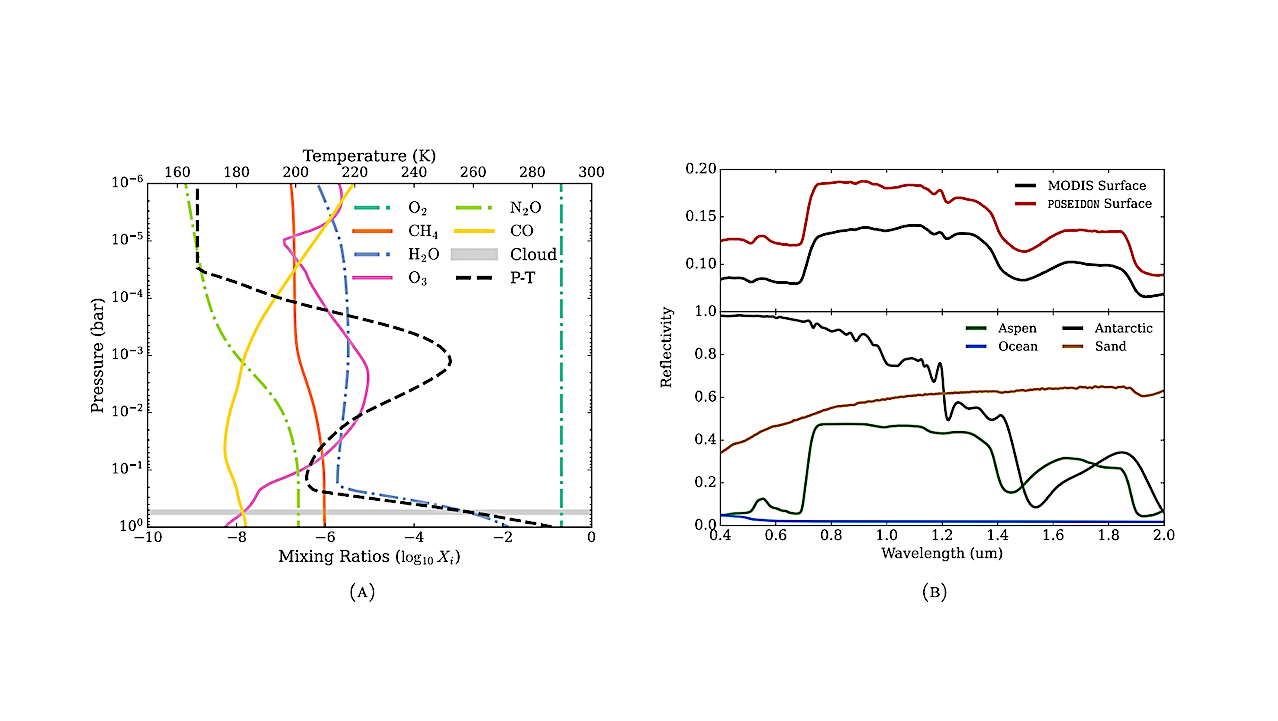
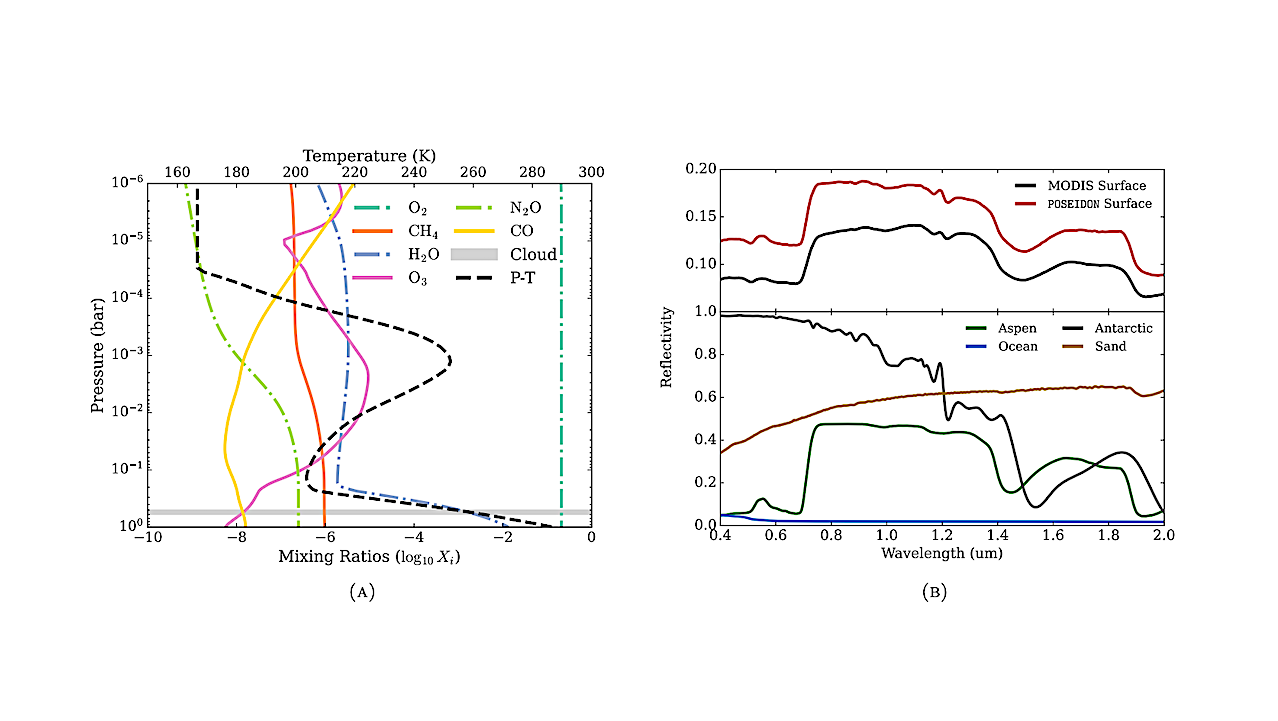
(A) P-T and chemical mixing ratio profile from L. Kaltenegger et al. (2020a) used in the MODIS-derived surface coverage model. Solid and dashed-dotted curves show the vertical mixing ratios of the molecular species contributing to the spectra. The dashed black line represents the P-T profile, and the gray horizontal bar indicates the water cloud height and thickness. (B) The top panel shows the surface spectra derived from MODIS observations, as outlined in Sec.2.2, as well as the simpler four-component surface model for the three self-consistent POSEIDON spectra. The bottom panel shows the four spectra used in the three self-consistent forward models and in all retrievals. — astro-ph.EP
Characterizing the surface and atmosphere of Earth-like planets in reflected light is a key goal for upcoming direct imaging surveys.
NASA’s next flagship-class astrophysics mission concept, the Habitable Worlds Observatory (HWO), is a space-based Ultraviolet/Optical/Near-Infrared observatory with a mission design requirement to reach the 10−10 contrast necessary to characterize Earth-like planets around Sun-like stars.
While reflected light from planetary surfaces provides a unique opportunity to constrain the coverage of surface materials and biopigments, detailed predictions of HWO’s ability to retrieve surface fractions are necessary but have not been conducted.
Here, we model photon-counting noise from astrophysical, instrumental, and post-processing sources for the HWO Exploratory Analytic Case 5 design equipped with a charge-6 vector-vortex coronagraph. By combining our photon-counting noise with five distinct modern Earth models at quadrature, we simulate single-visit HWO observations and perform spectral retrievals using the open-source code 𝙿𝙾𝚂𝙴𝙸𝙳𝙾𝙽 to assess our ability to constrain both the surface and atmospheric composition.
We find that degeneracies between planetary radius, surface pressure, surface material, and cloud coverage in reflected-light retrievals can significantly complicate the classification of surface features. These degeneracies can complicate the detection of surface biopigments, such as the chlorophyll-induced red edge on modern Earth.
Our work shows that developing concrete strategies for detecting surface features and breaking degeneracies in reflected-light observations of Earth-like planets is a critical priority for mission design and data analysis.
Aiden S. Zelakiewicz, Elijah Mullens, Lisa Kaltenegger, Dmitry Savransky
Comments: Submitted to JATIS HWO Special Edition
Subjects: Earth and Planetary Astrophysics (astro-ph.EP); Instrumentation and Methods for Astrophysics (astro-ph.IM)
Cite as: arXiv:2603.25694 [astro-ph.EP] (or arXiv:2603.25694v1 [astro-ph.EP] for this version)
https://doi.org/10.48550/arXiv.2603.25694
Focus to learn more
Submission history
From: Aiden Zelakiewicz
[v1] Thu, 26 Mar 2026 17:41:17 UTC (11,128 KB)
https://arxiv.org/abs/2603.25694
Astrobiology, biosignatures,










Related Posts
Stay Informed With the Latest & Most Important News
Previous Post
Next Post
Previous Post

Next Post


Advertisement
-
 01Two Black Holes Observed Circling Each Other for the First Time
 -
 02From Polymerization-Enabled Folding and Assembly to Chemical Evolution: Key Processes for Emergence of Functional Polymers in the Origin of Life
 -
 03Astronomy 101: From the Sun and Moon to Wormholes and Warp Drive, Key Theories, Discoveries, and Facts about the Universe (The Adams 101 Series)
 -
 04True Anomaly hires former York Space executive as chief operating officer
 -
 05Φsat-2 begins science phase for AI Earth images
 -
 06Hurricane forecasters are losing 3 key satellites ahead of peak storm season − a meteorologist explains why it matters
 -
 07Binary star systems are complex astronomical objects − a new AI approach could pin down their properties quickly