
Now Reading: Imaging Venus-like Worlds: Spectral, Polarimetric, And UV Diagnostics For The Habitable Worlds Observatory
-
01
Imaging Venus-like Worlds: Spectral, Polarimetric, And UV Diagnostics For The Habitable Worlds Observatory

Imaging Venus-like Worlds: Spectral, Polarimetric, And UV Diagnostics For The Habitable Worlds Observatory

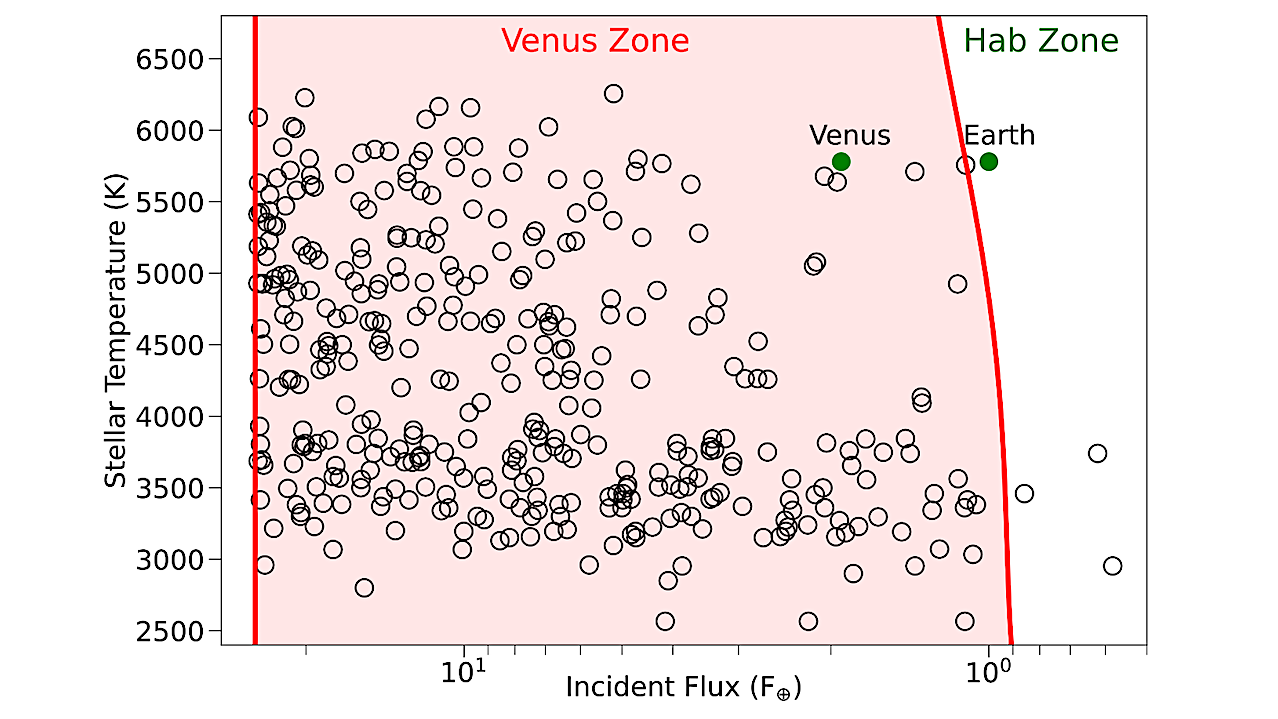
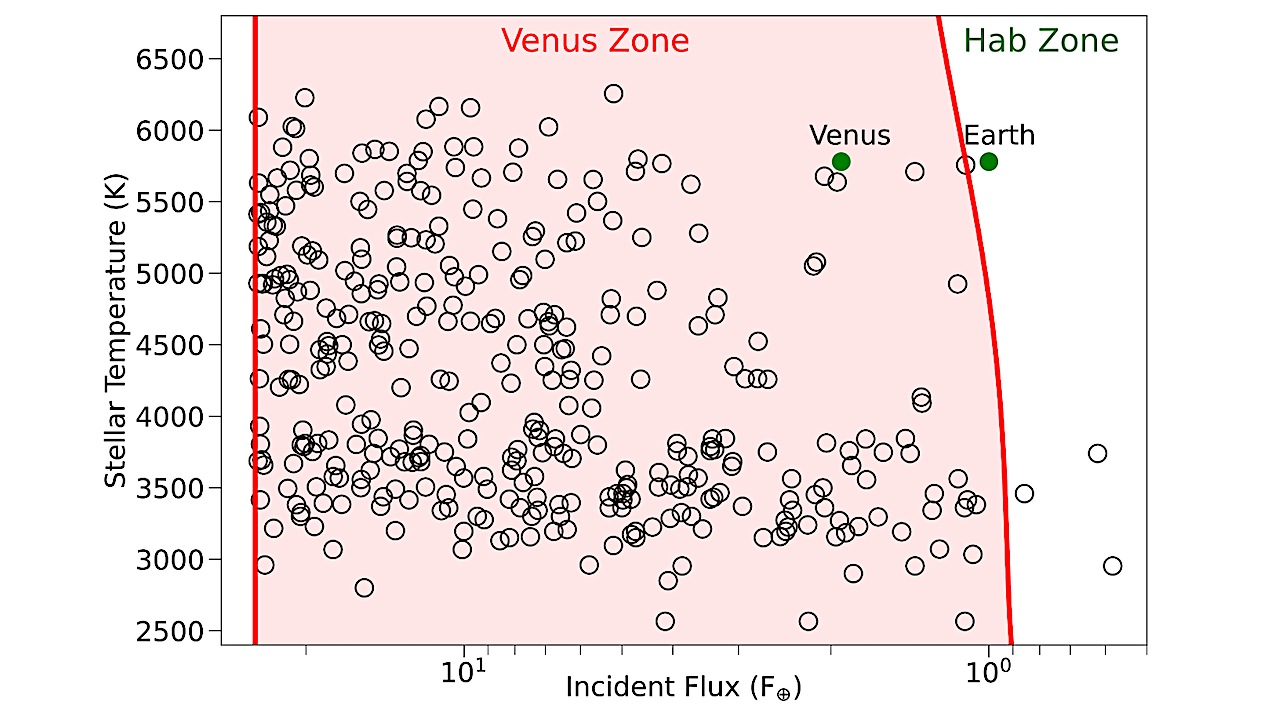
The distribution of currently known exoplanets from the NASA Exoplanet Archive that are in the VZ and have radii Rp ≲ 2 R⊕. The inner VZ boundary is indicated by the red line on the left, and the outer VZ boundary is shown on the right. As of November 2025 there are 370 potential exoVenuses, and this number will continue to grow as there are over 7000 TESS planet candidates yet to be confirmed. The VZ will be calculated and translated against the IWA for all proposed HWO priority targets. — astro-ph.EP
Understanding planetary habitability requires a comparative approach that explores the divergent evolutionary outcomes of Earth and Venus.
The Habitable Worlds Observatory (HWO) will be uniquely positioned to conduct a statistical and physical census of terrestrial exoplanets spanning the Venus Zone (VZ) and the Habitable Zone (HZ), enabling the detection and atmospheric characterization of post-runaway greenhouse worlds (“exoVenuses”).
We present an updated list of VZ exoplanets, which raises the number of known candidates to 370. We describe a science case and an observing strategy for VZ exoplanets that integrates precursor exoplanet detection data and stellar characterization with HWO direct imaging, spectroscopy across the UV/optical/IR, and spectropolarimetry.
Our proposed framework emphasizes a pathway toward the diagnosis of sulfur chemistry (SO2) and aerosol physics (H2SO4 clouds/hazes), planetary redox states (O2/O3 false positives from hydrogen loss), and cloud microphysics detection (rainbow polarization).
We quantify implications for HWO requirements, including UV access to 0.2–0.4 μm, optical/NIR coverage to ≳1.5 μm, inner working angle (IWA) reaching 0.3–1.5 AU around nearby Sun-like stars, and the SNR/resolution needed for key features. Finally, we outline a community-driven path to producing robust demographic inferences and target selection for optimizing HWO observations.
Stephen R. Kane, Kimberly M. Bott, Kenneth E. Goodis Gordon, Emma L. Miles, Colby M. Ostberg, Paul K. Byrne, Ludmila Carone, Tansu Daylan, Antonio Garcia Munoz, Caleb K. Harada, Renyu Hu, Noam. R. Izenberg, Erika Kohler, Malena Rice, Sabina Sagynbayeva, Manuel Scherf, Edward W. Schwieterman, Peter Woitke
Comments: 15 pages, 5 figures, 2 tables, accepted for publication in PASP
Subjects: Earth and Planetary Astrophysics (astro-ph.EP); Instrumentation and Methods for Astrophysics (astro-ph.IM)
Cite as: arXiv:2602.02728 [astro-ph.EP] (or arXiv:2602.02728v1 [astro-ph.EP] for this version)
https://doi.org/10.48550/arXiv.2602.02728
Focus to learn more
Submission history
From: Stephen Kane
[v1] Mon, 2 Feb 2026 19:43:55 UTC (2,247 KB)
https://arxiv.org/abs/2602.02728
Astrobiology, exoplanet,










Related Posts
Stay Informed With the Latest & Most Important News
Previous Post
Next Post

Advertisement
-
 01Two Black Holes Observed Circling Each Other for the First Time
 -
 02From Polymerization-Enabled Folding and Assembly to Chemical Evolution: Key Processes for Emergence of Functional Polymers in the Origin of Life
 -
 03Astronomy 101: From the Sun and Moon to Wormholes and Warp Drive, Key Theories, Discoveries, and Facts about the Universe (The Adams 101 Series)
 -
 04True Anomaly hires former York Space executive as chief operating officer
 -
 05Φsat-2 begins science phase for AI Earth images
 -
 06Hurricane forecasters are losing 3 key satellites ahead of peak storm season − a meteorologist explains why it matters
 -
 07Binary star systems are complex astronomical objects − a new AI approach could pin down their properties quickly