
Now Reading: Information Content Of JWST Transmission Spectroscopy Of The Exoplanet HAT-P-12b From The Optical To The Mid-infrared
-
01
Information Content Of JWST Transmission Spectroscopy Of The Exoplanet HAT-P-12b From The Optical To The Mid-infrared

Information Content Of JWST Transmission Spectroscopy Of The Exoplanet HAT-P-12b From The Optical To The Mid-infrared

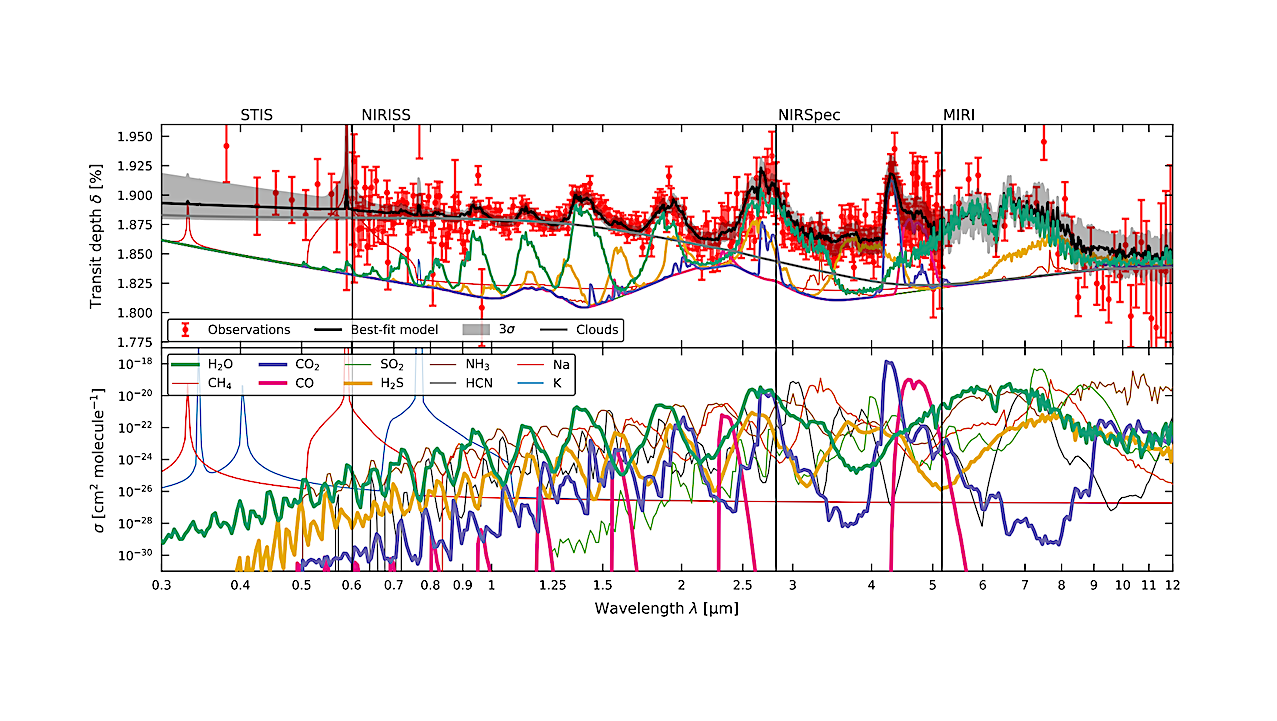
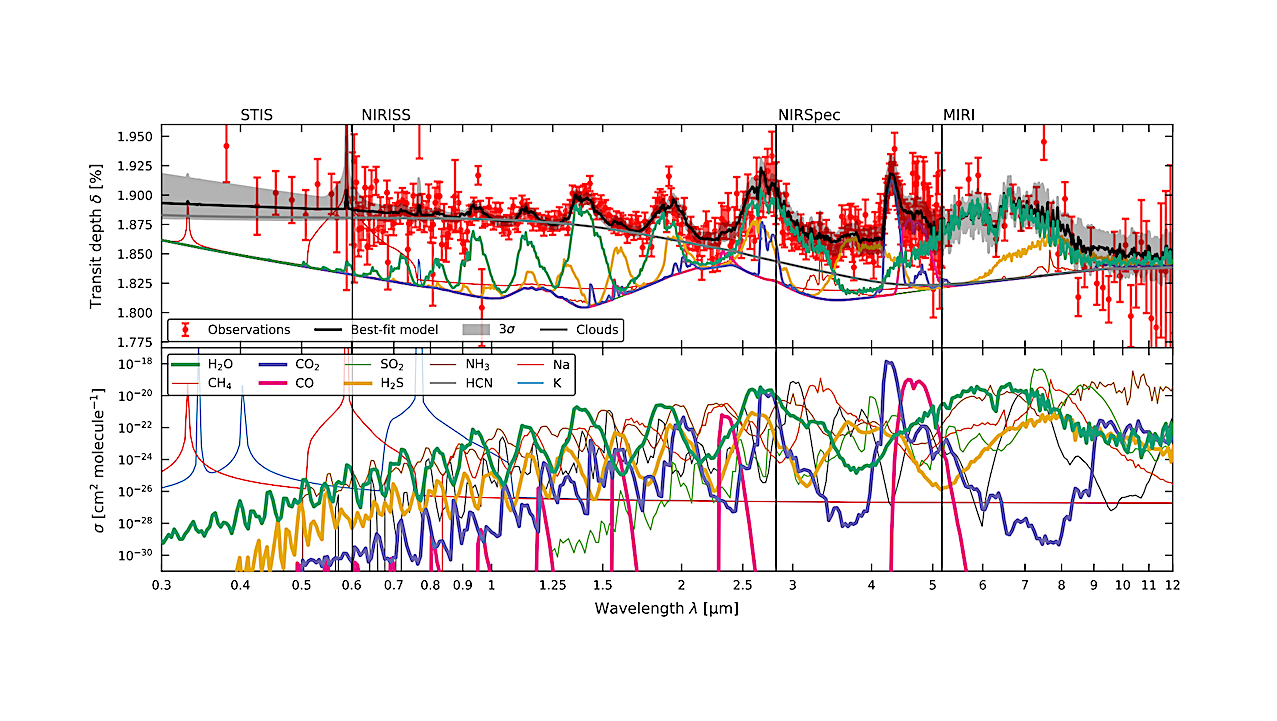
Visualization of the HAT-P-12b transmission spectrum and the underlying opacity contributions. Top: Combined spectra from the three JWST instruments and HST STIS (Alexoudi et al. 2020) with 1σ uncertainties, together with the best-fit model with its 3σ credible interval.Model spectra including only the opacity of individual contributors (chemical species or non-gray cloud parametrization) are also shown. Bottom: Absorption cross sections σ of all tested chemical species; significantly detected species are emphasized with thicker lines. — astro-ph.EP
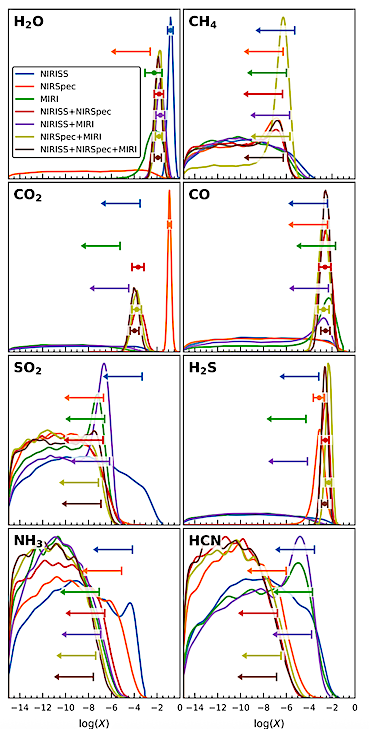
Marginal posterior distributions of the chemical abundances for all included molecules, retrieved using different JWST instrument combinations. The shown distributions were derived from the samples via kernel density estimation (KDE; Gaussian kernel with bandwidth h = 0.1). For each distribution, markers indicate either the 1σ credible interval, in cases of well-constrained posteriors, or the 95th percentile upper limit (arrows) when only an upper bound can be established. — astro-ph.EP
The James Webb Space Telescope (JWST) provides low- to medium-resolution spectra with unprecedented precision and broad near- to mid-infrared wavelength coverage, enabling detailed characterization of exoplanet atmospheres.
We present a new JWST NIRISS SOSS transit observation of the warm sub-Saturn HAT-P-12b. Combined with NIRSpec G395M and MIRI LRS data, this enables an assessment of the information content across JWST instruments over the full accessible wavelength range.
The NIRISS data were reduced and the impact of reduction choices on the transmission spectrum evaluated. Atmospheric retrievals were performed for all JWST combinations, with selected cases including archival HST data.
Four molecules are significantly detected: H2O, CO2, CO, and H2S. Except for H2O, detections require NIRSpec coverage, while H2S is only detected in multi-instrument retrievals. NIRISS SOSS is essential to establish robust evidence for non-gray cloud behavior.
A moderate scattering slope (p < 4) is consistently retrieved. Single-instrument retrievals tend to overestimate abundances, whereas combined JWST datasets yield more consistent constraints.
The C/O ratio remains sensitive to differences between NIRSpec reductions. Results broadly agree with studies of WASP-39b, but highlight variations in information content across exoplanet types.
L. Heinke, M. Min, J. Bouwman, N. Crouzet, T. Konings, L. Decin, L. B. F. M. Waters, P.-O. Lagage, T. Henning, P. I. Palmer, B. Edwards, J. P. Pye, M. Güdel, O. Absil, D. Barrado, C. Cossou, A. Glasse, A. M. Glauser, G. Östlin, N. Whiteford, T. P. Ray
Comments: 21 pages, 15 figures, 4 tables; submitted to A&A
Subjects: Earth and Planetary Astrophysics (astro-ph.EP)
Cite as: arXiv:2604.01219 [astro-ph.EP] (or arXiv:2604.01219v1 [astro-ph.EP] for this version)
https://doi.org/10.48550/arXiv.2604.01219
Focus to learn more
Submission history
From: Linus Heinke
[v1] Wed, 1 Apr 2026 17:57:47 UTC (1,129 KB)
https://arxiv.org/abs/2604.01219
Astrobiology, exoplanet,










Related Posts
Stay Informed With the Latest & Most Important News
Previous Post
Next Post



Advertisement
-
 01Two Black Holes Observed Circling Each Other for the First Time
 -
 02From Polymerization-Enabled Folding and Assembly to Chemical Evolution: Key Processes for Emergence of Functional Polymers in the Origin of Life
 -
 03Astronomy 101: From the Sun and Moon to Wormholes and Warp Drive, Key Theories, Discoveries, and Facts about the Universe (The Adams 101 Series)
 -
 04True Anomaly hires former York Space executive as chief operating officer
 -
 05Φsat-2 begins science phase for AI Earth images
 -
 06Hurricane forecasters are losing 3 key satellites ahead of peak storm season − a meteorologist explains why it matters
 -
 07Binary star systems are complex astronomical objects − a new AI approach could pin down their properties quickly