
Now Reading: Innospace plans second launch in 2026 after failure of first Hanbit-Nano rocket
-
01
Innospace plans second launch in 2026 after failure of first Hanbit-Nano rocket


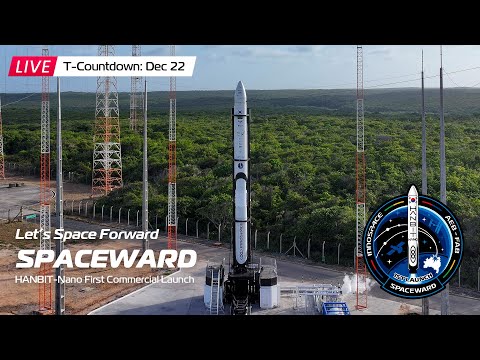
SANTA FE, N.M. — South Korean launch startup Innospace said it will attempt a second launch of its small rocket in the first half of 2026 after its inaugural flight failed shortly after liftoff Dec. 22.
The company’s Hanbit-Nano rocket lifted off from the Alcântara Space Center in Brazil at 8:13 p.m. Eastern, carrying eight small satellites and hosted payloads from Brazil, India and South Korea.
The rocket appeared to lift off normally. However, the Innospace webcast did not include commentary, mission control audio or telemetry after liftoff. After the vehicle passed through a cloud deck, the webcast switched to audio and what appeared to be internal camera views.

About 80 seconds after liftoff, the webcast briefly showed what appeared to be an explosion before cutting back to the launch pad. Seconds later, the webcast displayed a message stating, “We experienced an anomaly during the flight.” The webcast then ended.
In a Dec. 23 letter to shareholders, Innospace Chief Executive Soojong Kim said the rocket’s first stage, powered by a hybrid motor using liquid oxygen and paraffin propellants, ignited normally.
“However, approximately 30 seconds after liftoff, an anomaly occurred in the vehicle due to an unknown cause, and the launch vehicle fell within the pre-established ground safety zone,” he wrote, according to a translation of the Korean-language letter. He added there were no injuries or damage to ground facilities.
Kim did not provide details about the cause of the failure. “At this stage, rather than concluding on a specific cause, we are focusing on objectively confirming the phenomena observed in the actual flight environment and systematically verifying them,” he wrote.
“Based on the data and analysis results obtained from this launch, we will implement necessary technical improvements,” Kim added. “We plan to conduct further verification quickly and, after a thorough improvement process, attempt another commercial launch in the first half of next year.”

Hanbit-Nano is a small launch vehicle capable of carrying up to 90 kilograms to sun-synchronous orbit when launching from Alcântara. Innospace also has plans for larger vehicles, including Hanbit-Micro, with a payload capacity of 170 kilograms, and Hanbit-Mini, with a capacity of 1,300 kilograms.
Innospace went public on South Korea’s KOSDAQ exchange in July 2024, pricing shares at 43,300 won ($29.96). Shares dropped nearly 29% in trading Dec. 23 to 10,710 won but rose slightly Dec. 24 to 10,910 won.
“Although this launch did not achieve the planned final outcome, the successful collection of flight, propulsion and operational data that can only be obtained in a real flight environment is a very important achievement,” Kim wrote.
“We believe this experience will serve as an important foundation for increasing the probability of success in the next launch, similar to how major global launch vehicle companies have accumulated real flight data and improved their technological capabilities during the initial stages of commercial launches,” he said.










Related Posts

Stay Informed With the Latest & Most Important News
Previous Post
Next Post




Advertisement
-
 01Two Black Holes Observed Circling Each Other for the First Time
 -
 02From Polymerization-Enabled Folding and Assembly to Chemical Evolution: Key Processes for Emergence of Functional Polymers in the Origin of Life
 -
 03Astronomy 101: From the Sun and Moon to Wormholes and Warp Drive, Key Theories, Discoveries, and Facts about the Universe (The Adams 101 Series)
 -
 04True Anomaly hires former York Space executive as chief operating officer
 -
 05Φsat-2 begins science phase for AI Earth images
 -
 06Hurricane forecasters are losing 3 key satellites ahead of peak storm season − a meteorologist explains why it matters
 -
 07Binary star systems are complex astronomical objects − a new AI approach could pin down their properties quickly