
Now Reading: Insights Into The Exoplanet Radius Valley From Host-Star Ages, Activity, Chemistry, And Birth Radius
-
01
Insights Into The Exoplanet Radius Valley From Host-Star Ages, Activity, Chemistry, And Birth Radius

Insights Into The Exoplanet Radius Valley From Host-Star Ages, Activity, Chemistry, And Birth Radius

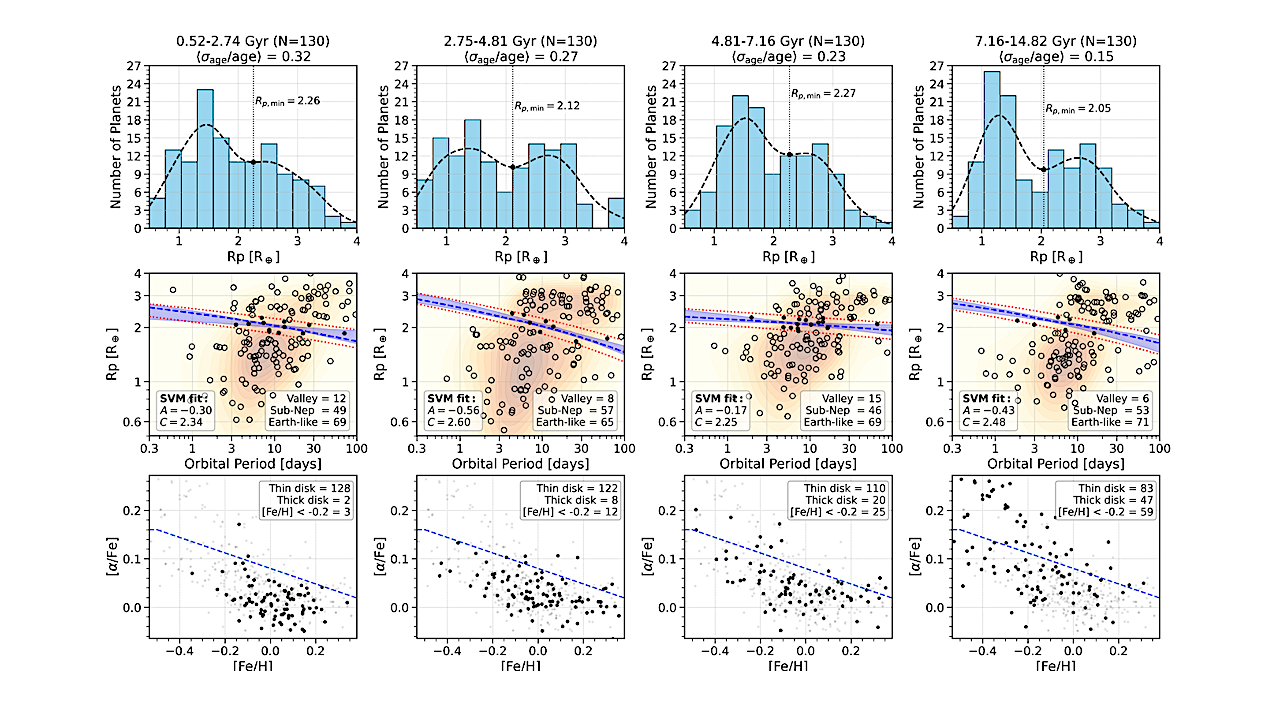
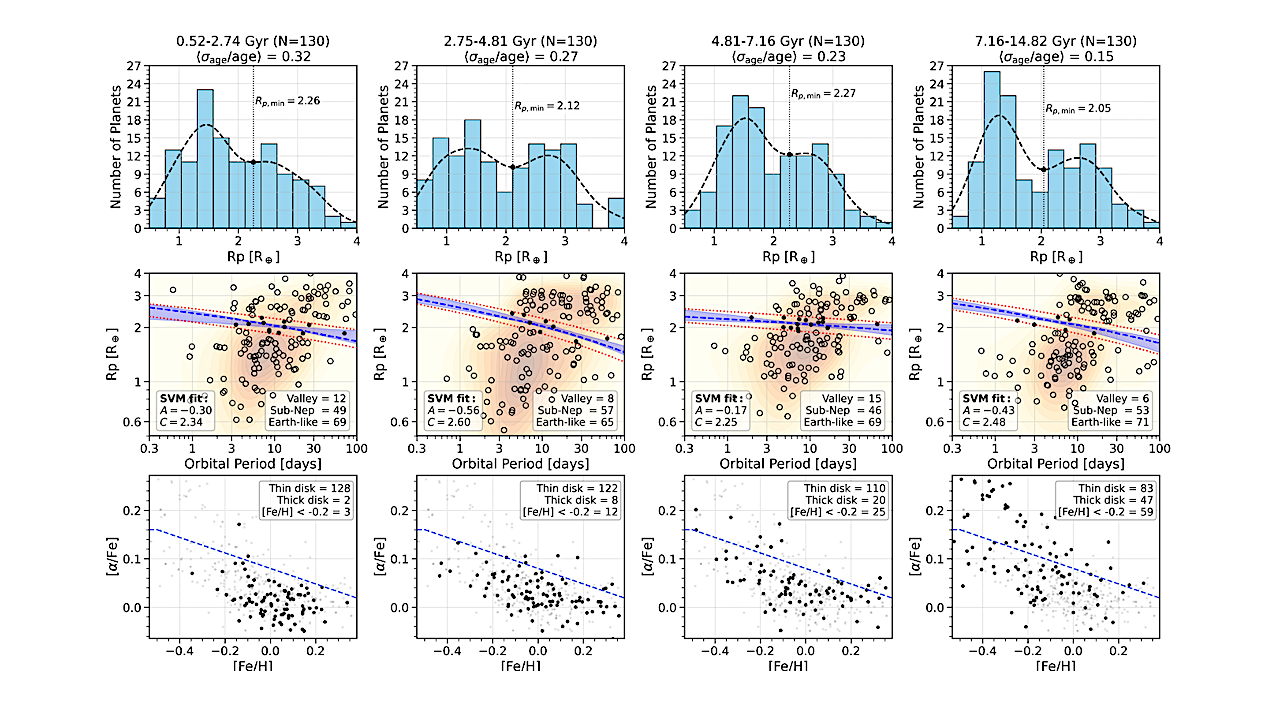
Comparison of planet radius distributions and radius–period diagrams across stellar age bins. Upper panels: Planet-radius histograms for four equally populated age bins, defined by the 25th, 50th, and 75th percentiles of the stellar age distribution. The dashed curves show the corresponding kernel density estimates, and the inferred radius-valley locations from the KDE fits are indicated. Middle panels: Radius–period diagrams for the same age bins, where the background shading represents the two-dimensional kernel density estimate in the Rp–Porb plane. The dashed blue line indicates the median SVM-derived radius valley, the blue band shows the 1σ uncertainty from bootstrap resampling, and the dotted red curves mark a fixed ±0.2 R⊕ interval used to define planets within the valley (filled symbols); planets above and below the valley are shown as open symbols. Bottom panels: Stellar chemical abundance distributions in the [α/Fe]–[Fe/H] plane for the same age bins. Gray points show the full background sample, while black points indicate stars hosting planets in each age bin. The dashed line marks the adopted chemical separation between thin- and thick-disk populations: [α/Fe]= 0.16 for [Fe/H]≤ −0.5, and [α/Fe]= −0.16 × [Fe/H] + 0.08 for [Fe/H]> −0.5. Stars above the boundary are classified as thick-disk and those below as thin-disk. The numbers of thin-disk and thick-disk stars, as well as the number of stars with [Fe/H] −0.2, are indicated in each panel. — astro-ph.SR
The radius valley, a bimodal feature in the size distribution of close-in small exoplanets, is widely interpreted as a signature of atmospheric loss and therefore provides a key constraint on the formation and atmospheric evolution of these planets.
We investigate its dependence on host-star properties using 769 planets orbiting 558 stars, for which we derive stellar ages, chromospheric activity, and Galactic birth radius, together with elemental abundances. We find that the radius valley is not fully established at ages ∼3 Gyr and evolves over gigayear timescales, with its prominence strongly affected by stellar population mixing.
The dependence on magnetic activity is non-monotonic: a clear valley is present even among magnetically quiet stars, while highly active systems do not show a systematically stronger depletion. The valley morphology also varies with stellar composition: the valley is strongest in metal-poor stars, weakens near solar metallicity, and partially strengthens again at the highest metallicities.
In addition, the valley shows sensitivity to refractory element ratios such as [Mg/Si], while correlations with [C/O] are weaker, indicating a dependence on planetary interior structure. Our results are more consistent with a dominant role for core-powered atmospheric mass loss than with purely irradiation-driven photoevaporation.
Finally, the radius valley also depends on the Galactic birth environment, with systems near the estimated solar birth radius ∼4.5 kpc showing a high fraction of Earth-like planets and a well-defined bimodal structure, suggesting that the Solar System formed in a region with a well-developed Earth-sized planet population.
Xunzhou Chen, Tiancheng Sun, Yuxi (Lucy)Lu, Zixuan Lu, Lifei Ye
Comments: 21 pages, 17 figures. Accepted for publication in ApJ
Subjects: Solar and Stellar Astrophysics (astro-ph.SR); Earth and Planetary Astrophysics (astro-ph.EP)
Cite as: arXiv:2603.21581 [astro-ph.SR] (or arXiv:2603.21581v1 [astro-ph.SR] for this version)
https://doi.org/10.48550/arXiv.2603.21581
Focus to learn more
Submission history
From: Xunzhou Chen
[v1] Mon, 23 Mar 2026 05:06:19 UTC (15,534 KB)
https://arxiv.org/abs/2603.21581
Astrobiology, exoplanet,










Related Posts


Stay Informed With the Latest & Most Important News
Previous Post
Next Post





Advertisement
-
 01Two Black Holes Observed Circling Each Other for the First Time
 -
 02From Polymerization-Enabled Folding and Assembly to Chemical Evolution: Key Processes for Emergence of Functional Polymers in the Origin of Life
 -
 03Astronomy 101: From the Sun and Moon to Wormholes and Warp Drive, Key Theories, Discoveries, and Facts about the Universe (The Adams 101 Series)
 -
 04True Anomaly hires former York Space executive as chief operating officer
 -
 05Φsat-2 begins science phase for AI Earth images
 -
 06Hurricane forecasters are losing 3 key satellites ahead of peak storm season − a meteorologist explains why it matters
 -
 07Binary star systems are complex astronomical objects − a new AI approach could pin down their properties quickly