
Now Reading: Interaction Between Vegetation And Snowball Phases In The Late Proterozoic Earth
-
01
Interaction Between Vegetation And Snowball Phases In The Late Proterozoic Earth


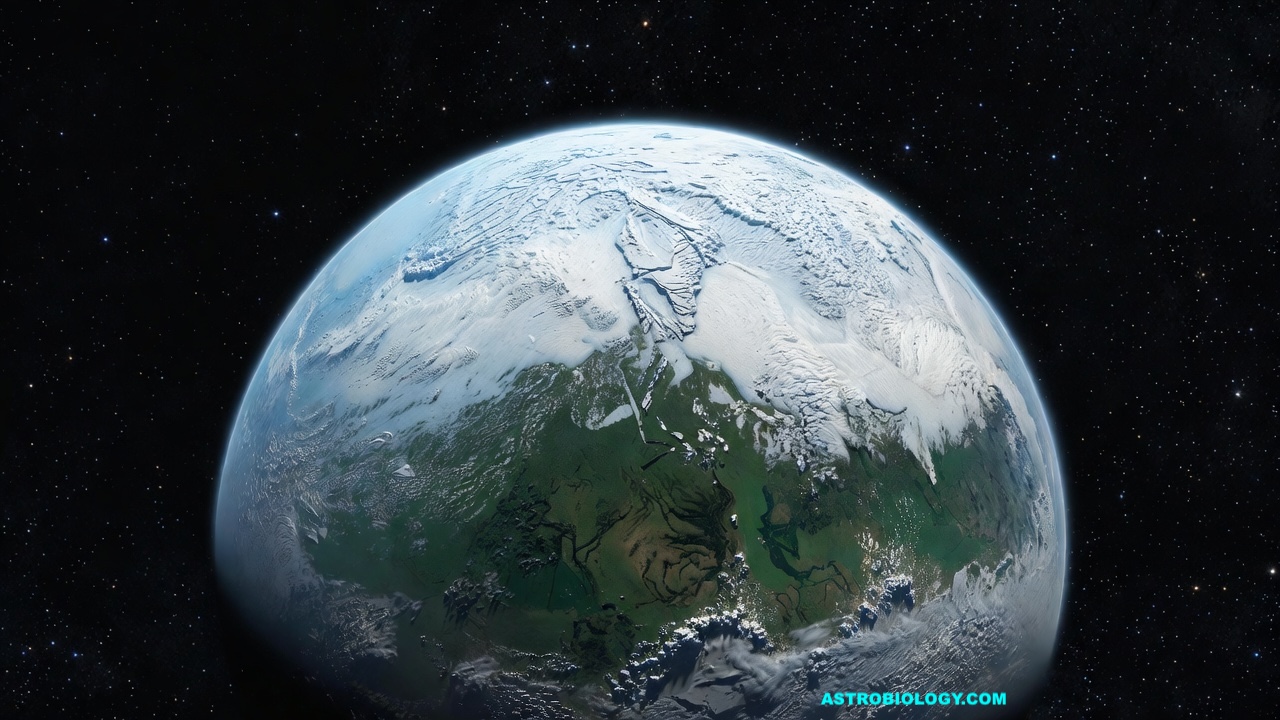
Intermediate stage in Snowball Earth — Grok via Astrobiology.com
Between 2.4 and 0.6 Gy ago, our planet underwent several episodes of global glaciations, including the Snowball Earth case that ended 635 My ago.
Causes of this last Snowball event presumably included a decreased greenhouse gas concentration and high continental albedo, both associated with the passage of the super-continent Rodinia at equatorial latitudes.
When large continental masses are in equatorial regions, silicate weathering is enhanced, leading to decreased atmospheric CO2 concentration, while the bare continental masses, which at the time hosted no vegetation, enhanced reflection of solar radiation.
Since then, no other Snowball episodes were recorded. Here we numerically explore the climatic dynamics of a rocky planet for different values of solar output, continental configuration (current and Rodinia-like), CO2 concentration and continental albedo, simulating the effects of land vegetation.
We found that for the solar input typical of 600-700 My ago (95% of the current value), the presence of bare continents with albedo 0.35 (granite) in the position estimated for Rodinia was sufficient to trigger a Snowball state for CO2 concentrations up to at least 1000 ppm.
When bare continents are located in modern positions, Snowball could be triggered only for values of CO2 concentration below 400 ppm. At current solar input values, Snowball states appear only at or below 100 ppm.
Thus, we found: a lower solar output is an essential component of the transition to Snowball; the presence of land vegetation is crucial and reduces the probability of entering a Snowball state; a low CO2 concentration was not needed for triggering a Snowball in bare Rodinia-like conditions and reduced solar output; current solar luminosity does not allow Snowball states, even for equatorial continents, unless continental albedo is that of granite and CO2 concentration is 100 ppm or less. [Abridged]
Erica Bisesi, Giuseppe Murante, Antonello Provenzale, Jost von Hardenberg, Michele Maris, Laura Silva
Comments: Accepted for publication in the International Journal of Astrobiology 13 pages, 3 figures, 1 table
Subjects: Earth and Planetary Astrophysics (astro-ph.EP); Geophysics (physics.geo-ph)
MSC classes: 86A08
Cite as: arXiv:2603.25321 [astro-ph.EP] (or arXiv:2603.25321v1 [astro-ph.EP] for this version)
https://doi.org/10.48550/arXiv.2603.25321
Focus to learn more
Submission history
From: Erica Bisesi
[v1] Thu, 26 Mar 2026 11:09:30 UTC (569 KB)
https://arxiv.org/abs/2603.25321
Astrobiology,










Related Posts
Stay Informed With the Latest & Most Important News
Previous Post
Next Post


Advertisement
-
 01Two Black Holes Observed Circling Each Other for the First Time
 -
 02From Polymerization-Enabled Folding and Assembly to Chemical Evolution: Key Processes for Emergence of Functional Polymers in the Origin of Life
 -
 03Astronomy 101: From the Sun and Moon to Wormholes and Warp Drive, Key Theories, Discoveries, and Facts about the Universe (The Adams 101 Series)
 -
 04True Anomaly hires former York Space executive as chief operating officer
 -
 05Φsat-2 begins science phase for AI Earth images
 -
 06Hurricane forecasters are losing 3 key satellites ahead of peak storm season − a meteorologist explains why it matters
 -
 07Binary star systems are complex astronomical objects − a new AI approach could pin down their properties quickly