
Now Reading: Interstellar comet 3I/ATLAS caught on camera in new images from Hubble Space Telescope and JUICE Jupiter probe
-
01
Interstellar comet 3I/ATLAS caught on camera in new images from Hubble Space Telescope and JUICE Jupiter probe

Interstellar comet 3I/ATLAS caught on camera in new images from Hubble Space Telescope and JUICE Jupiter probe

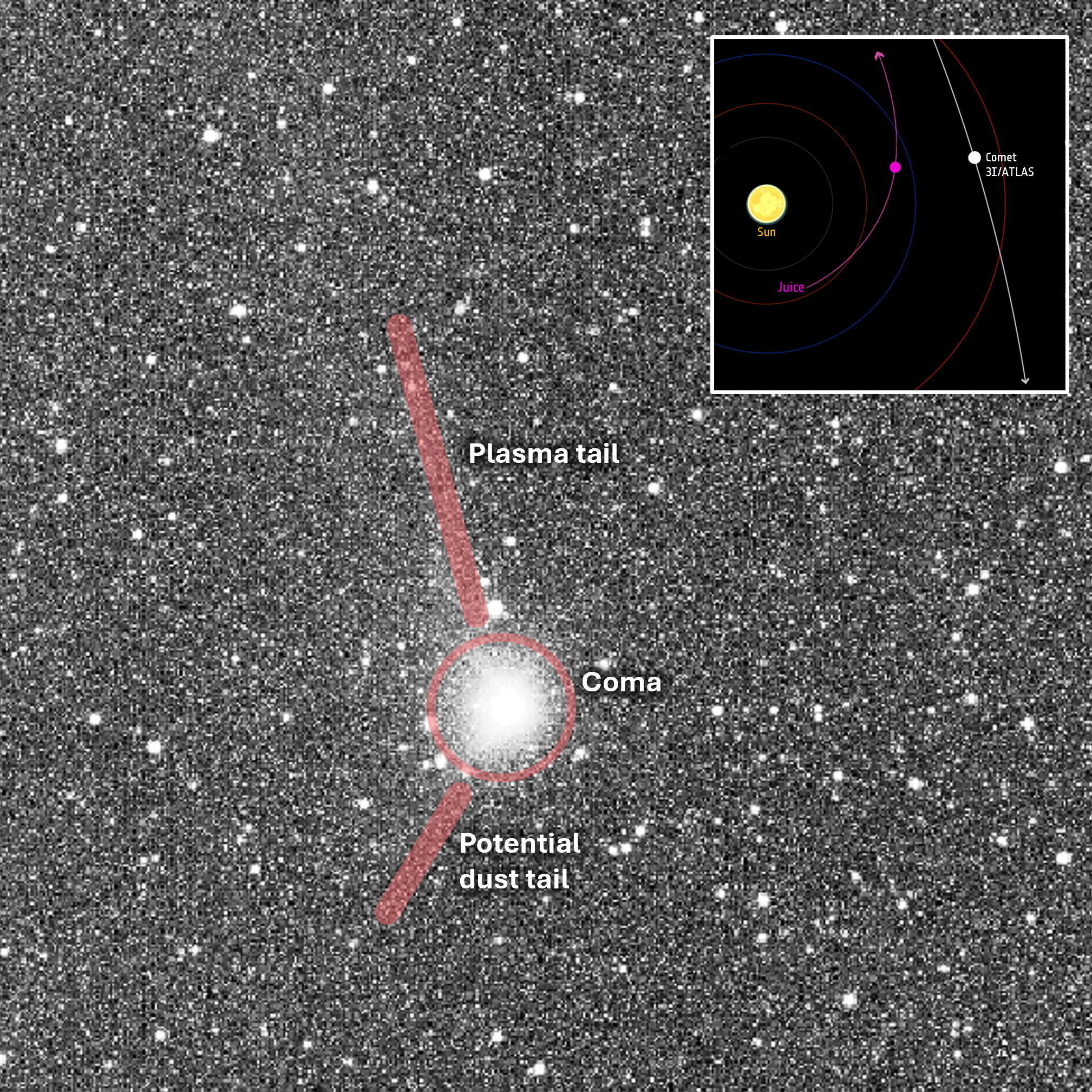
Two flagship spacecraft captured striking new images of Interstellar comet 3I/ATLAS, including a surprisingly sharp snapshot from a camera never meant for scientific imaging.
Discovered on July 1 by the NASA-funded ATLAS telescope in Chile, 3I/ATLAS is only the third confirmed visitor from another solar system, following 1I/’Oumuamua in 2017 and comet 2I/Borisov in 2019.
On Nov. 2, JUICE pointed five of its science instruments at 3I/ATLAS during a planned campaign to study the comet’s activity and composition. That high-resolution data won’t reach Earth until February 2026, however. The spacecraft is currently using its main high-gain antenna as a heat shield to protect itself from the sun, according to an ESA statement.
“Our JUICE team couldn’t wait that long,” ESA wrote. Eager for a sneak peek, engineers used the spacecraft’s smaller, slower antenna to trickle home just one-quarter of a single frame from JUICE’s Navigation Camera (NavCam), a low-resolution imager designed not for science but for navigating JUICE around Jupiter’s icy moons after its 2031 arrival.
The resulting grainy teaser reveals the comet’s bright nucleus surrounded by a glowing coma of gas and dust. If you look closely, a faint tail stretches upward. That is the comet’s plasma tail, created when sunlight ionizes gas released from its warming surface and the solar wind sweeps those charged particles away from the sun, according to ESA.
If you squint harder, you might also spot a subtler dust tail drifting down and to the left. Recent observations show this dust shows slightly atypical properties, hinting that its grain sizes differ from those of local comets, NASA revealed at a news briefing last month.

The snapshot was taken on Nov. 2, just two days before JUICE’s closest approach to 3I/ATLAS, when the spacecraft passed about 41 million miles (66 million kilometers) from the comet. Because JUICE observed the comet just after its closest approach to the sun, on Oct. 30, mission scientists expect the full dataset to reveal even more vigorous, sun-driven activity.
Just weeks after JUICE captured its preview, the Hubble Space Telescope turned its Wide Field Camera 3 back toward 3I/ATLAS for a second round of observations on Nov. 30. The comet was then about 178 million miles (286 million kilometers) from Earth and racing across the background stars. Hubble tracked the comet’s motion, causing the stars to smear into thin streaks in the image, a second ESA statement read.
Hubble first imaged 3I/ATLAS in July, shortly after its discovery, revealing a teardrop-shaped cocoon of dust streaming from the comet’s icy nucleus. The new observations show a bright central core similarly wrapped in a glow of dust, confirming continued activity.

A recent coordinated NASA-led campaign, which drew on dozens of spacecraft and telescopes from Earth orbit to Mars and beyond, hints at unusual chemistry in the comet’s dust, including a higher-than-normal carbon-dioxide–to–water ratio and gas unusually rich in nickel relative to iron. Both findings may point to formation conditions unlike those in our own solar system, NASA scientists said at a November news briefing.
At the briefing, scientists also said 3I/ATLAS has probably spent a very long time drifting through interstellar space. Its incoming speed suggests it may have been born in an ancient planetary system, possibly one that predates our own.
That “gives me goosebumps to think about, frankly,” said Tom Statler, the lead scientist at NASA for solar system small bodies.
At the same briefing, Nicky Fox, the associate administrator of NASA’s Science Mission Directorate, stressed that 3I/ATLAS poses no threat to Earth. The comet will come no closer than 170 million miles (270 million kilometers) to our planet and will not pass near any planets as it exits the solar system, including when it crosses Jupiter’s orbit in spring 2026.
The objects in our solar system, Fox said, “will be just fine.”










Related Posts

Stay Informed With the Latest & Most Important News
Previous Post
Next Post


Advertisement
-
 01Two Black Holes Observed Circling Each Other for the First Time
 -
 02From Polymerization-Enabled Folding and Assembly to Chemical Evolution: Key Processes for Emergence of Functional Polymers in the Origin of Life
 -
 03Astronomy 101: From the Sun and Moon to Wormholes and Warp Drive, Key Theories, Discoveries, and Facts about the Universe (The Adams 101 Series)
 -
 04True Anomaly hires former York Space executive as chief operating officer
 -
 05Φsat-2 begins science phase for AI Earth images
 -
 06Hurricane forecasters are losing 3 key satellites ahead of peak storm season − a meteorologist explains why it matters
 -
 07Binary star systems are complex astronomical objects − a new AI approach could pin down their properties quickly