
Now Reading: Interstellar Object 3I/ATLAS Observed from Mars by China’s Tianwen-1 Spacecraft
-
01
Interstellar Object 3I/ATLAS Observed from Mars by China’s Tianwen-1 Spacecraft


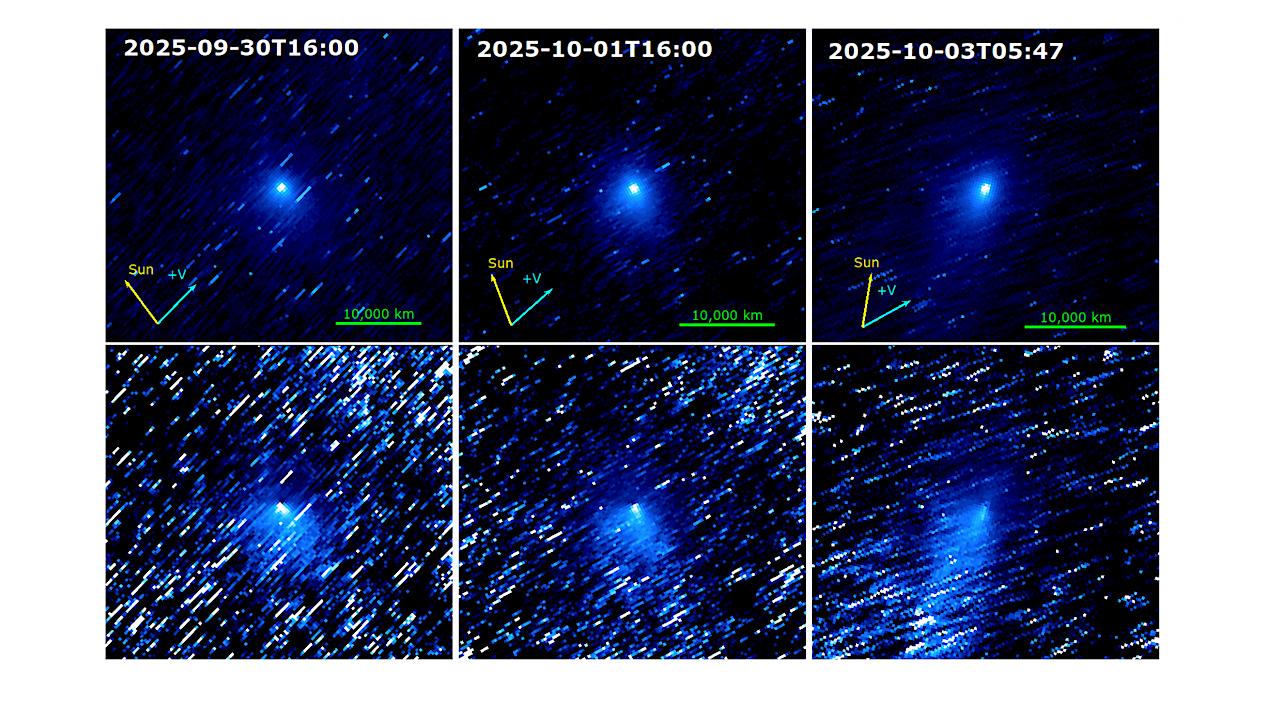
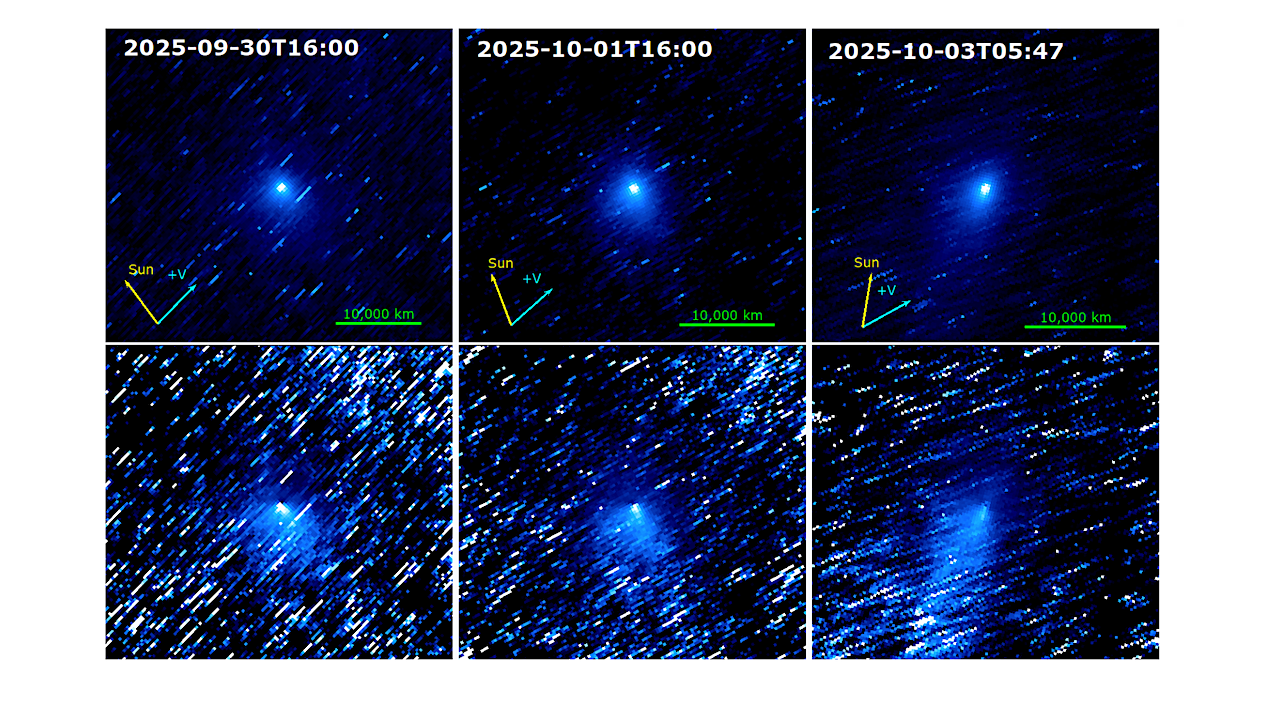
Stacked images of 3I/ATLAS acquired by HiRIC CMOS camera onboard Tianwen-1 spacecraft (upper row) and the corresponding 1/ρ divided images (lower row) from the three epochs. All images are displayed north up and east to the left. The stacked images are displayed with logarithmic brightness stretch, and the enhanced images are displayed with a linear brightness stretch. The arrows in the upper panels mark the projected directions of the Sun and the heliocentric velocity vector. The scalebars are 10,000 km. The bright star trails are visible in each stack due to the apparent movement of 3I in the sky background during each 30-second observation epoch. — astro-ph.EP
China’s Tianwen-1 Mars orbiter successfully imaged the third interstellar object, 3I/ATLAS, during its close encounter with Mars using the onboard HiRIC CMOS camera. This is China’s first deep-space observation of an astronomical object.
These observations constitute the first imaging of this object from a vantage point significantly out of its orbital plane, providing a unique constraint on dust dynamics. Three observing epochs between 2025 September 30 and October 3 reveal clear changes in coma and tail morphology driven by the rapidly evolving viewing geometry.
Comparison with Finson-Probstein dust dynamical models indicates that the coma is dominated by large grains with solar radiation pressure parameter β≈10−3 – 10−2, corresponding to grain sizes of a few 100s μm.
The extent of the sunward coma implies dust ejection velocities of 3 – 10 m s−1. Despite the morphological evolution, the azimuthally averaged surface brightness profile remains nearly unchanged through the three epochs, transitioning from a radial slope near -1 close to the nucleus to slightly steeper than -1.5 at larger cometocentric distances, consistent with steady-state dust outflow accelerated by solar radiation pressure.
Photometry yields an average Afρ∼(2.0±0.2)×104 cm and a corresponding dust mass loss rate of M˙∼103 kg s−1. The dominance of large grains in both interstellar comets discovered to date, 2I/Borisov and 3I/ATLAS, together with their high supervolatile contents, may indicate that these objects originate from the outer regions of their parent planetary disks.
Xin Ren, Wei Yan, Ruining Zhao, Shu Wang, Xingye Gao, Qiang Fu, Qing Zhang, Bin Yang, Man-To Hui, Zhiyong Xiao, Xiaodong Liu, Cunhui Li, Renhao Tian, Wenguang Liu, Dong Wang, Shaoran Liu, Cong Ren, Jie Dong, Xinbo Zhu, Pan Xie, Jian-Yang Li, Yan Geng, Jianjun Liu
Comments: Submitted to ApJL
Subjects: Earth and Planetary Astrophysics (astro-ph.EP); Astrophysics of Galaxies (astro-ph.GA)
Cite as: arXiv:2603.10350 [astro-ph.EP] (or arXiv:2603.10350v1 [astro-ph.EP] for this version)
https://doi.org/10.48550/arXiv.2603.10350
Focus to learn more
Submission history
From: Jian-Yang Li
[v1] Wed, 11 Mar 2026 02:51:49 UTC (1,257 KB)
https://arxiv.org/abs/2603.10350
Astrobiology,










Related Posts
Stay Informed With the Latest & Most Important News
Previous Post
Next Post



Advertisement
-
 01Two Black Holes Observed Circling Each Other for the First Time
 -
 02From Polymerization-Enabled Folding and Assembly to Chemical Evolution: Key Processes for Emergence of Functional Polymers in the Origin of Life
 -
 03Astronomy 101: From the Sun and Moon to Wormholes and Warp Drive, Key Theories, Discoveries, and Facts about the Universe (The Adams 101 Series)
 -
 04True Anomaly hires former York Space executive as chief operating officer
 -
 05Φsat-2 begins science phase for AI Earth images
 -
 06Hurricane forecasters are losing 3 key satellites ahead of peak storm season − a meteorologist explains why it matters
 -
 07Binary star systems are complex astronomical objects − a new AI approach could pin down their properties quickly