
Now Reading: Interstellar Stereoisomerism
-
01
Interstellar Stereoisomerism


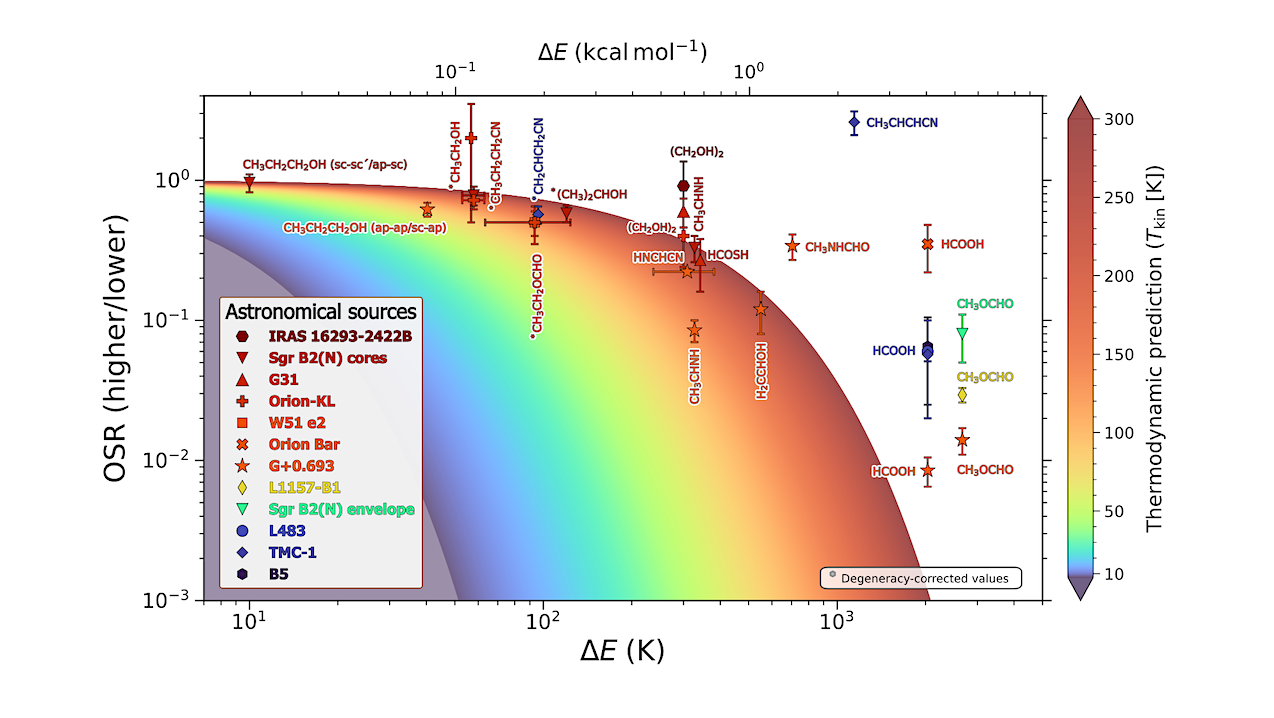
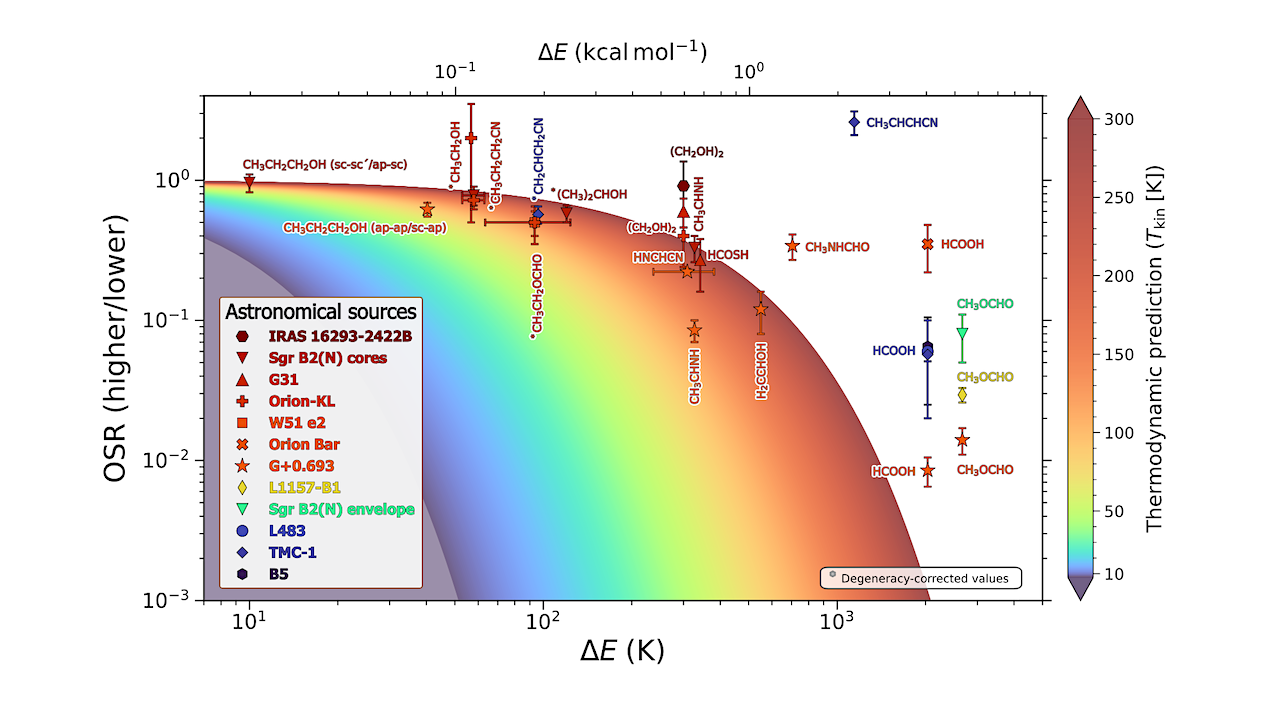
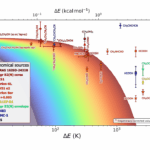
Observed Stereoisomeric Ratio (OSR) – defined as the column density ratio between the higher and the lower-energy isomer – for the different stereoisomeric pairs gathered in Table 1 (points), overlaid with the thermodynamic equilibrium prediction (g×e−∆E/Tkin at g = 1, colored area), as a function of the relative energy (∆E= Ehigher– Elower) between isomers. The points corresponding to the detections are colored according to the particular source Tkin (see Tables 1 and 2), following the color code of the vertical bar. For CH3CH2OH, CH3CH2OCHO, CH2CHCH2CN, CH3CH2CH2CN and (CH3)2CHOH, the observational points were “corrected” (indicated with *) accounting for the double degeneracy of one of the isomers in the pair (the higher-energy for the first three, the lower-energy for the last two), multiplying the corresponding ratios shown in Table 1 by 1/g=1/2, 1/2, 1/2, 2 and 2, respectively, to match the displayed thermodynamic prediction which omits this fact. — astro-ph.GA
The increasing detection of new molecules in the interstellar medium (ISM) shows that stereoisomerism is a fundamental contributor to interstellar molecular complexity.
This work presents the first comprehensive overview of interstellar stereoisomerism. A total of 16 stereoisomeric pairs have been identified (13 conformational and 3 geometric), spanning molecules with 5-12 atoms and energy separations from 10 K to 2667 K. They were observed across diverse astrophysical environments with kinetic temperatures ranging from low to high values (7.5-300 K).
The observed stereoisomeric ratios (OSR) – defined as the column density ratio of the higher-energy isomer divided by that of the lower-energy isomer – vary widely (0.009-4). While systems with small energy differences (1.2 kcal/mol) in hot environments (> 100 K) generally follow thermodynamic expectations (often assisted by tunneling-driven interconversion), many stereoisomers – particularly those in cold clouds or with larger energy separations – exhibit abundances far exceeding equilibrium values.
This demonstrates that thermodynamics alone cannot explain interstellar stereoisomerism. Instead, stereoselective formation/destruction pathways (in the gas phase and/or in the surface of dust grains), photoisomerization, and chemical rearrangement during desorption must play a dominant role.
Stereoisomeric ratios thus provide powerful constraints on interstellar chemical pathways, and about the physico/chemical conditions of the ISM. This review highlights the need for stereochemistry-sensitive astrochemical models.
Progress in this field requires expanded laboratory spectroscopy of higher-energy stereoisomers, dedicated quantum chemical studies of isomerization processes, and the explicit inclusion of stereoselective chemistry in chemical networks.
Víctor M. Rivilla, Miguel Sanz-Novo, David San Andrés
Comments: Accepted for publication in ACS Earth and Space Chemistry – 35 pages, 5 figures, 3 Tables
Subjects: Astrophysics of Galaxies (astro-ph.GA)
Cite as: arXiv:2603.24848 [astro-ph.GA](or arXiv:2603.24848v1 [astro-ph.GA] for this version)
https://doi.org/10.48550/arXiv.2603.24848
Focus to learn more
Submission history
From: Victor Manuel Rivilla
[v1] Wed, 25 Mar 2026 22:29:00 UTC (11,297 KB)
https://arxiv.org/abs/2603.24848
Astrobiology, Astrochemistry,










Related Posts

Stay Informed With the Latest & Most Important News



Advertisement
-
 01Two Black Holes Observed Circling Each Other for the First Time
 -
 02From Polymerization-Enabled Folding and Assembly to Chemical Evolution: Key Processes for Emergence of Functional Polymers in the Origin of Life
 -
 03Astronomy 101: From the Sun and Moon to Wormholes and Warp Drive, Key Theories, Discoveries, and Facts about the Universe (The Adams 101 Series)
 -
 04True Anomaly hires former York Space executive as chief operating officer
 -
 05Φsat-2 begins science phase for AI Earth images
 -
 06Hurricane forecasters are losing 3 key satellites ahead of peak storm season − a meteorologist explains why it matters
 -
 07Binary star systems are complex astronomical objects − a new AI approach could pin down their properties quickly