
Now Reading: Iron Isotope Anomalies And The Origin Of The Earth
-
01
Iron Isotope Anomalies And The Origin Of The Earth


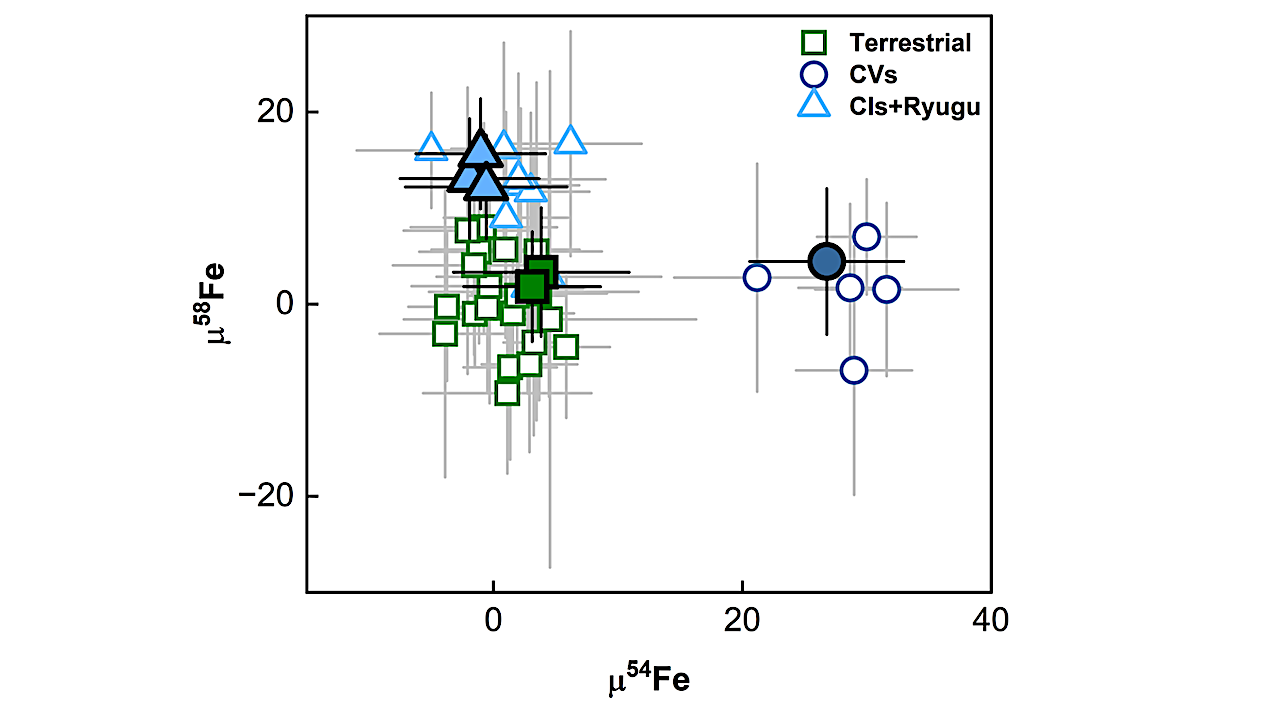
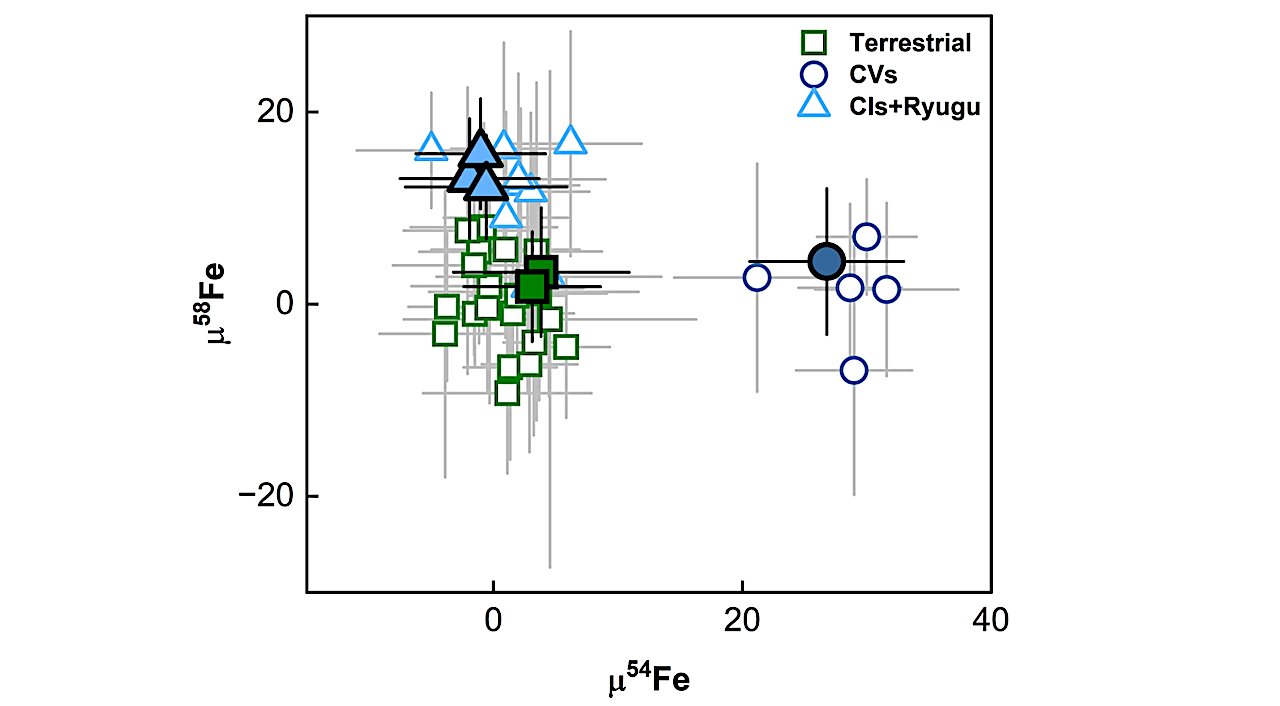
Iron isotopic compositions of CI chondrites, CV chondrites, and terrestrial rocks. The μ 54Fe and μ58Fe data for different sample types (see legend) from this study (solid symbols) together with data from previous works (open symbols) (Table S1). Error bars indicate 95% confidence intervals. CV chondrites have similar μ 58Fe but elevated μ 54Fe compared to terrestrial samples. CI chondrites have similar μ 54Fe but elevated μ 58Fe compared to terrestrial samples. — astro-ph.EP
Understanding the origin of the Earth requires determining the original formation location of its building material.
Based on the similar Fe isotopic composition of Earth’s mantle and Ivuna-type (CI) chondrites, a prior study has argued that Earth formed by accretion of sunward-drifting pebbles from the outer Solar System.
Here, using new high-precision Fe isotopic data, we show however that CI chondrites and Earth’s mantle have distinct Fe isotopic composition when the neutron-rich 58Fe is also considered. This observation rules out that the Fe in Earth’s mantle derives from CI chondrite-like material and demonstrates that Earth did not form by accretion of sunwards-drifting pebbles.
We show that the Fe in Earth’s mantle instead derives from the inner Solar System, and has been partly or wholly delivered by bodies from the innermost disk that remained unsampled among meteorites.
This provenance of terrestrial Fe is consistent with the classical model of Earth’s formation by hierarchical growth among inner Solar System planetesimals and planetary embryos.
Timo Hopp, Shengyu Tian, Thorsten Kleine
Comments: Accepted for publication in Icarus
Subjects: Earth and Planetary Astrophysics (astro-ph.EP)
Cite as: arXiv:2603.21360 [astro-ph.EP] (or arXiv:2603.21360v1 [astro-ph.EP] for this version)
https://doi.org/10.48550/arXiv.2603.21360
Focus to learn more
Submission history
From: Timo Hopp
[v1] Sun, 22 Mar 2026 18:45:05 UTC (415 KB)
https://arxiv.org/abs/2603.21360
Astrobiology, Astrochemistry, Astrogeology,











Related Posts
Stay Informed With the Latest & Most Important News



Advertisement
-
 01Two Black Holes Observed Circling Each Other for the First Time
 -
 02From Polymerization-Enabled Folding and Assembly to Chemical Evolution: Key Processes for Emergence of Functional Polymers in the Origin of Life
 -
 03Astronomy 101: From the Sun and Moon to Wormholes and Warp Drive, Key Theories, Discoveries, and Facts about the Universe (The Adams 101 Series)
 -
 04True Anomaly hires former York Space executive as chief operating officer
 -
 05Φsat-2 begins science phase for AI Earth images
 -
 06Hurricane forecasters are losing 3 key satellites ahead of peak storm season − a meteorologist explains why it matters
 -
 07Binary star systems are complex astronomical objects − a new AI approach could pin down their properties quickly