
Now Reading: Is Jupiter on a diet? New measurements say it’s smaller than we thought
-
01
Is Jupiter on a diet? New measurements say it’s smaller than we thought


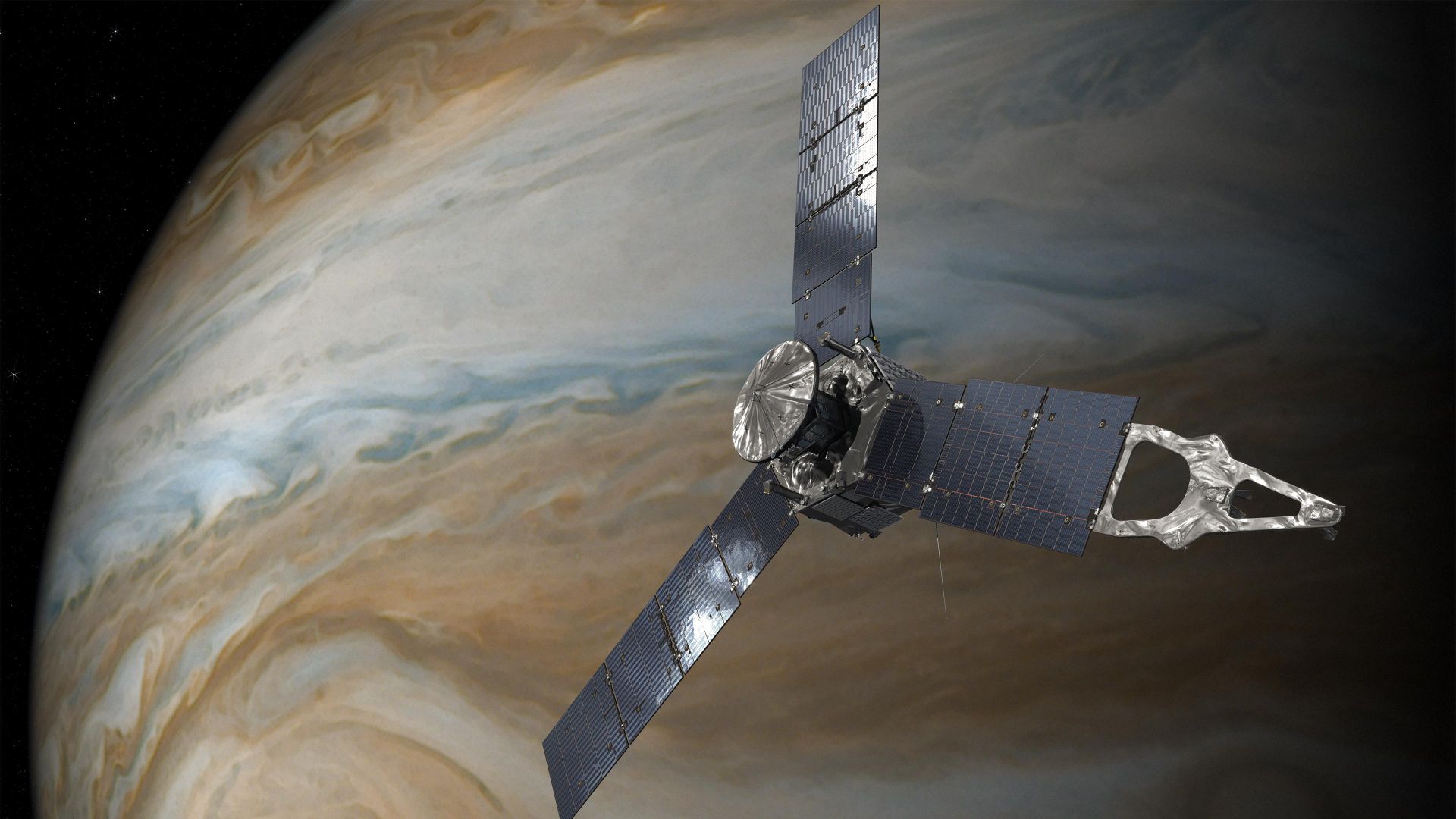
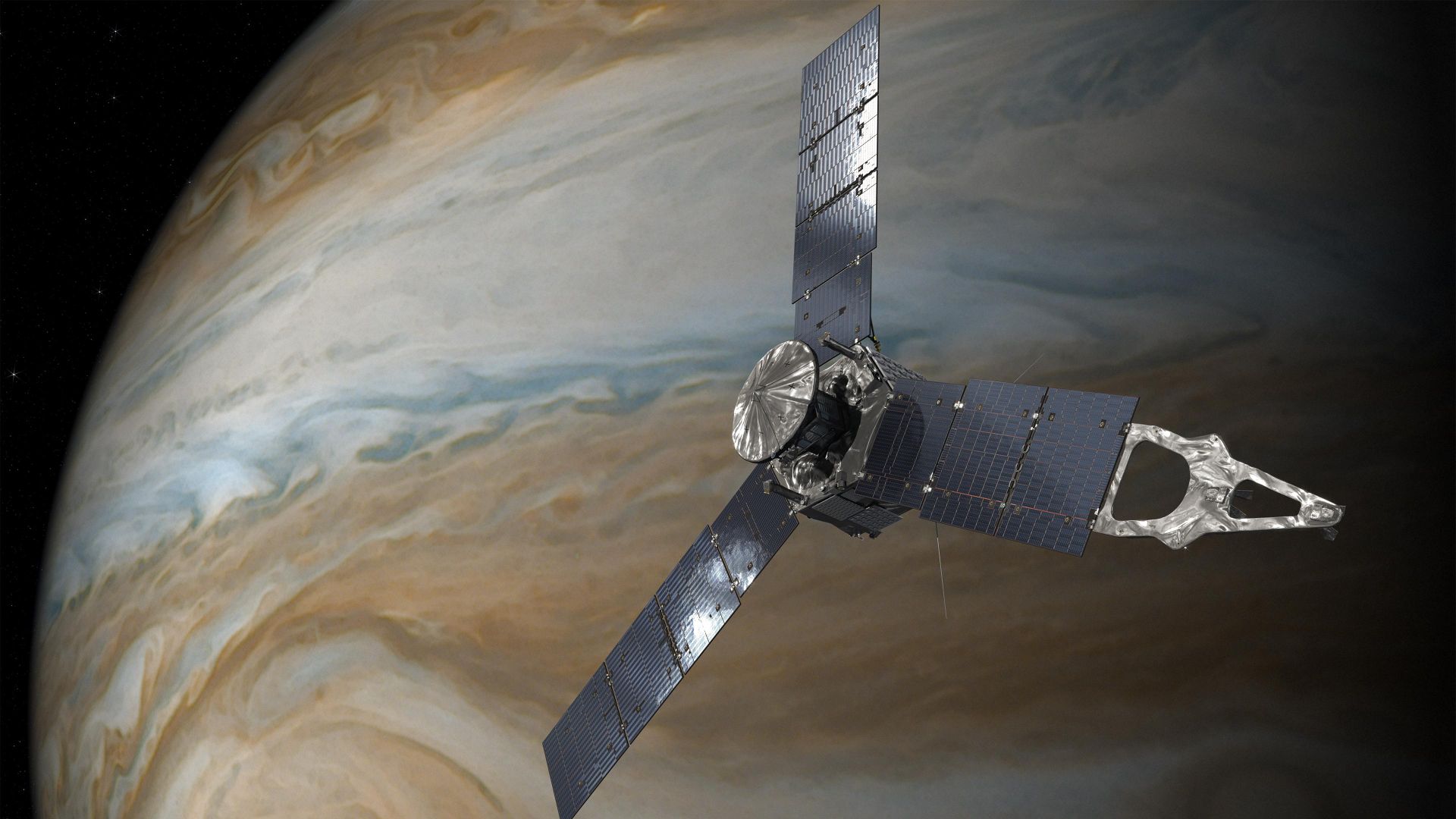
Jupiter has had its length and breadth measured again, and it turns out the giant planet is skinnier and shorter than scientists had thought.
“Textbooks will need to be updated,” said Yohai Kaspi of the Weizmann Institute in Israel in a statement. “The size of Jupiter hasn’t changed, of course, but the way we measure it has.”
The previous measurements had come from NASA’s Pioneer 10 and 11 and Voyager 1 and 2 missions, amounting to just six data points in total, whereas Juno has been able to add another 26 measurements.
Juno has been orbiting Jupiter on an elongated orbit since 2016, but since its mission extension in 2021, Juno has moved onto a different trajectory that gives it close fly-bys of Jupiter’s Galilean moons as well as passes behind Jupiter as seen from Earth, which previously it never did.
The trick to measuring how large a planet like Jupiter is involves the spacecraft passing behind Jupiter from our point of view while beaming radio signals back to Earth. Where the signals are bent by the effect of Jupiter’s upper atmosphere, or cut out completely by the bulk of the planet only to reappear on the opposite limb, tells us how large Jupiter must be.
“We tracked how the radio signals bend as they pass through Jupiter’s atmosphere, which allowed us to translate this information into detailed maps of Jupiter’s temperature and density, producing the clearest picture yet of the giant planet’s shape and size,” said the Weizmann Institute’s Maria Smirnova, who developed the techniques necessary to process the raw Juno data.
And although a few kilometers off here and there doesn’t sound like much, it’s actually quite a big deal for accurately modeling the interior of Jupiter.
“These few kilometers matter,” said Weizmann’s Eli Galanti, who led the research. “Shifting the radius by just a little lets our models of Jupiter’s interior fit both the gravity data and atmospheric measurements much better.”
Indeed, by adjusting Jupiter’s dimensions to those measured by Juno, Galanti’s team found that current state-of-the-art models describing the interior density structure of Jupiter worked even better. And since Jupiter is the gold standard for understanding gas giant planets, the better we know Jupiter, the better astronomers can understand other gas giant planets too — not just in the solar system but also around other stars.
The new measurements of Jupiter are reported in a paper published on Feb. 2 in the journal Nature Astronomy.










Related Posts

Stay Informed With the Latest & Most Important News
Previous Post
Next Post





Advertisement
-
 01Two Black Holes Observed Circling Each Other for the First Time
 -
 02From Polymerization-Enabled Folding and Assembly to Chemical Evolution: Key Processes for Emergence of Functional Polymers in the Origin of Life
 -
 03Astronomy 101: From the Sun and Moon to Wormholes and Warp Drive, Key Theories, Discoveries, and Facts about the Universe (The Adams 101 Series)
 -
 04True Anomaly hires former York Space executive as chief operating officer
 -
 05Φsat-2 begins science phase for AI Earth images
 -
 06Hurricane forecasters are losing 3 key satellites ahead of peak storm season − a meteorologist explains why it matters
 -
 07Binary star systems are complex astronomical objects − a new AI approach could pin down their properties quickly