
Now Reading: Isar Aerospace sets date for second Spectrum launch
-
01
Isar Aerospace sets date for second Spectrum launch


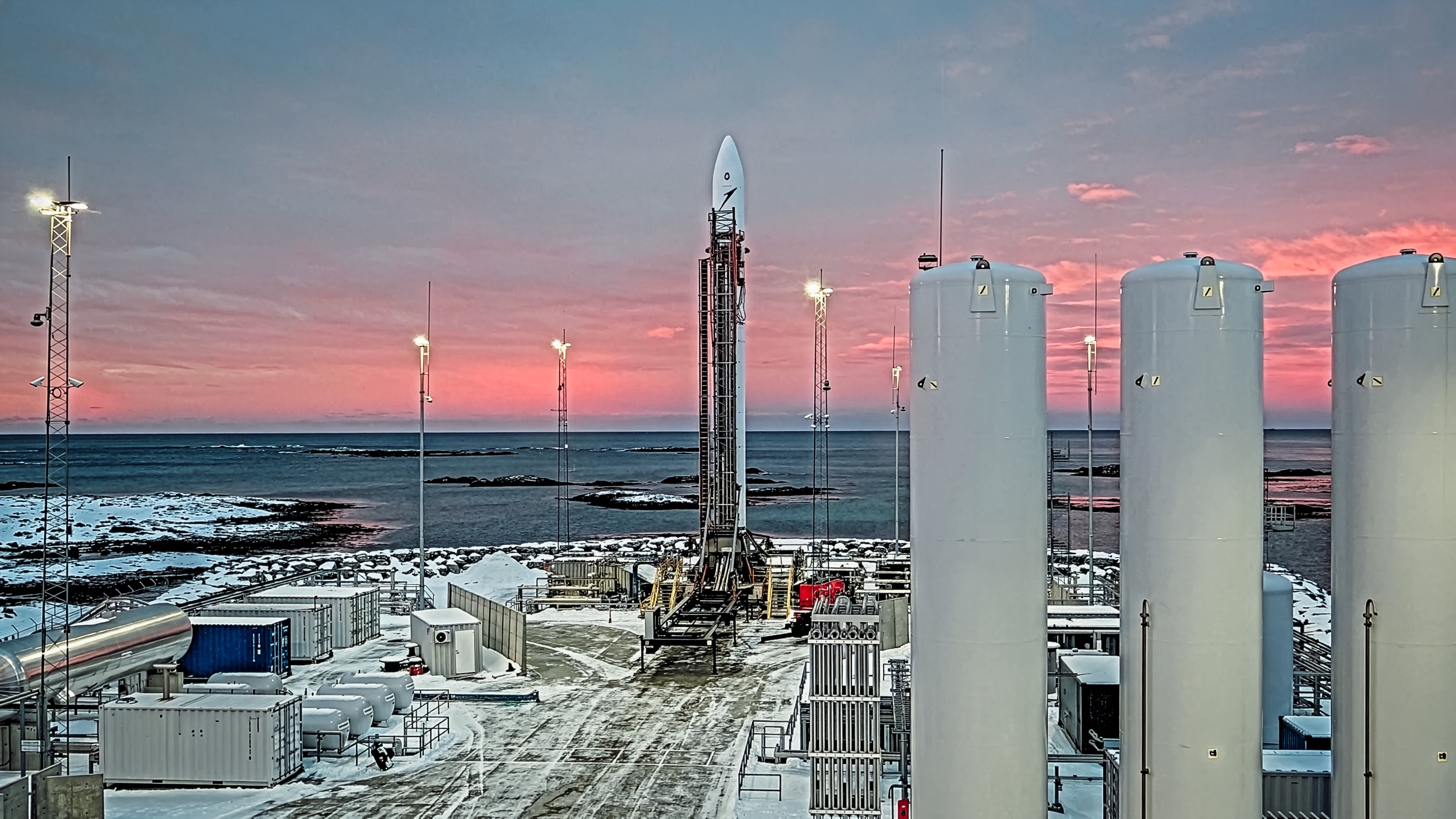

WASHINGTON — German launch company Isar Aerospace is preparing for the second launch of its Spectrum rocket, this time carrying several satellite payloads.
The Munich-based company announced Jan. 16 that it plans to launch Spectrum from Andøya Spaceport in northern Norway no earlier than Jan. 21, with a window opening at 3 p.m. Eastern. The launch window will be open for 15 minutes daily through Jan. 23, according to notices restricting airspace and waters near the launch site.
The launch, called “Onward and Upward” by Isar Aerospace, will be the company’s second orbital launch attempt. Spectrum’s inaugural launch last March malfunctioned shortly after liftoff, with the rocket crashing into waters adjacent to the launch pad.
Unlike the first launch, which carried no customer payloads, this mission will carry five CubeSats from EnduroSat, the Norwegian University of Science and Technology, TU Berlin, TU Wien Space Team and the University of Maribor. It will also carry a hosted payload from Dcubed. The payloads were arranged through the European Space Agency’s Boost! program, which supports microlauncher development.
While the rocket is carrying customer payloads, Isar Aerospace considers the launch a test flight. “The insights we gain with this mission will strengthen Europe’s space infrastructure, a capability essential for defense readiness and economic resilience,” said Alexandre Dalloneau, vice president for mission and launch operations at the company, in a statement.
An investigation into the first launch concluded the vehicle suffered a loss of attitude control because engineers did not properly characterize the rocket’s bending modes at liftoff. A vent valve was also left open at launch, which would have caused additional problems had the flight continued.
At a briefing in September, company officials said they had improved modeling of the rocket and made software changes to ensure vent valves are closed at launch.
“This qualification flight is a deliberate step toward delivering sovereign access to space for Europe and allied nations. Just 10 months after proving that launch vehicles can be designed, built and launched from continental European soil, we’re ready to fly again,” said Daniel Metzler, chief executive of Isar Aerospace.
Isar is the first of a cohort of European launch startups to attempt an orbital launch. It is also one of five companies selected for funding through ESA’s European Launcher Challenge at the agency’s ministerial conference in November. ESA member states committed 205.65 million euros ($238.6 million) for Isar, with Germany providing 176.85 million euros and Norway most of the remainder.
The program is designed to support the development of new European launch systems through contracts for launch services as well as funding for vehicle upgrades. Most of the funding awarded to Isar is for vehicle upgrades.
“Europe’s immediate need for space access is clear. Rapid iteration is essential to developing space capabilities precisely when they are required,” Metzler said.










Related Posts

Stay Informed With the Latest & Most Important News
Previous Post
Next Post





Advertisement
-
 01Two Black Holes Observed Circling Each Other for the First Time
 -
 02From Polymerization-Enabled Folding and Assembly to Chemical Evolution: Key Processes for Emergence of Functional Polymers in the Origin of Life
 -
 03Astronomy 101: From the Sun and Moon to Wormholes and Warp Drive, Key Theories, Discoveries, and Facts about the Universe (The Adams 101 Series)
 -
 04True Anomaly hires former York Space executive as chief operating officer
 -
 05Φsat-2 begins science phase for AI Earth images
 -
 06Hurricane forecasters are losing 3 key satellites ahead of peak storm season − a meteorologist explains why it matters
 -
 07Binary star systems are complex astronomical objects − a new AI approach could pin down their properties quickly