
Now Reading: Isotopic Evidence For A Cold And Distant Origin Of The Interstellar Object 3I/ATLAS
-
01
Isotopic Evidence For A Cold And Distant Origin Of The Interstellar Object 3I/ATLAS

Isotopic Evidence For A Cold And Distant Origin Of The Interstellar Object 3I/ATLAS

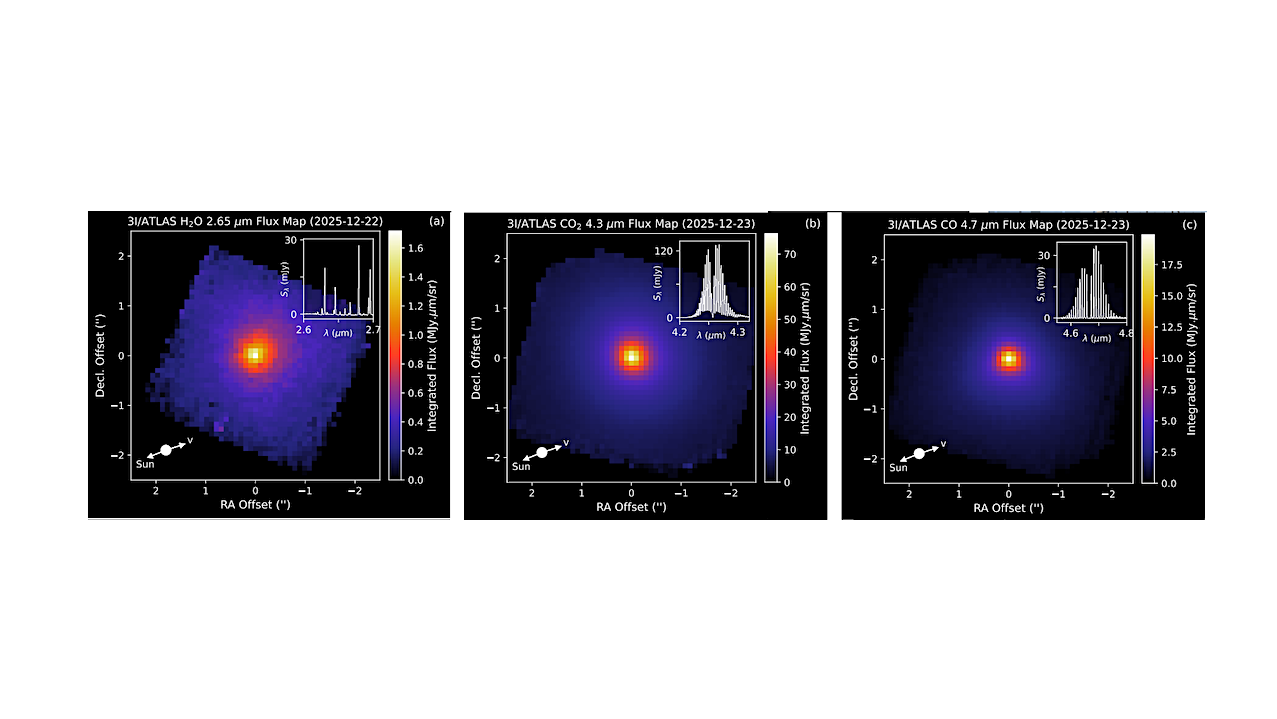
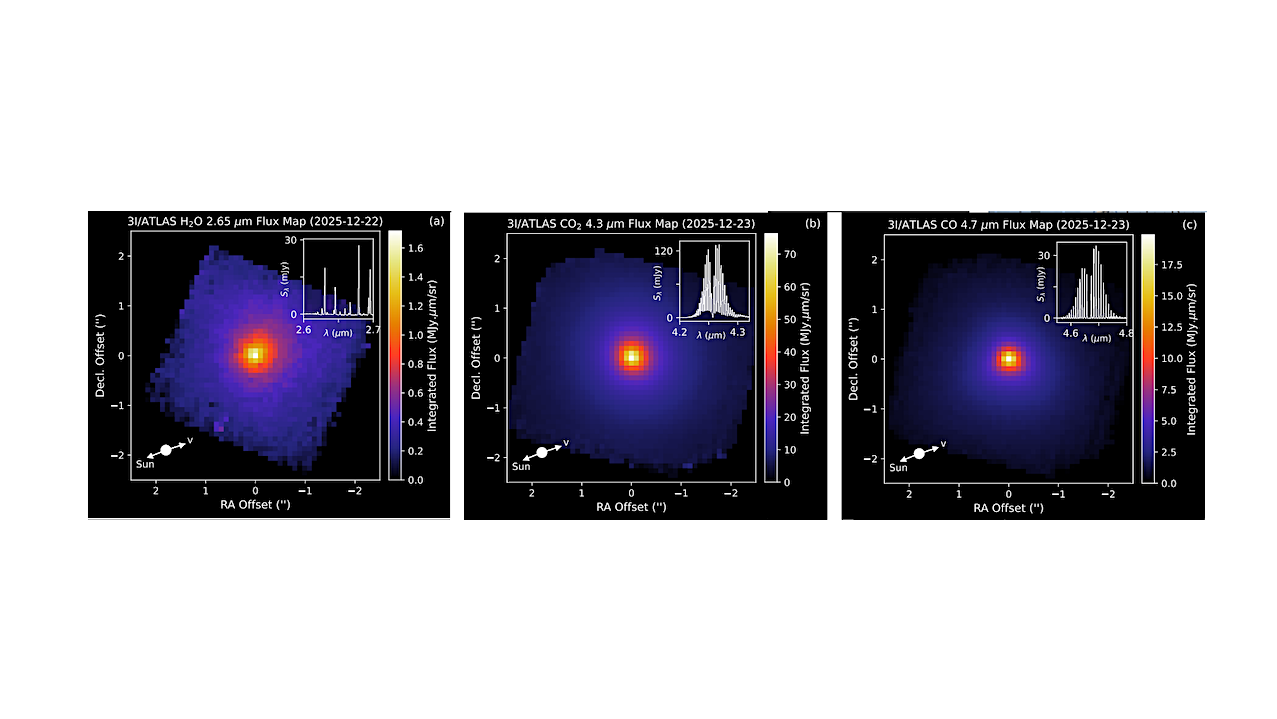
Spectrally integrated line flux maps for 3I/ATLAS observed using JWST NIRSpec: (a) H2O at 2.7 µm, (b) CO2 at 4.3 µm, (c) CO at 4.7 µm. Image axes are aligned with the equatorial (RA/decl.) grid. Molecular emission has been isolated by subtracting a polynomial fit to the adjacent continuum. Spatial coordinates are with respect to the brightest pixel in each map (the pseudo-nucleus). Inset panels (upper right) show the continuum-subtracted spectra within the image integration wavelength range, spatially integrated within a 3′′ diameter circular aperture centered on the pseudo-nucleus (corresponding to 3,900 km at the 1.8 au distance of the comet from the telescope). Lower left corner shows the direction of the (sky-projected) comet-Sun (S) and nucleus velocity (v) vectors. — astro-ph.EP
Interstellar objects provide the only directly observable samples of icy planetesimals formed around other stars, and can therefore provide insight into the diversity of physical and chemical conditions occurring during exoplanet formation.
Here we report isotopic measurements of the interstellar comet 3I/ATLAS, which reveal an elemental composition unlike any Solar System body. The water in 3I/ATLAS is enriched in deuterium, at a level of D/H = (0.95 +- 0.06)%, which is more than an order of magnitude higher than in known comets, while its range of 12C/13C ratios (141-191 for CO2 and 123-172 for CO) exceeds typical values found in the Solar System, as well as nearby interstellar clouds and protoplanetary disks.
Such extreme isotopic signatures indicate formation at temperatures ≲30 K in a relatively metal-poor environment, early in the history of the Galaxy. When interpreted with respect to models for Galactic chemical evolution, the carbon isotopic composition implies that 3I/ATLAS accreted roughly 10-12 billion years ago, following an early period of intense star formation.
3I/ATLAS thus represents a preserved fragment of an ancient planetary system, and provides direct evidence for active ice chemistry and volatile-rich planetesimal formation in the young Milky Way.
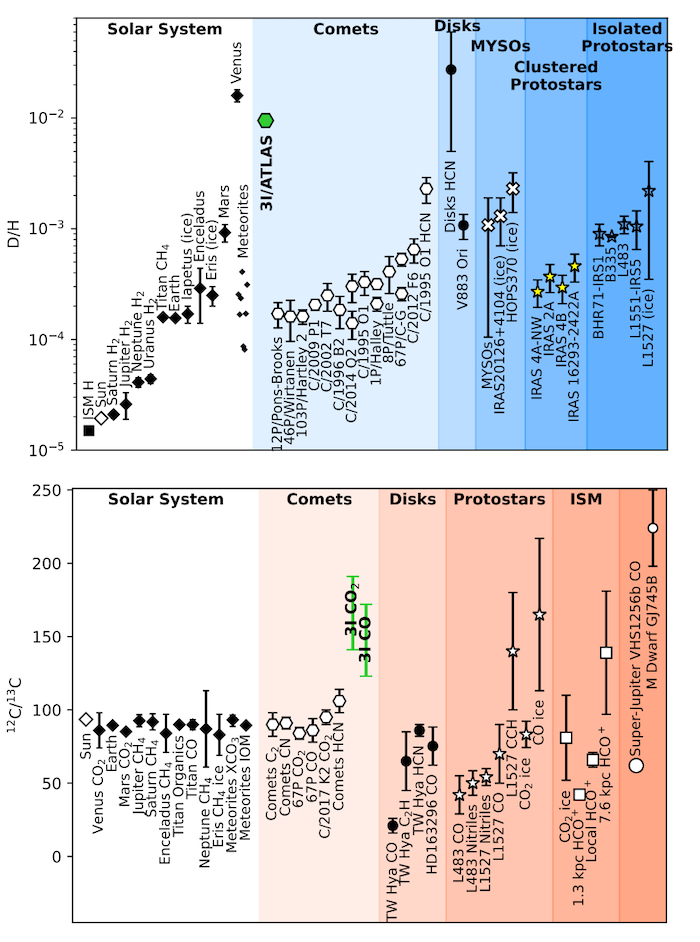
Isotopic ratios observed in the coma of 3I/ATLAS compared with Galactic and Solar System observations for D/H (top) and 12C/13C (bottom). Data are from the compilation of Nomura et al. (2023), with additional D/H values for V883 Ori (gas-phase; Tobin et al. 2023), and IRAS20126+4104, HOPS370 and L1527 (ice-phase; Slavicinska et al. 2024, 2025). D/H data are for H2O unless otherwise specified. The “disks HCN” data represent the mean and range of observed D/H values across five protoplanetary disks. For 12C/13C, the meteoritic “XCO3” and “IOM” data are the mean values (and ranges) for carbonates and insoluble organic matter, respectively, in carbonaceous chondrites (Alexander et al. 2007, 2010, 2015); the TW Hya and HD 163296 values for CO are from Yoshida et al. (2022); Qi et al. (2026); protostellar ice CO and CO2 are the mean values from Brunken et al. (2024); interstellar CO2 ice is the average (and range) of values from Boogert et al. (2015); interstellar HCO+ values for three Galactocentric distances are from Luo et al. (2024); super-Jupiter exoplanet CO data are from Gandhi et al. (2023); M dwarf GJ745 data are from Crossfield et al. (2019). Error bars are 1σ unless otherwise specified. — astro-ph.EP
Martin Cordiner, Nathan X. Roth, Marco Micheli, Geronimo Villanueva, Davide Farnocchia, Steven Charnley, Nicolas Biver, Dominique Bockelee-Morvan, Dennis Bodewits, Colin Orion Chandler, Jacques Crovisier, Maria N. Drozdovskaya, Kenji Furuya, Michael S. P. Kelley, Stefanie Milam, John W. Noonan, Cyrielle Opitom, Megan E. Schwamb, Cristina A. Thomas
Comments: In Review at Nature; March 6th 2026
Subjects: Earth and Planetary Astrophysics (astro-ph.EP); Astrophysics of Galaxies (astro-ph.GA)
Cite as: arXiv:2603.06911 [astro-ph.EP] (or arXiv:2603.06911v1 [astro-ph.EP] for this version)
https://doi.org/10.48550/arXiv.2603.06911
Focus to learn more
Related DOI:
https://doi.org/10.21203/rs.3.rs-8930056/v1
Focus to learn more
Submission history
From: Martin Cordiner PhD
[v1] Fri, 6 Mar 2026 22:16:58 UTC (452 KB)
https://arxiv.org/abs/2603.06911
Astrobiology, Astrochemistry,










Related Posts
Stay Informed With the Latest & Most Important News
Previous Post
Next Post


Advertisement
-
 01Two Black Holes Observed Circling Each Other for the First Time
 -
 02From Polymerization-Enabled Folding and Assembly to Chemical Evolution: Key Processes for Emergence of Functional Polymers in the Origin of Life
 -
 03Astronomy 101: From the Sun and Moon to Wormholes and Warp Drive, Key Theories, Discoveries, and Facts about the Universe (The Adams 101 Series)
 -
 04True Anomaly hires former York Space executive as chief operating officer
 -
 05Φsat-2 begins science phase for AI Earth images
 -
 06Hurricane forecasters are losing 3 key satellites ahead of peak storm season − a meteorologist explains why it matters
 -
 07Binary star systems are complex astronomical objects − a new AI approach could pin down their properties quickly