
Now Reading: Isotopomer-Specific Carbon Isotope Ratio of Complex Organic Molecules in Star-Forming Cores
-
01
Isotopomer-Specific Carbon Isotope Ratio of Complex Organic Molecules in Star-Forming Cores

Isotopomer-Specific Carbon Isotope Ratio of Complex Organic Molecules in Star-Forming Cores

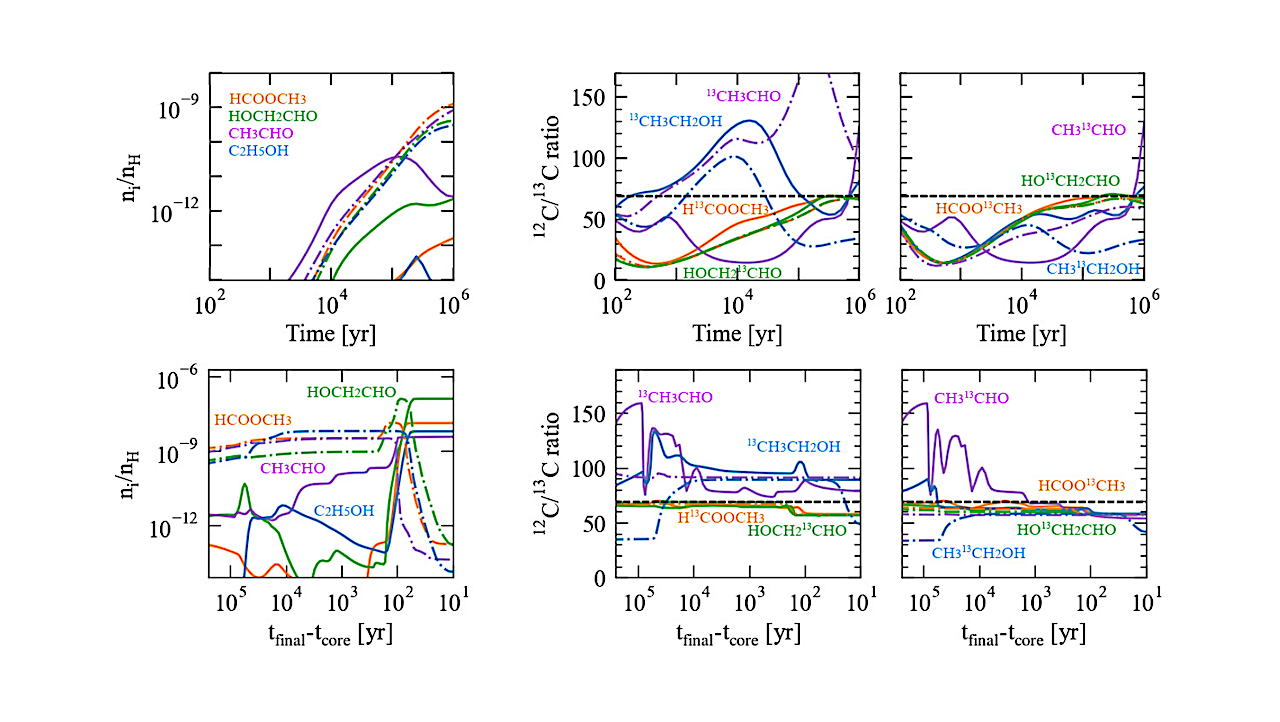
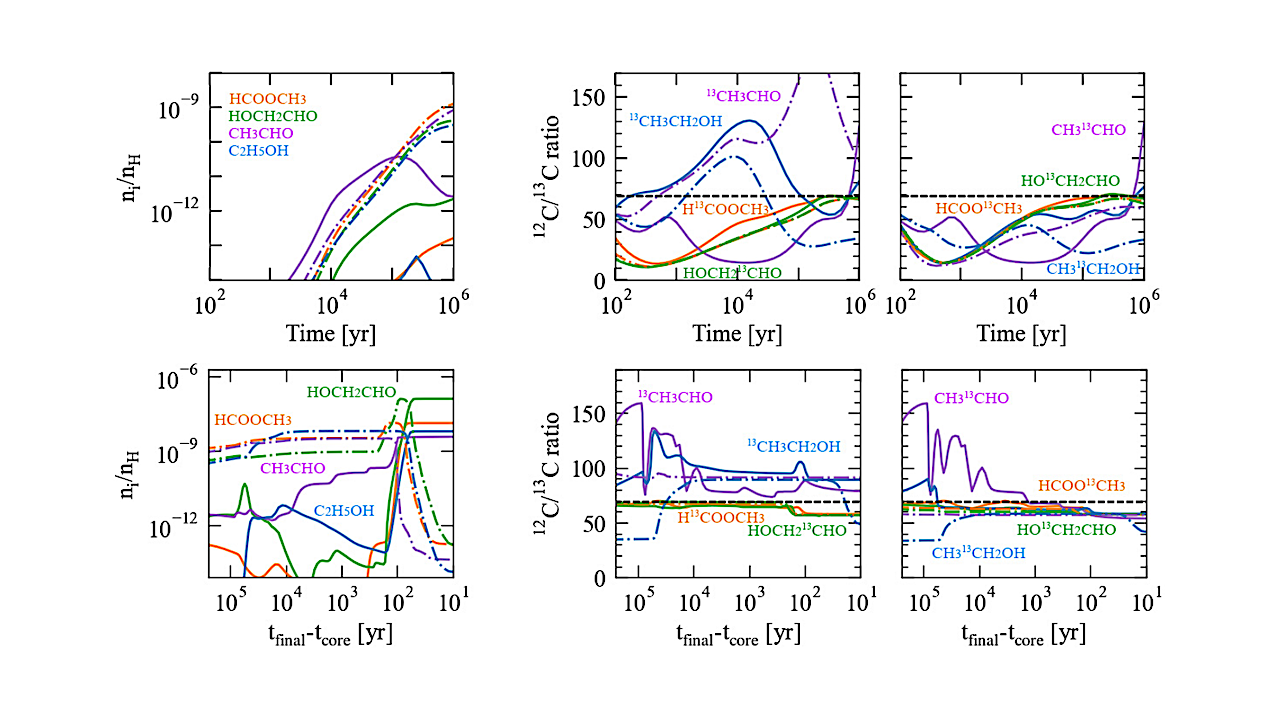
Temporal variation of the abundances (left panels) and 12C/13C ratios (middle and right panels) of selected COMs in the gas phase (solid lines) and in the bulk (surface + mantle) ice (dash-dotted lines) during the static phase (upper panels) and the collapse phase (lower panels). The middle panels show 12C/13C ratios for H13COOCH3, HOCH2 13CHO, 13CH3CHO, and 13CH3CH2OH, while the right panels show those for HCOO13CH3, HO13CH2CHO, CH3 13CHO, and CH3 13CH2OH. The vertical axis is shared between the middle and right panels, and the horizontal black dashed line represents the elemental 12C/13C ratio. — astro-ph.GA
Recent high-resolution and sensitivity ALMA observations have unveiled the carbon isotope ratios (12C/13C) of Complex Organic Molecules (COMs) in a low-mass protostellar source.
To understand the 12C/13C ratios of COMs, we investigated the carbon isotope fractionation of COMs from prestellar cores to protostellar cores with a gas-grain chemical network model.
We confirmed that the 12C/13C ratios of small molecules are bimodal in the prestellar phase: CO and species formed from CO (e.g., CH3OH) are slightly enriched in 13C compared to the local ISM (by ∼ 10 %), while those from C and C+ are depleted in 13C owing to isotope exchange reactions. COMs are mainly formed on the grain surface and in the hot gas (> 100 K) in the protostellar phase. The 12C/13C ratios of COMs depend on which molecules the COMs are formed from.
In our base model, some COMs in the hot gas are depleted in 13C compared to the observations. Thus, We additionally incorporate reactions between gaseous atomic C and H2O ice or CO ice on the grain surface to form H2CO ice or C2O ice, as suggested by recent laboratory studies.
The direct C-atom addition reactions open pathways to form 13C-enriched COMs from atomic C and CO ice. We find that these direct C-atom addition reactions mitigate 13C-depletion of COMs, and the model with the direct C-atom addition reactions better reproduces the observations than our base model. We also discuss the impact of the cosmic ray ionization rate on the 12C/13C ratio of COMs.
Ryota Ichimura, Hideko Nomura, Kenji Furuya, Tetsuya Hama, T. J. Millar
Subjects: Astrophysics of Galaxies (astro-ph.GA); Solar and Stellar Astrophysics (astro-ph.SR)
Report number: No.: sp-2025-00180e
Cite as: arXiv:2512.10516 [astro-ph.GA] (or arXiv:2512.10516v1 [astro-ph.GA] for this version)
https://doi.org/10.48550/arXiv.2512.10516
Focus to learn more
Related DOI:
https://doi.org/10.1021/acsearthspacechem.5c00180
Focus to learn more
Submission history
From: Ryota Ichimura
[v1] Thu, 11 Dec 2025 10:38:09 UTC (1,310 KB)
https://arxiv.org/abs/2512.10516
Astrobiology, Astrochemistry,











Related Posts
Stay Informed With the Latest & Most Important News
Previous Post
Next Post


Advertisement
-
 01Two Black Holes Observed Circling Each Other for the First Time
 -
 02From Polymerization-Enabled Folding and Assembly to Chemical Evolution: Key Processes for Emergence of Functional Polymers in the Origin of Life
 -
 03Astronomy 101: From the Sun and Moon to Wormholes and Warp Drive, Key Theories, Discoveries, and Facts about the Universe (The Adams 101 Series)
 -
 04True Anomaly hires former York Space executive as chief operating officer
 -
 05Φsat-2 begins science phase for AI Earth images
 -
 06Hurricane forecasters are losing 3 key satellites ahead of peak storm season − a meteorologist explains why it matters
 -
 07Binary star systems are complex astronomical objects − a new AI approach could pin down their properties quickly