
Now Reading: ISS astronaut snaps stunning nighttime photo of Florida and Cuba | Space photo of the day for Dec. 29, 2025
-
01
ISS astronaut snaps stunning nighttime photo of Florida and Cuba | Space photo of the day for Dec. 29, 2025

ISS astronaut snaps stunning nighttime photo of Florida and Cuba | Space photo of the day for Dec. 29, 2025

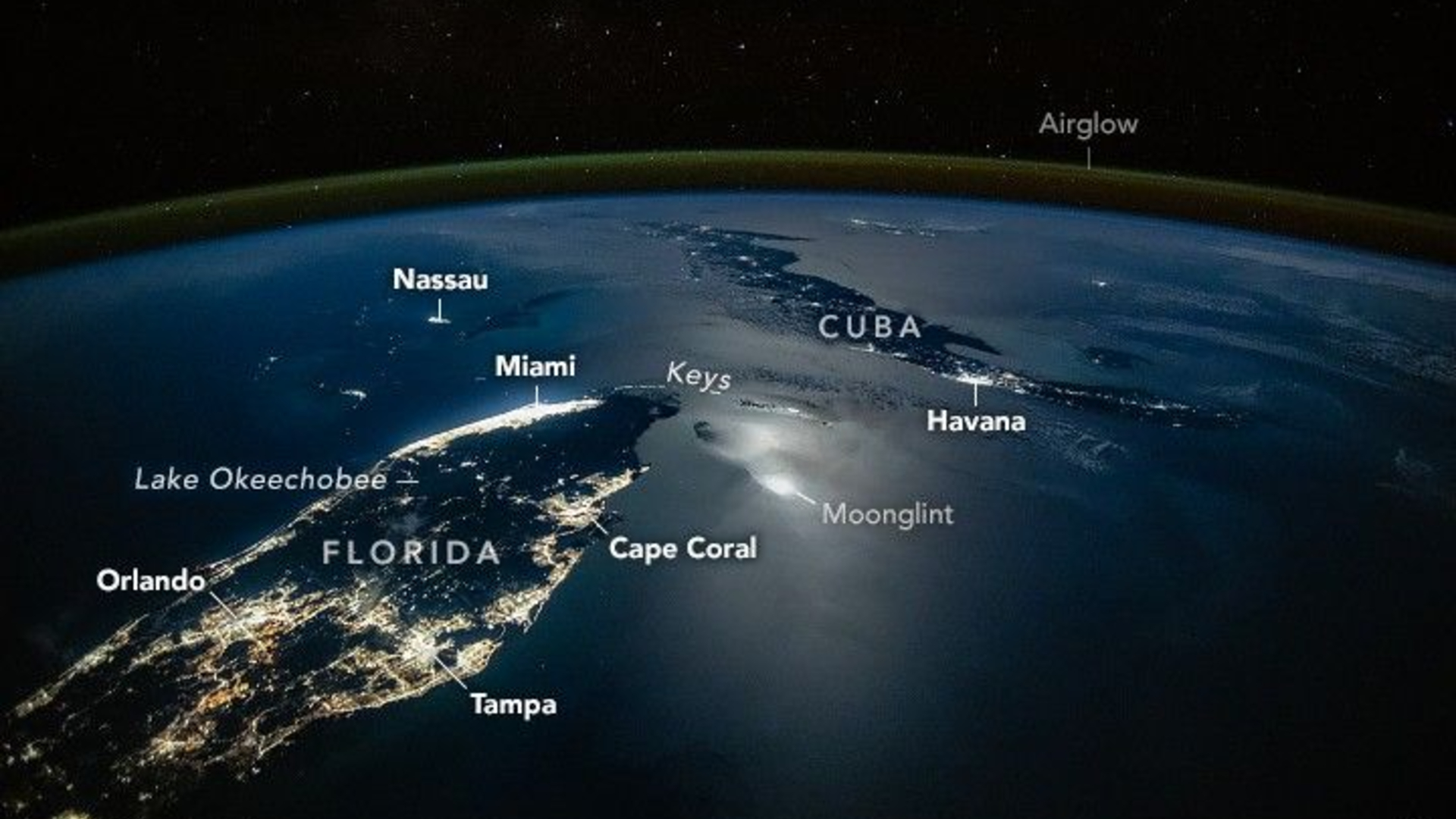
At 2:23 am Eastern time on March 19, 2025, an astronaut aboard the International Space station (ISS) captured a striking nighttime view of Earth, where shimmering moonlight dances across dark ocean waters while clusters of city lights outline the Florida Peninsula, the Caribbean, and parts of Central America.
Dense clusters of illumination trace major population centers, including the bright corridor from Miami to Fort Lauderdale along Florida’s southeastern coast, the Tampa–St. Petersburg area on the Gulf Coast, and the Orlando metropolitan region near the center of the peninsula. Smaller but still discernible patterns of light mark the Florida Keys, Nassau in the Bahamas, and Havana and other cities across Cuba.
What is it?
Besides the stunning city lights, what sets this image apart is the presence of moonglint, the nighttime counterpart to sunglint. Much like sunlight reflecting off the ocean’s surface during the day, moonglint occurs when moonlight reflects off water at just the right angle to reach the observer.
In this case, the observer was a crewmember on the ISS, orbiting hundreds of miles above Earth. At the time, the moon was in a waning phase and about 78% illuminated, bright enough to produce a concentrated reflection across the sea, especially near the Florida Keys and Cuba.
The photograph was taken using a Nikon Z9 digital camera with a 28-millimeter lens, giving a wide field of view similar to that of the human eye. This perspective allows viewers to appreciate the curvature of the planet, accentuated by a thin, faint green layer of airglow along the horizon, a reminder of Earth’s atmosphere glowing softly against the darkness of space.
Where is it?
This photo was taken aboard the ISS, around 248 miles (400 kilometers) above Earth.

Why is it amazing?
Nighttime images of Earth reveal patterns of human settlement, infrastructure, and land use that are difficult to capture during the day. Scientists use such observations to study urban growth, energy consumption, and light pollution, while also tracking how human activity intersects with natural environments.
The appearance of moonglint is especially valuable for researchers. Reflections of moonlight off the ocean can help scientists study sea-surface conditions, such as roughness and wave patterns, even at night. When combined with other data sources, these observations improve understanding of ocean–atmosphere interactions and refine models used in climate and environmental research.
Want to learn more?
You can learn more about airglow and the International Space Station










Related Posts


Stay Informed With the Latest & Most Important News
Previous Post
Next Post

Advertisement
-
 01Two Black Holes Observed Circling Each Other for the First Time
 -
 02From Polymerization-Enabled Folding and Assembly to Chemical Evolution: Key Processes for Emergence of Functional Polymers in the Origin of Life
 -
 03Astronomy 101: From the Sun and Moon to Wormholes and Warp Drive, Key Theories, Discoveries, and Facts about the Universe (The Adams 101 Series)
 -
 04True Anomaly hires former York Space executive as chief operating officer
 -
 05Φsat-2 begins science phase for AI Earth images
 -
 06Hurricane forecasters are losing 3 key satellites ahead of peak storm season − a meteorologist explains why it matters
 -
 07Binary star systems are complex astronomical objects − a new AI approach could pin down their properties quickly