
Now Reading: ISS astronauts take out the space trash | Space photo of the day for March 11, 2026
-
01
ISS astronauts take out the space trash | Space photo of the day for March 11, 2026


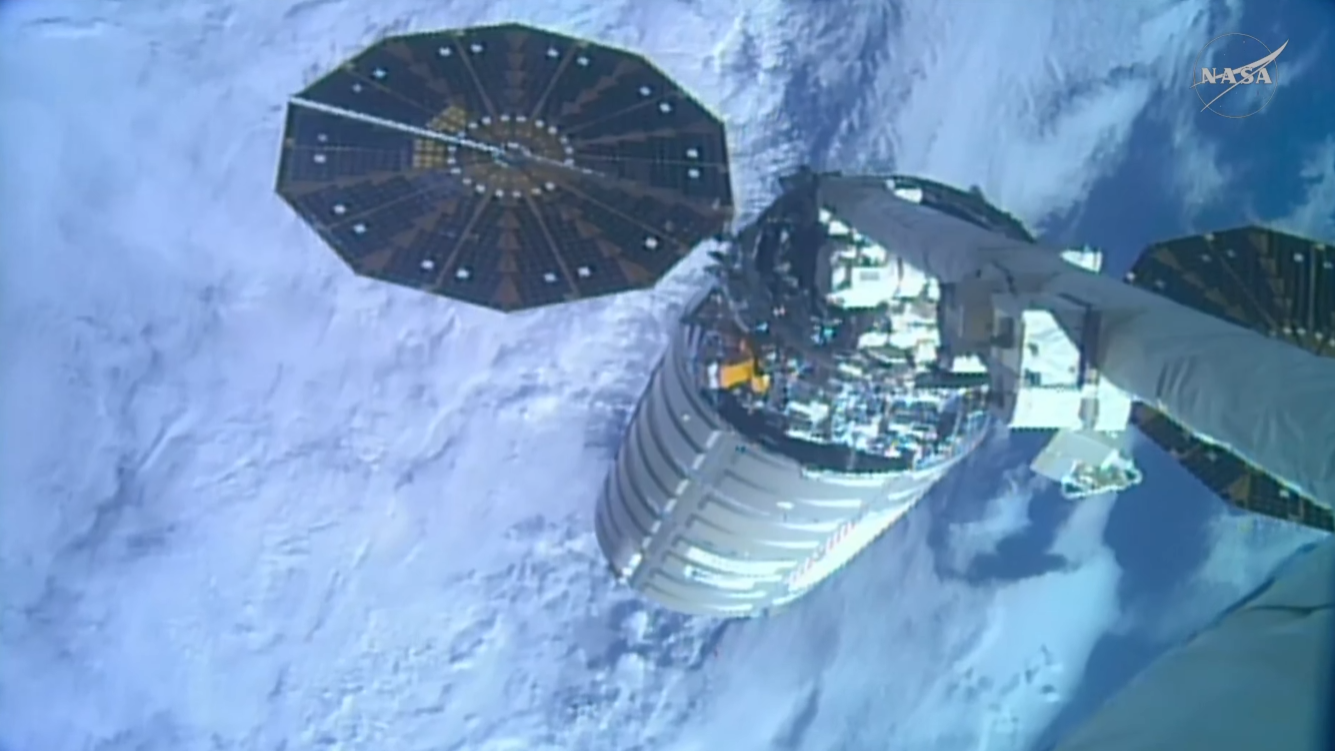

A new extra-large spacecraft loaded with garbage prepares to meet its fiery demise in Earth’s atmosphere in this shot from the International Space Station.
What is it?
In this screenshot from one of the live cameras aboard the International Space Station (ISS), the new Northrop Grumman Cygnus XL freighter is being jettisoned away from the station.
Cygnus XL arrived at the ISS on Sept. 18, 2025, carrying around 11,000 pounds (4,990 kilograms) of supplies to the astronauts aboard the station, making it the largest-ever cargo spacecraft to arrive at the orbital laboratory.
Article continues below
After docking at the station for seven months, Cygnus XL was released from its berth on the Earth-facing port of the ISS’s Unity module on Thursday (March 12) while over the south Atlantic Ocean. It will now deorbit into Earth’s atmosphere and burn up, carrying thousands of pounds of garbage produced on the ISS, according to NASA.
Why is it amazing?
Images like this one are a reminder of the mind-boggling technological achievement that is the International Space Station.
The ISS measures around 356 feet (109 meters) end-to-end and weighs close 925,000 pounds (420 metric tons) and orbits Earth at a speed of 17,500 mph (28,000 km/h), or about 4.8 miles per second (7.7 km/s) — all while 260 miles (420 km) above the surface of Earth.
Even at such an altitude and orbital velocity, cargo spacecraft like Cygnus XL — not to mention crewed spacecraft like SpaceX’s Crew Dragon — routinely launch from the surface and dock with the orbital laboratory.
The ISS is currently scheduled to be deorbited into a spacecraft graveyard in the Pacific Ocean around 2030, although some U.S. lawmakers would like to see its operations extended to 2032 while commercial replacements are still being developed.










Related Posts
Stay Informed With the Latest & Most Important News
Previous Post
Next Post



Advertisement
-
 01Two Black Holes Observed Circling Each Other for the First Time
 -
 02From Polymerization-Enabled Folding and Assembly to Chemical Evolution: Key Processes for Emergence of Functional Polymers in the Origin of Life
 -
 03Astronomy 101: From the Sun and Moon to Wormholes and Warp Drive, Key Theories, Discoveries, and Facts about the Universe (The Adams 101 Series)
 -
 04True Anomaly hires former York Space executive as chief operating officer
 -
 05Φsat-2 begins science phase for AI Earth images
 -
 06Hurricane forecasters are losing 3 key satellites ahead of peak storm season − a meteorologist explains why it matters
 -
 07Binary star systems are complex astronomical objects − a new AI approach could pin down their properties quickly