
Now Reading: Italy’s Argotec plans to scale Florida satellite facility to meet rising US demand
-
01
Italy’s Argotec plans to scale Florida satellite facility to meet rising US demand


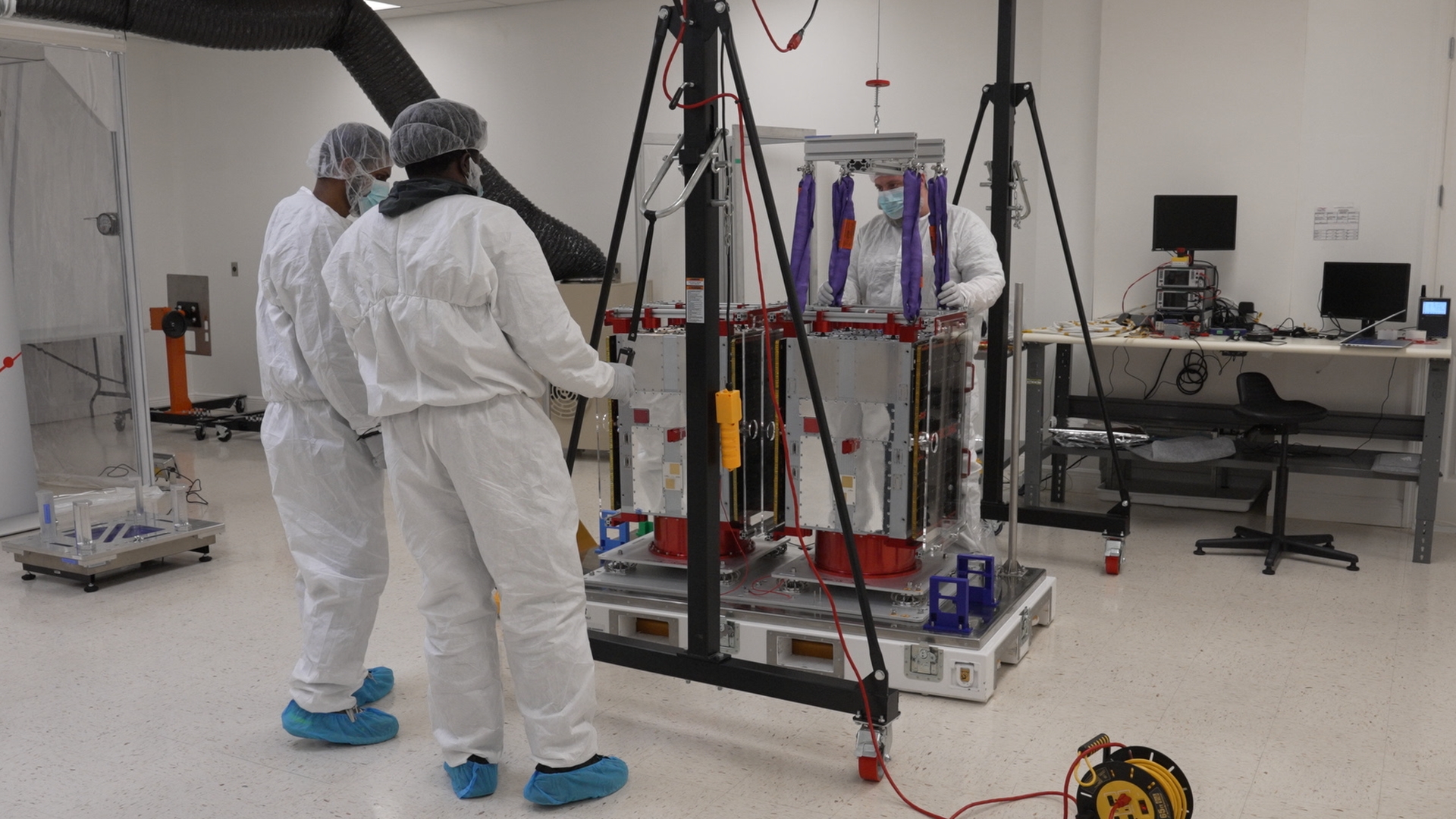

TAMPA, Fla. — Italy’s Argotec has officially opened its first U.S. satellite production facility, cementing a foothold near Kennedy Space Center in Florida to join other foreign space firms pursuing growing demand from American programs.
The company vowed to triple its U.S. staff of about 20 in two years during the April 2 inauguration, as part of a more than $25 million investment that builds on a workforce of about 300 across Italy, Germany and the United States.
The 465-square-meter facility is designed to enable the assembly and integration of more than 10 of Argotec’s highly elliptical orbit (HEO) small satellites simultaneously, with future capacity to produce one spacecraft per month based on its recently announced modular Hawk Plus platform.
“The U.S. is heavily investing in expanding our space efforts,” Argotec U.S general manager Corbett Hoenninger told SpaceNews, “both in NASA and U.S. Defense.”
Hoenninger pointed to NASA’s evolving focus beyond exploration toward sustained lunar activityfollowing the recent launch of Artemis 2, alongside the government’s proposed Golden Dome missile defense initiative, as drivers of demand for space-based communications and observation infrastructure.
“To meet this need the U.S. will require many reliable suppliers who can not only deliver on time but have a record of 100% success,” he said.
Increasing U.S. exposure
Argotec began initial operations at the Florida facility in June when it processed its first HEO satellite for IRIDE, an Italian government-backed Earth observation constellation funded through post-pandemic recovery programs.
While IRIDE is intended to strengthen Italy’s domestic space industry, fueling and other final satellite processing work is carried out in Florida ahead of launch from the Space Coast.
Argotec is building its share of IRIDE in Turin, Italy, at the 17,000-square-meter SpacePark facility it opened in 2024, before shipping those satellites to Florida.
Eight IRIDE satellites from Argotec are already in orbit and the company is currently working through seven more, with another batch of 10 expected to be processed and launched by the end of 2026.
Other Italian companies involved in IRIDE include Thales Alenia Space, OHB Italia, Sitael and D-Orbit.
Hoenninger said Argotec’s new facility is also supporting its first and currently only direct U.S. customer mission, MiniCOR (Miniature Coronagraph), which is scheduled for critical design review this month.
Argotec is providing the satellite platform for MiniCOR to host a miniaturized coronagraph, developed by Johns Hopkins University’s Applied Physics Laboratory (APL), that would observe the sun’s corona.
“The purpose is to show that valuable science can be collected using miniature versions of large sensors and thereby reducing the costs from billions of dollars to around $10 million,” Hoenninger said.
Modular production push
Building on the heritage of satellites developed for IRIDE, Argotec says its Hawk Plus platform will be central to its strategy in both Europe and the United States, with production planned in both regions.
“Hawk Plus is a game changer due to its modularity and flexibility,” Hoenninger said.
While satellite platforms are increasingly standardized, sensors and propulsion systems typically vary by mission.
The Hawk Plus platform uses modular panels that enable suppliers to integrate components directly before final assembly, reducing the need for redesign.
“This flexibility helps us reduce the time from contract award to spacecraft delivery from years to months,” Hoenninger said.
U.K.-based Space Forge also recently set up operations near Kennedy Space Center to develop semiconductor manufacturing capabilities leveraging space-based production.
Last year, India’s Bellatrix Aerospace announced plans to establish a U.S. footprint to improve access to government demand and launch infrastructure.










Related Posts

Stay Informed With the Latest & Most Important News
Previous Post
Next Post


Advertisement
-
 01Two Black Holes Observed Circling Each Other for the First Time
 -
 02From Polymerization-Enabled Folding and Assembly to Chemical Evolution: Key Processes for Emergence of Functional Polymers in the Origin of Life
 -
 03Astronomy 101: From the Sun and Moon to Wormholes and Warp Drive, Key Theories, Discoveries, and Facts about the Universe (The Adams 101 Series)
 -
 04True Anomaly hires former York Space executive as chief operating officer
 -
 05Φsat-2 begins science phase for AI Earth images
 -
 06Hurricane forecasters are losing 3 key satellites ahead of peak storm season − a meteorologist explains why it matters
 -
 07Binary star systems are complex astronomical objects − a new AI approach could pin down their properties quickly