
Now Reading: James Webb Space Telescope directly studies an exoplanet’s surface for the 1st time: ‘We see a dark, hot, barren rock’
-
01
James Webb Space Telescope directly studies an exoplanet’s surface for the 1st time: ‘We see a dark, hot, barren rock’

James Webb Space Telescope directly studies an exoplanet’s surface for the 1st time: ‘We see a dark, hot, barren rock’

Astronomers using the James Webb Space Telescope have, for the first time, directly analyzed the surface of a planet beyond our solar system,
The James Webb Space Telescope’s (JWST) exoplanet subject, LHS 3844 b, is a so-called “super-Earth” about 30% larger than our planet and located nearly 50 light-years away. Unlike most exoplanet studies, which focus on atmospheres, astronomers analyzed heat emitted from this planet’s surface.
“Thanks to the amazing sensitivity of JWST, we can detect light coming directly from the surface of this distant rocky planet,” Laura Kreidberg of the Max Planck Institute for Astronomy in Germany, who served as the principal investigator of the JWST observations, said in a statement. “We see a dark, hot, barren rock, devoid of any atmosphere.”
Discovered in 2019, LHS 3844 b orbits a cool red dwarf star in just 11 hours and is tidally locked, meaning one side constantly faces the star while the other remains in darkness. The dayside reaches temperatures of about 1,340 degrees Fahrenheit (725 degrees Celsius), the scientists say.
In 2023 and 2024, Kreidberg and her team observed three secondary eclipses, when the planet moved behind its star. Using the JWST’s Mid-Infrared Instrument (MIRI), they measured the infrared light emitted from the planet’s intensely hot dayside and used it to study its surface.
By comparing the signal with known rocks and minerals from Earth, the moon and Mars, the team ruled out an Earth-like crust rich in silica and granite. Such crusts typically form through water-driven geological processes and plate tectonics, which recycle rock and allow lighter minerals to rise to the surface, the study notes.
Instead, the data point to a surface dominated by basalt, a dark volcanic rock rich in iron and magnesium commonly found on the moon and Mercury, the researchers say.
“This planet likely only contains little water,” study lead author Sebastian Zieba of the Center for Astrophysics, Harvard & Smithsonian in Massachusetts said in the statement.
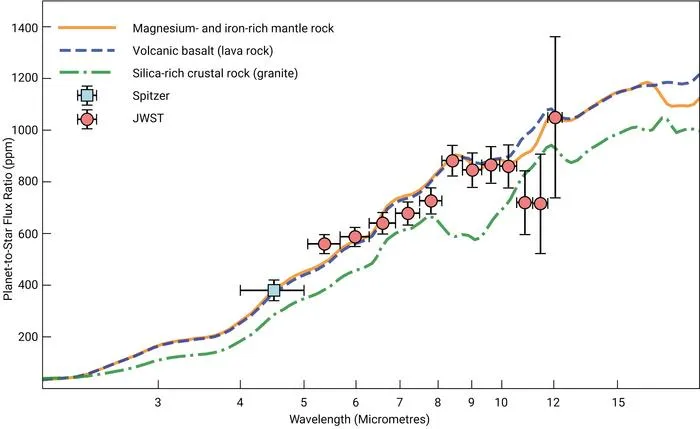
One possible explanation, the researchers say, is that LHS 3844 b has a relatively young surface shaped by recent volcanic activity, where fresh lava has not yet been broken down by micrometeorite impacts. However, such activity is known to release gases such as carbon dioxide or sulfur dioxide, which were not detected by MIRI, the study notes.
“If present on LHS 3844 b in reasonable amounts, MIRI should have detected it,” the statement read. “Still, it found nothing.”
Alternatively, the planet may be covered in a thick layer of dark, fine-grained material formed over long periods by radiation and meteorite impacts, similar to the moon or Mercury. Without an atmosphere, the surface would be especially vulnerable to this process, known as space weathering, which gradually breaks down and darkens rock.
“This alternative relies on longer periods of geological inactivity, thereby requiring conditions opposite to the first scenario,” the statement read.
Follow-up JWST observations are planned to further refine the planet’s surface properties and determine whether it is solid rock or loose, weathered material, the study notes.
“We are confident the same technique will allow us to clarify the nature of LHS 3844 b’s crust and, in the future, other rocky exoplanets,” Kreidberg said in the same statement.
A study about these results was published Monday (May 4) in the journal Nature Astronomy,










Related Posts


Stay Informed With the Latest & Most Important News
Previous Post
Next Post
Previous Post
Next Post


Advertisement
-
 01Two Black Holes Observed Circling Each Other for the First Time
 -
 02From Polymerization-Enabled Folding and Assembly to Chemical Evolution: Key Processes for Emergence of Functional Polymers in the Origin of Life
 -
 03Astronomy 101: From the Sun and Moon to Wormholes and Warp Drive, Key Theories, Discoveries, and Facts about the Universe (The Adams 101 Series)
 -
 04True Anomaly hires former York Space executive as chief operating officer
 -
 05Φsat-2 begins science phase for AI Earth images
 -
 06Hurricane forecasters are losing 3 key satellites ahead of peak storm season − a meteorologist explains why it matters
 -
 07Binary star systems are complex astronomical objects − a new AI approach could pin down their properties quickly