
Now Reading: Jared Isaacman on rebuilding, Artemis and what he’s learned during his first months as NASA administrator
-
01
Jared Isaacman on rebuilding, Artemis and what he’s learned during his first months as NASA administrator

Jared Isaacman on rebuilding, Artemis and what he’s learned during his first months as NASA administrator

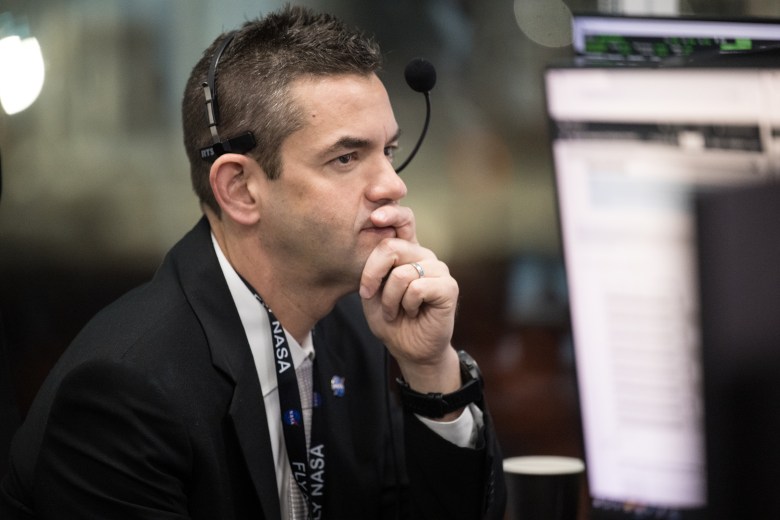
When Jared Isaacman was sworn in as NASA administrator Dec. 18, he hit the ground running — or, perhaps more accurately, hit the air flying. At a town hall the next day, he said he would visit all the agency’s field centers, a task he completed by late January. In some cases he showed up on one of his own fighter jets, bedecked in a patriotic livery featuring logos for NASA and the nation’s 250th anniversary. On those flights, he flew passengers ranging from Defense Secretary Pete Hegseth to agency employees.
Isaacman also has been driven by something else that took place the day he was sworn in: the release of an executive order on space policy. That directive calls on NASA to return humans to the moon by 2028 and establish the initial elements of a lunar outpost by 2030, among other requirements. It came as NASA had already been working with the two Human Landing System (HLS) companies, Blue Origin and SpaceX, on ways to accelerate progress on their landers.
Isaacman, in an interview with SpaceNews Senior Staff Writer Jeff Foust in late January, said many of his plans, on topics ranging from HLS to commercial space stations, were pending a formal response from the administration. But he has been able to move ahead in other areas. For example, in early February, he announced a workforce directive that seeks to bring in work currently done by contractors in-house, something he hinted at in the interview.
The interview has been edited for clarity and length.
SpaceNews: You completed your tour of NASA’s field centers. What have you learned from that? What greater understanding of the agency and its capabilities do you now have that you didn’t when you took the job?
Jared Isaacman: There weren’t a lot of major surprises. After I was confirmed, we stood up very quickly this ideas box and a regulatory reform box that anyone in the workforce can submit, contractors as well. It goes right to the top, no filters from center directors or mission directorates. Each one of those submission boxes has over 700 submissions. I also had a chance to look through the 300-plus questions that came in from the original town hall.
So, before I ever hit the road, I felt like I had a reasonable pulse of how the workforce was thinking about certain things, like where there were good opportunities to do better, and where there were obstacles or problems to clear, also to do better.
Probably one of the bigger surprises is that in certain areas within NASA, we have either lost or outsourced some of our core competencies. That was surprising. More or less 75% of our workforce is contractors. There’s a lot of things that we have some external dependencies on that I would not have expected. We’ve got to look at that. There has to be certain expertise relevant to our mission that we retain inside the organization.
Are you thinking about how to bring those core competencies back into the agency in some way? Does that include changes to a workforce that is significantly smaller now than it was a year ago?
If the question is whether this is an opportunity to bring more talent into the organization, the answer is yes. The whole distinction of whether the workforce is significantly smaller or not, if you look at it going from 18,000 civil servants to 14,000, sure, that’s a valid point. If you look at that plus the 35,000 contractors that are fully integrated within the agency — these are people that have been here 10, 20 years — on a percentage basis, it wasn’t as significant of a workforce reduction from the voluntary retirement program as it might appear. But the answer ultimately to the question is yes, there are certain capabilities and areas of expertise that I consider essential for NASA to execute on its mission that have been either degraded, lost or outsourced over the years that we have to rebuild.
What are examples of capabilities you want to rebuild?
It’s across the board, from areas of launching rockets to building launch complexes to mission control to running flight test programs for X-planes. You would find that, in those programs, there are a lot of external dependencies that you would think are pretty core to the mission of trying to change the world in air and space.
One of your top priorities right now is Artemis 2. How are you feeling about preparations for the launch?
We’re looking at everything. We have an extensive amount of pre-FRRs [flight readiness reviews] that we’re going through. We look at all the deltas from Artemis 1 to Artemis 2. Artemis 1 did not have the full-up ECLSS [environmental control and life support system] like Artemis 2 does. So, everything that has changed, either because it’s a new implementation or a change for the better, we want to double- and triple-check, because we didn’t have the flight experience from Artemis 1. I was very impressed with how the team was progressing towards wet dress and feeling that the team is very energized and motivated.
[Editor’s note: This interview took place in January before NASA delayed Artemis 2 to April.]
Beyond Artemis 2, what are other key priorities?
All the components of the president’s national space policy have to be worked in parallel, not serial, if we’re to achieve them within the target time frames. That is a good thing because, as I’ve said many times, NASA should be able to undertake multiple world-changing missions in parallel. So, yes, Artemis 2, because it is the most important human spaceflight mission in a half century. We have to get that right. At the same time, you need to be doing everything you can to pull forward, help enable and support our two HLS providers so that you have a lander on time for the subsequent mission. You’ve got to help your [space]suits provider, because that’s been a journey for a long time. We shouldn’t be sitting on our hands and saying, where’s our product or service or capability? We should be applying all the expertise that lives within NASA and try to set them up for success. We need to do that more.
What’s the moon base going to look like? We can start landing some of that early infrastructure, maybe as a component of expanded CLPS [Commercial Lunar Payload Services] programs, as soon as possible. You can’t wait a year or two to start that and hope to have some infrastructure there when our astronauts arrive. Nuclear power and propulsion has been funded not to fail, but also not to succeed for a long time. If we want America to get underway on nuclear power so that someday we can undertake human missions to Mars, we’re going to have to start moving on that right now.
You have the International Space Station. It should be rather clear that we have a transition plan for it, which means you have to start undertaking some of those early steps today. And then there’s science and discovery. We have Dragonfly, we have a couple other signature missions. We’re going to launch Roman before the end of the year, which is exciting to have that tee up additional missions and not lose our edge in exploration and discovery. All these things have to be worked in parallel. There’s no opportunity to delay.

For HLS and the lunar spacesuits, what timeline do you have to try and reshape those programs, to accelerate them to meet the 2028 goal of landing on the moon?
We are taking measures now. We are going to do everything we can to enable the acceleration plans that were submitted by both HLS providers. We are willing to rethink a lot of our requirements on this to achieve the objective on time. We are willing to make available any resources and expertise that we have to better set those missions up for success. The same thing is applicable on the suit, so the decisions that needed to be made to pull those in have already been made. Now it’s just execution.
On the ISS transition, there’s a lot of restlessness in industry about seeing what the next phase of the Commercial Low Earth Orbit Destinations (CLD) program is going to look like. When can we expect to see some more details?
When the president’s national space policy came out, there were time frames that we needed to communicate back [and ask] how, as an agency in coordination with [the Office of Science and Technology Policy] do we expect to achieve these objectives? So, even though some of these programs may have been underway previously, we have a national space policy, which is an executive order with a timeline to communicate back, and that’s quickly approaching. I suspect that, whether it’s CLD, rovers, our moon base or power source on the moon, we will be communicating that shortly after submission of our response to the executive order.
When do you expect that to happen?
Approximately a month from now.
The final fiscal year 2026 spending bill for NASA did not include funding for the Mars Sample Return (MSR) program. How are you thinking about restarting or revamping that effort to bring back the samples the Perseverance rover is collecting?
I think with the clarity now on the human exploration focus on the moon, we can free up some of our resources to consider how we would go and retrieve the Mars samples.
I say all this because when there was at least some discussion last year about whether or not we would undertake a human mission to Mars — which is inspiring, and it’s ambitious and I fully support getting it done when the timeline and the technologies turn up to achieve it — it was very hard to say we should also spend on Mars Sample Return if humans were able to get there.
Now that we are focused on our Artemis plan, and that’s going to be a long running campaign on the moon well past Artemis 5, it frees us up to look at how we best go and consider retrieving those samples.
Step one is closing out the old program. This is not, in my opinion, even remotely a political issue. This was canceled under the previous administration, but we’ve spent hundreds of millions of dollars since then on a canceled program. Now, those are resources you don’t get back. Ideally, maybe there are some things we can recycle from it or repurpose.
Every time hundreds of millions of dollars go out the door on something that is not going to yield a return, that comes at the expense of future missions for science and discovery. So we need to close that out right and stop the bleeding on those resources, so that we now have those dollars to consider an achievable plan to go for those samples.
What is the timeline for that plan?
I understand that there were some alternative proposals that were submitted. I have not gotten to those yet. So, we’re going to have to take a look and see which of those, if any of them, are economical and can be achieved in a reasonable time period. If not, we have to reformulate and think about an alternative approach to it. But as of now, the most important thing is to stop the bleeding on a program that was canceled under the previous administration.
After several weeks in the role, what is your appreciation for the job of NASA Administrator now versus when you were sworn in?
I consider it just as much of an honor and privilege today as it was then. There isn’t a meeting I walked into, a procurement strategy that I’ve reviewed, any sort of workforce interaction where I didn’t think there was an opportunity for us to do a lot better. I think that’s really energizing. It’s exciting, right? In every area of pursuit — human exploration to low Earth orbit, to the moon, scientific missions, X-planes — there is area for improvement in all of these so we can get after the exciting science and discovery faster. That’s great. To me, that is incredibly energizing.
This article first appeared in the March 2026 issue of SpaceNews Magazine with the title “In the cockpit at NASA.”










Related Posts

Stay Informed With the Latest & Most Important News
Previous Post
Next Post


Advertisement
-
 01Two Black Holes Observed Circling Each Other for the First Time
 -
 02From Polymerization-Enabled Folding and Assembly to Chemical Evolution: Key Processes for Emergence of Functional Polymers in the Origin of Life
 -
 03Astronomy 101: From the Sun and Moon to Wormholes and Warp Drive, Key Theories, Discoveries, and Facts about the Universe (The Adams 101 Series)
 -
 04True Anomaly hires former York Space executive as chief operating officer
 -
 05Φsat-2 begins science phase for AI Earth images
 -
 06Hurricane forecasters are losing 3 key satellites ahead of peak storm season − a meteorologist explains why it matters
 -
 07Binary star systems are complex astronomical objects − a new AI approach could pin down their properties quickly