
Now Reading: JWST COMPASS: A NIRSpec G395H Transmission Spectrum of Radius Valley-Dweller TOI-260 b
-
01
JWST COMPASS: A NIRSpec G395H Transmission Spectrum of Radius Valley-Dweller TOI-260 b

JWST COMPASS: A NIRSpec G395H Transmission Spectrum of Radius Valley-Dweller TOI-260 b

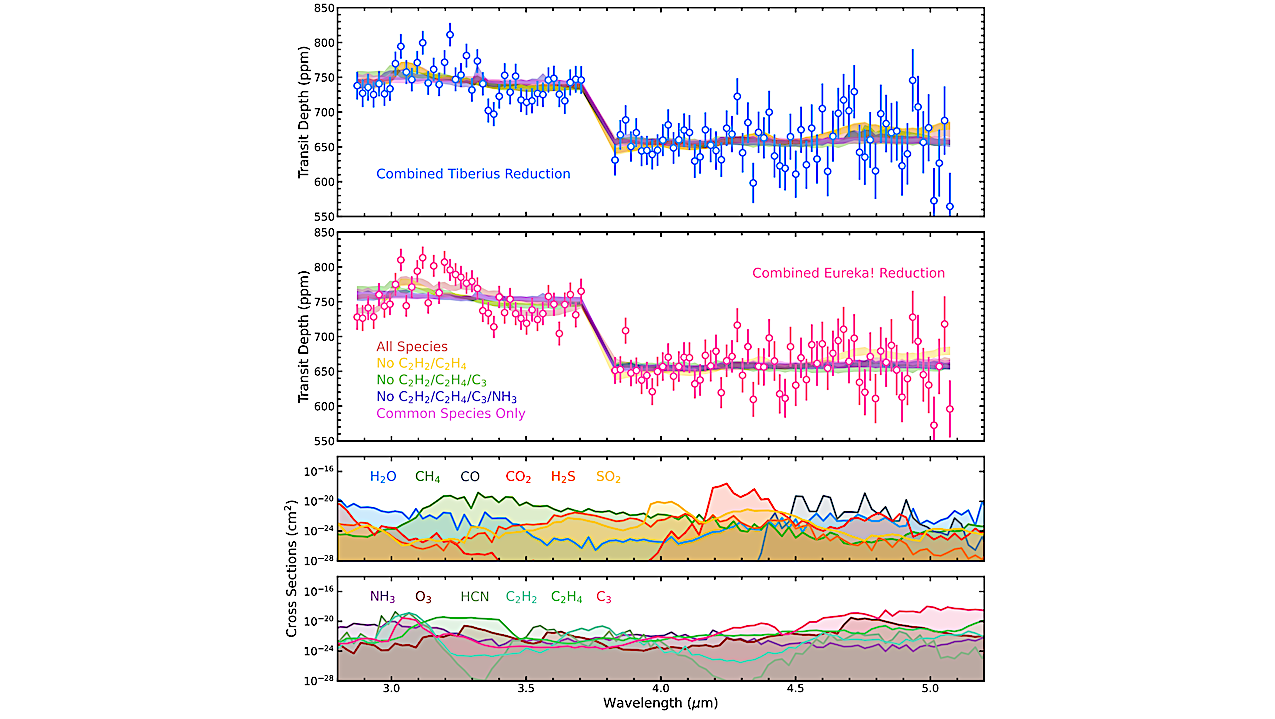
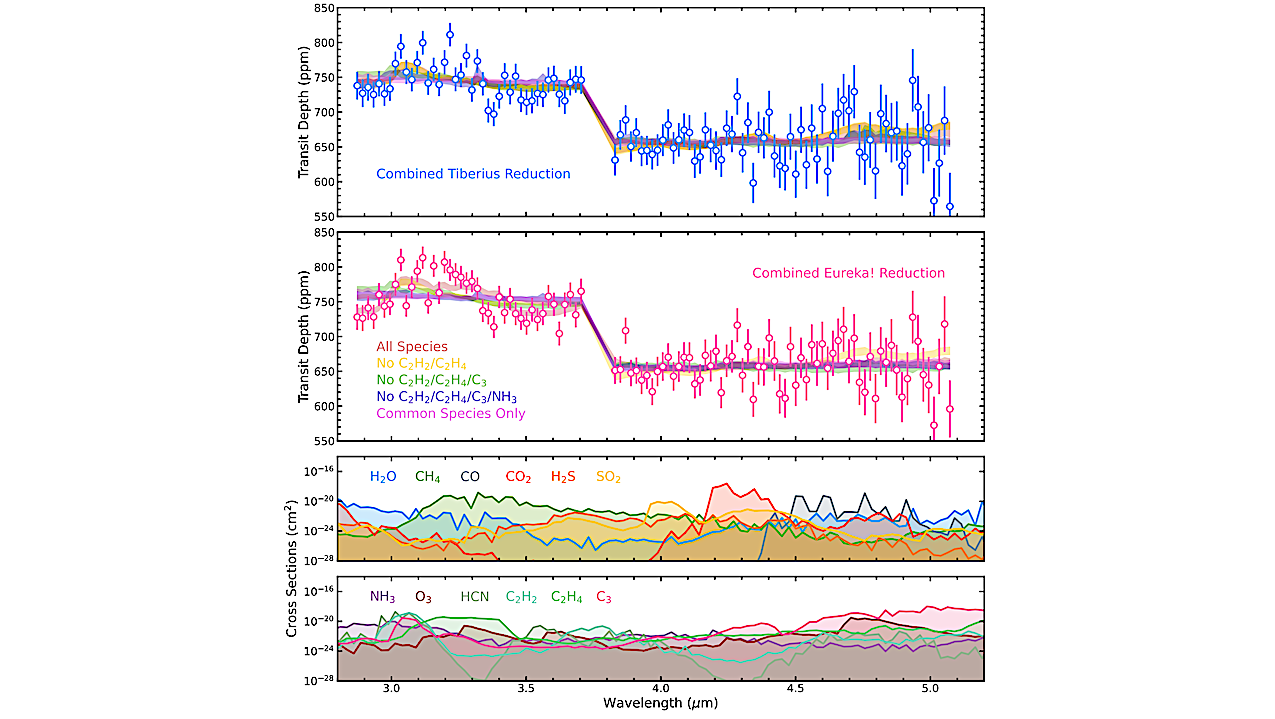
Free retrieval results (top two panels) and cross sections of considered chemical species (bottom two panels) from our investigation of the 3.17 µm feature. Free retrievals were conducted on the combined Tiberius (top, blue) and Eureka! (middle-top, pink) reductions. The 1σ range in retrieved spectra are shown in the colored bands for all considered species (red), all species except C2H2 and C2H4 (yellow), all species except for C2H2, C2H4, and C3 (green), all species except for C2H2, C2H4, C3, and NH3 (dark blue), and only the common species (H2O, CH4, CO2, CO, SO2, and H2S; light pink). — astro-ph.EP
We present a JWST/NIRSpec G395H transmission spectrum of TOI-260 b, a Teq∼490 K, Rp=1.76R⊕ planet.
The transmission spectrum is derived by combining two transit observations, collected as part of the JWST COMPASS program. We achieved the same median transit depth precision of 37 ppm in both visits, and a median precision of 26 ppm when combining the spectroscopic light curves from the two visits.
Implementing a 30-pixel-wide (R∼200) spectroscopic binning scheme, we find that the transmission spectrum is mostly featureless, with a possible feature around 3.17 μm. We assess the significance of any features in the transmission spectrum with a suite of non-parametric models, which confirm the presence of a potential feature in the NRS1 bandpass and an offset between the NRS1 and NRS2 detectors.
To investigate the atmospheric composition of TOI-260 b, we run a series of PLATON retrievals. We do not detect any clear molecular signatures, but the combined data from the two visits are sufficient to constrain the atmospheric metallicity to greater than 200× solar, assuming no opaque deck ≲2.5 mbar.
We also investigate causes of the potential feature near 3.17 μm; while we find some compatible gaseous species and cannot fully discard an astrophysical origin, we suspect a systematics origin due to the variance in strength and position of the feature.
Overall, this look at TOI-260 b adds to the small sample of radius-valley planets, which already seem to show a diversity in their atmospheric compositions. Determining the true nature of these enigmatic planets will require a larger telescope time investment.
Annabella Meech, Peter Gao, Nicole L. Wallack, Mercedes López-Morales, Dominic Oddo, Johanna Teske, Diana Dragomir, Angie Wolfgang, Nicholas Wogan, Hannah R. Wakeford, Sarah E. Moran, James Kirk, Tyler A. Gordon, Anna Gagnebin, Natasha E. Batalha, Natalie M. Batalha, Lili Alderson, Munazza K. Alam, Artyom Aguichine
Comments: 29 pages, 20 figures. Accepted for publication in AJ
Subjects: Earth and Planetary Astrophysics (astro-ph.EP)
Cite as: arXiv:2602.22329 [astro-ph.EP](or arXiv:2602.22329v1 [astro-ph.EP] for this version)
https://doi.org/10.48550/arXiv.2602.22329
Focus to learn more
Submission history
From: Annabella Meech
[v1] Wed, 25 Feb 2026 19:00:19 UTC (2,500 KB)
https://arxiv.org/abs/2602.22329
Astrobiology, Astrochemistry,










Related Posts
Stay Informed With the Latest & Most Important News
Previous Post
Next Post


Advertisement
-
 01Two Black Holes Observed Circling Each Other for the First Time
 -
 02From Polymerization-Enabled Folding and Assembly to Chemical Evolution: Key Processes for Emergence of Functional Polymers in the Origin of Life
 -
 03Astronomy 101: From the Sun and Moon to Wormholes and Warp Drive, Key Theories, Discoveries, and Facts about the Universe (The Adams 101 Series)
 -
 04True Anomaly hires former York Space executive as chief operating officer
 -
 05Φsat-2 begins science phase for AI Earth images
 -
 06Hurricane forecasters are losing 3 key satellites ahead of peak storm season − a meteorologist explains why it matters
 -
 07Binary star systems are complex astronomical objects − a new AI approach could pin down their properties quickly