
Now Reading: JWST Edge-on Disk Ice (JEDIce): Program Overview And Ice Survey Results
-
01
JWST Edge-on Disk Ice (JEDIce): Program Overview And Ice Survey Results


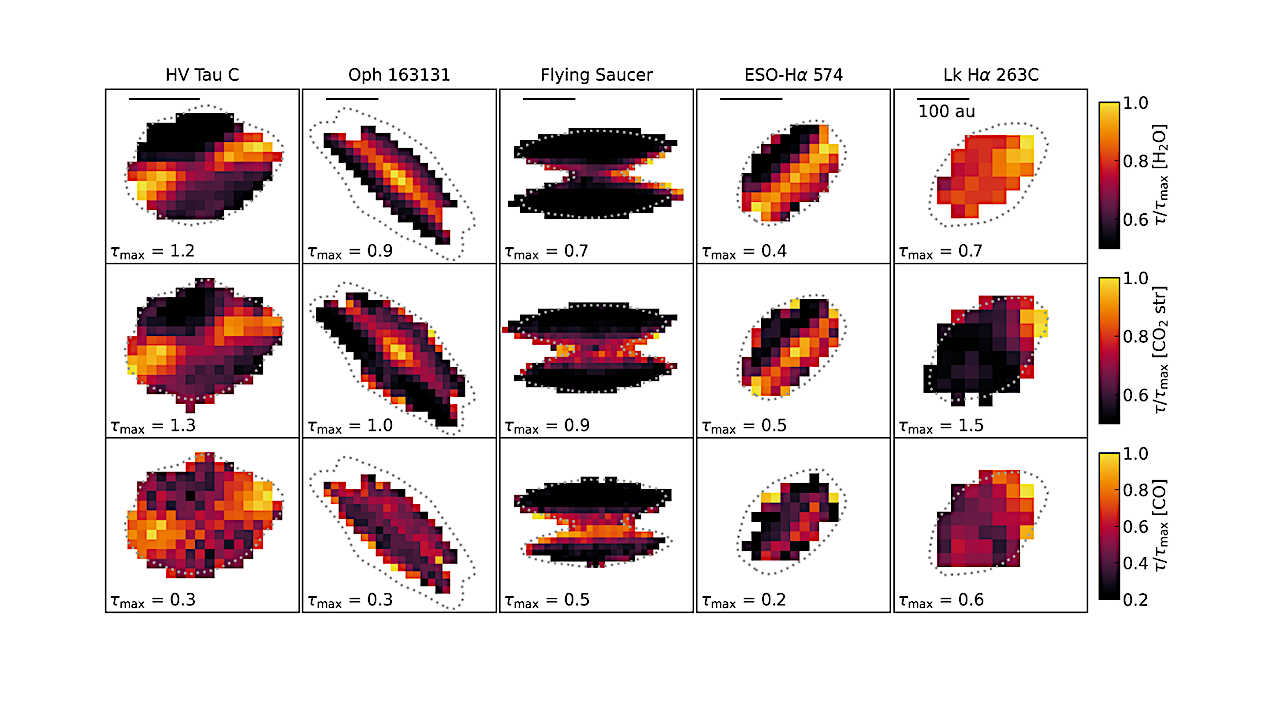
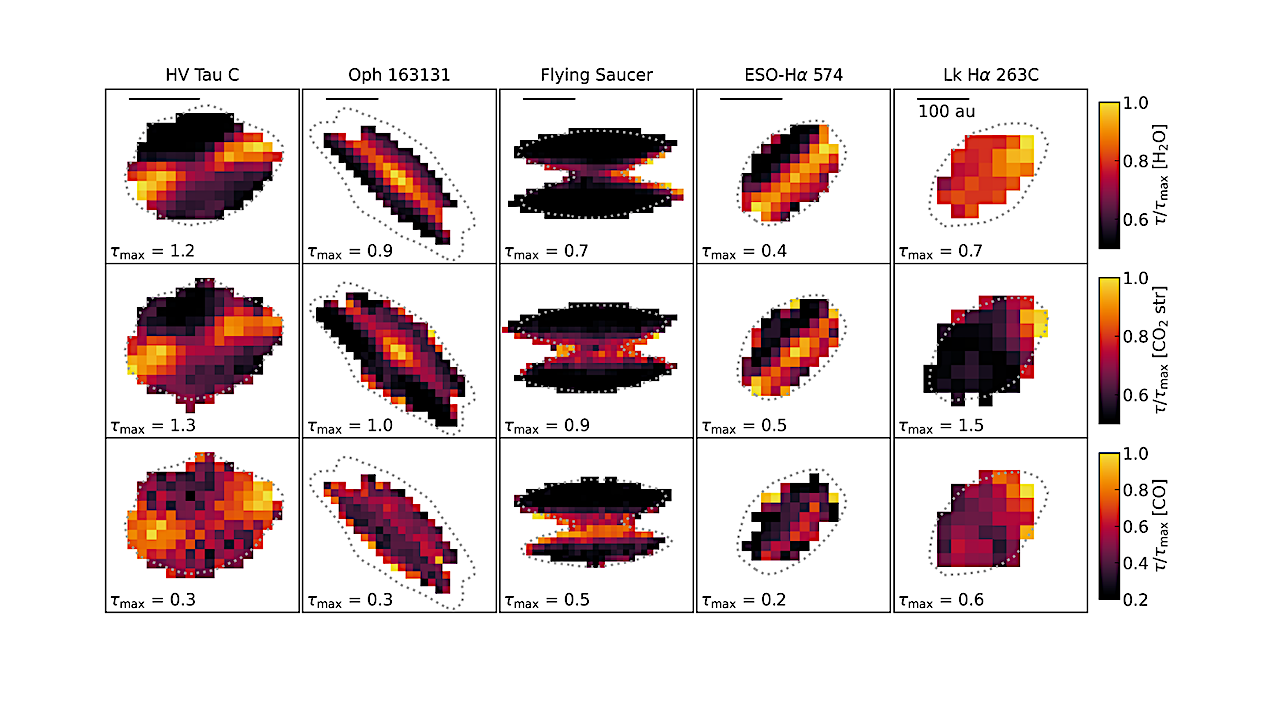
Optical depth maps of the near-IR H2O, CO2, and CO ice features in the disk sample, calculated for pixels with a >3σ detection across the ice band. For clarity, the color map within each panel is individually normalized (i.e., divided by the maximum per-pixel optical depth for a given ice band in a given disk). The maximum optical depths are indicated in the bottom left of each panel. Dotted grey lines represent the 3σ contour of the near-IR continuum maps shown in Figure 1. Horizontal bars represent a linear scale of 100 au. — astro-ph.EP
The icy material within protoplanetary disks plays a central role in planet formation, yet remains poorly characterized by observations. We present 1.6-28μm spectra of five disks obtained as part of the JWST Edge-on Disk Ice (JEDIce) program, representing the largest survey of disk ices to date.
The major ice species H2O, CO2, and CO are detected towards all disks, and exhibit a wide range of absolute optical depths and optical depth ratios across the sample. This is suggestive of a range of ice abundances and compositions, but quantitative constraints will require radiative transfer modeling.
All disks exhibit ice features across the entire spatial region where the IR continuum is detected; vertically elevated ice grains therefore seem to be ubiquitous in disks. The CO ice is consistently dominated by apolar CO:CO2 mixtures, implying that the disk ice compositions are neither completely reset nor pristinely inherited from the protostellar stage.
The presence of these mixtures also suggests that entrapment may be important in shaping the spatial distribution of CO within the disks. Small molecules commonly seen in protostellar ices (CH4, CH3OH, NH3) are generally not detected in our sample, though tracers of ammonium salts (OCN− and the 6.85 μm band) are common, potentially reflecting an evolution towards comet-like ice compositions.
The spectra also contain a wealth of information about the micron-sized dust, atomic and molecular gas, and PAH content, which together with the ice constraints will provide a comprehensive picture of the chemical, physical, and dynamical state of these systems.
Jennifer B. Bergner, Nicole Arulanantham, Emmanuel Dartois, Maria N. Drozdovskaya, Daniel Harsono, Melissa McClure, Jennifer A. Noble, Karin I. Öberg, Klaus M. Pontoppidan, Yao-Lun Yang, Korash Assani, Zhi-Yun Li, Julia C. Santos, Will E. Thompson, Lukas Welzel, Elizabeth S. Yunerman, Aditya M. Arabhavi, Alice S. Booth, Charles Mentzer, Mayank Narang, Thomas Henning, Inga Kamp, Giulia Perotti, Alice Somigliana
Comments: Accepted to ApJ
Subjects: Earth and Planetary Astrophysics (astro-ph.EP); Solar and Stellar Astrophysics (astro-ph.SR)
Cite as: arXiv:2603.18163 [astro-ph.EP] (or arXiv:2603.18163v1 [astro-ph.EP] for this version)
https://doi.org/10.48550/arXiv.2603.18163
Focus to learn more
Submission history
From: Jennifer Bergner
[v1] Wed, 18 Mar 2026 18:02:15 UTC (10,473 KB)
https://arxiv.org/abs/2603.18163
Astrobiology, Astrochemistry,










Related Posts
Stay Informed With the Latest & Most Important News
Previous Post
Next Post




Advertisement
-
 01Two Black Holes Observed Circling Each Other for the First Time
 -
 02From Polymerization-Enabled Folding and Assembly to Chemical Evolution: Key Processes for Emergence of Functional Polymers in the Origin of Life
 -
 03Astronomy 101: From the Sun and Moon to Wormholes and Warp Drive, Key Theories, Discoveries, and Facts about the Universe (The Adams 101 Series)
 -
 04True Anomaly hires former York Space executive as chief operating officer
 -
 05Φsat-2 begins science phase for AI Earth images
 -
 06Hurricane forecasters are losing 3 key satellites ahead of peak storm season − a meteorologist explains why it matters
 -
 07Binary star systems are complex astronomical objects − a new AI approach could pin down their properties quickly