
Now Reading: JWST/NIRSpec Detects Warm CO Emission In The Terrestrial-Planet Zone Of HD 131488
-
01
JWST/NIRSpec Detects Warm CO Emission In The Terrestrial-Planet Zone Of HD 131488


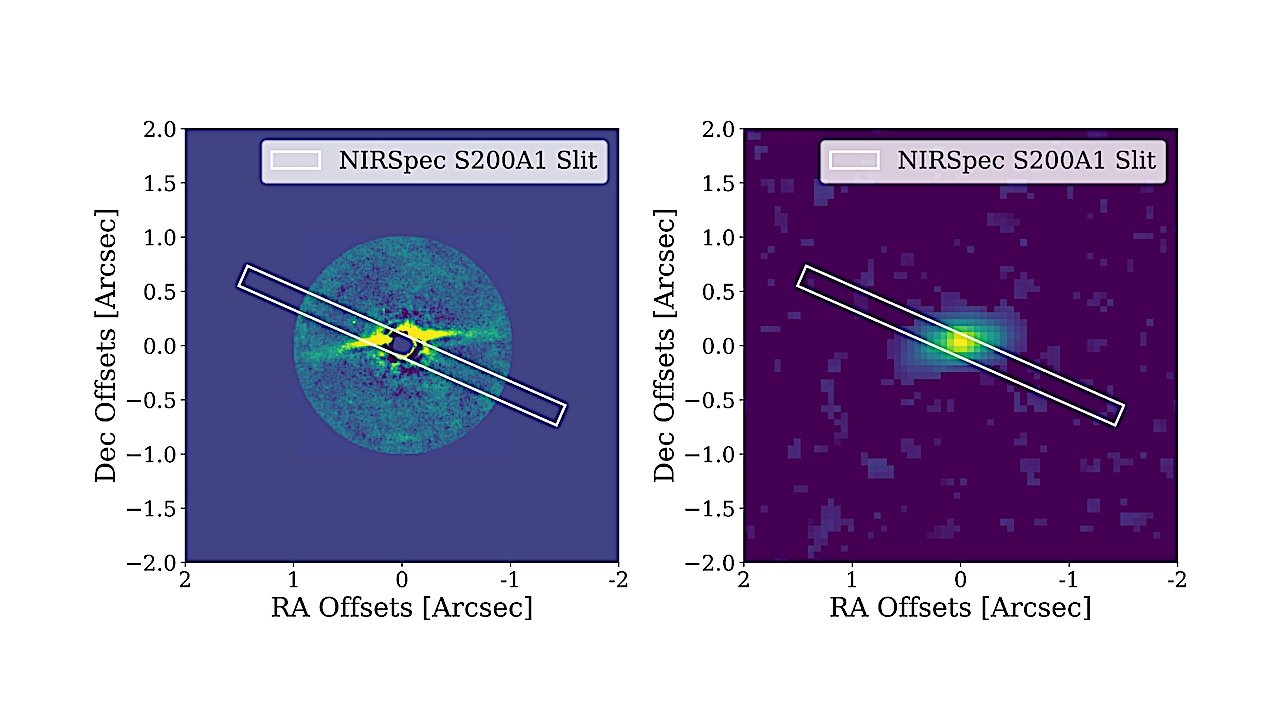

HD 131488 Disk and Slit Alignment, showcasing our data is sensitive to the disk region inward of 30 AU to the star. Left: The JWST NIRSpec Slit is overlaid on VLT/SPHERE coronagraphic imaging of scattered light of dust in the HD 131488 disk. The image has been post-processed with Non-negative matrix transformation (Xie et al. 2022). The alignment between the nearly edge-on disk and the PA of the slit clearly shows that our data is sensitive to the inner region of the disk. Right: Overlay of NIRSpec slit on ALMA 12CO(2-1) image of HD 131488 (Moór et al. 2017). The major and minor axes of the disk are assumed to be 1.14′′ by 0.7 ′′ according to the disk profile reported in the ALMA CO image (Moór et al. 2017). For both gas disk and dust disk, our data is sensitive to the disk region inward of a radius of 15 AU to the star, because the star and inner region of the disk fall in the slit, but are insensitive to the outer region of the disk, because those regions fall outside of the slit. — astro-ph.EP
We have obtained a high-resolution, JWST NIRSpec 2.87 — 5.14 μm spectrum of the debris disk around HD 131488.
We discover CO fundamental emission indicating the presence of warm fluorescent gas within ∼10 AU of the star. The large discrepancy in CO’s vibrational and rotational temperature indicates that CO is out of thermal equilibrium and is excited with UV fluorescence.
Our UV fluorescence model gives a best fit of 1150K with an effective temperature of 450, 332, and 125K for the warm CO gas kinetic temperature within 0.5, 1, and 10AU to the star and a gas vibrational temperature of 8800K.
The newly discovered warm CO gas population likely resides between sub-AU scales and ∼10AU, interior to the cold CO reservoir detected beyond 35AU with HST STIS and ALMA. The discovery of warm, fluorescent gas in a debris disk is the first such detection ever made. The detection of warm CO raises the possibility of unseen molecules (H2O, H2, etc) as collisional partners to excite the warm gas.
We estimated a lower mass limit for CO of 1.25×10⁻⁷M⊕, which is 10−5 of the cold CO mass detected with ALMA and HST. We demonstrate that UV fluorescence emerges as a promising avenue for detecting tenuous gas at 10−7 Earth-mass level in debris disks with JWST.
Worthen, Joan Najita, Chen Xie, Aoife Brennan, Amaya Moro-Martin, John Debes, Kevin France, Luca Matrà, Marshall Perrin, Aki Roberge
Comments: 30 Pages, 15 Figures, 6 Tables; Accepted to ApJ; Data Behind Figure 2 Available on the Journal Publisher Site
Subjects: Earth and Planetary Astrophysics (astro-ph.EP); Solar and Stellar Astrophysics (astro-ph.SR)
Cite as: arXiv:2512.11972 [astro-ph.EP] (or arXiv:2512.11972v1 [astro-ph.EP] for this version)
https://doi.org/10.48550/arXiv.2512.11972
Focus to learn more
Related DOI:
https://doi.org/10.3847/1538-4357/ae2797
Focus to learn more
Submission history
From: Cicero Lu
[v1] Fri, 12 Dec 2025 19:00:10 UTC (3,249 KB)
https://arxiv.org/abs/2512.11972
Astrobiology, exoplanet,










Related Posts
Stay Informed With the Latest & Most Important News


Advertisement
-
 01Two Black Holes Observed Circling Each Other for the First Time
 -
 02From Polymerization-Enabled Folding and Assembly to Chemical Evolution: Key Processes for Emergence of Functional Polymers in the Origin of Life
 -
 03Astronomy 101: From the Sun and Moon to Wormholes and Warp Drive, Key Theories, Discoveries, and Facts about the Universe (The Adams 101 Series)
 -
 04True Anomaly hires former York Space executive as chief operating officer
 -
 05Φsat-2 begins science phase for AI Earth images
 -
 06Hurricane forecasters are losing 3 key satellites ahead of peak storm season − a meteorologist explains why it matters
 -
 07Binary star systems are complex astronomical objects − a new AI approach could pin down their properties quickly