
Now Reading: Laboratory Rotational Spectroscopy And Interstellar Search For The Protein Precursor 4-oxobutanenitrile (HCOCH2CH2CN)
-
01
Laboratory Rotational Spectroscopy And Interstellar Search For The Protein Precursor 4-oxobutanenitrile (HCOCH2CH2CN)

Laboratory Rotational Spectroscopy And Interstellar Search For The Protein Precursor 4-oxobutanenitrile (HCOCH2CH2CN)

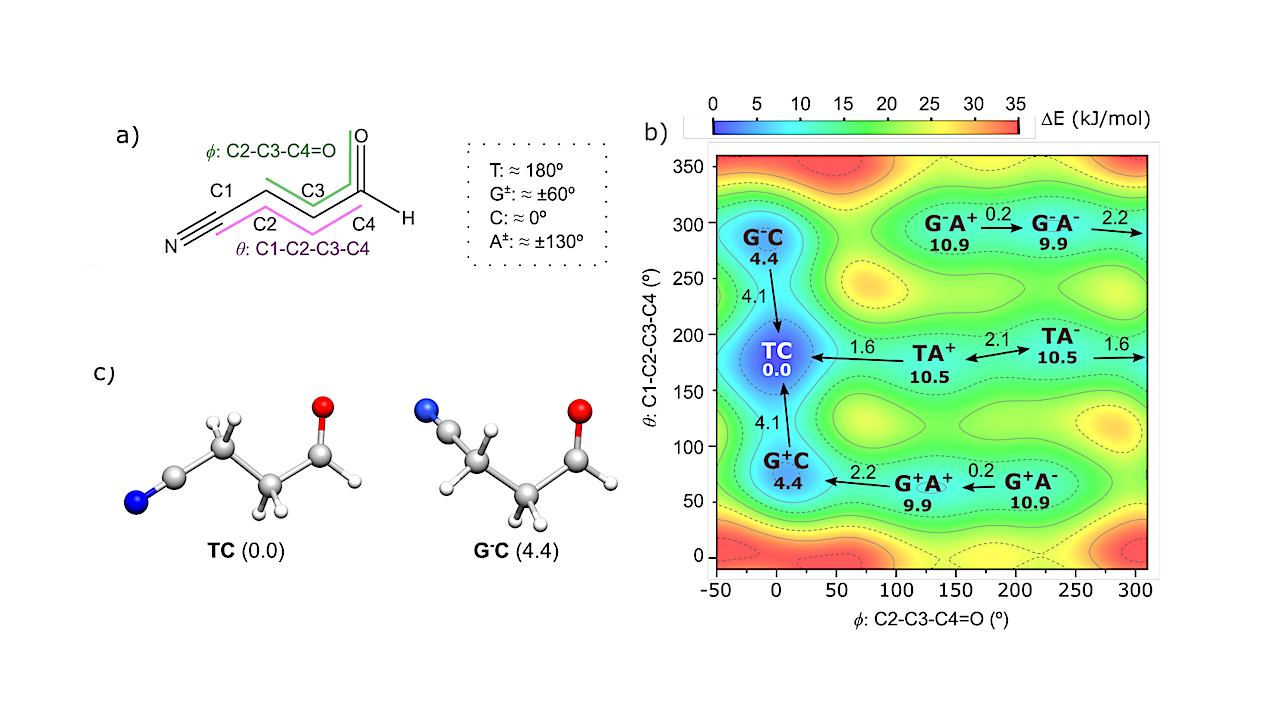
(a) Definition of the torsional angles 𝜃 = C1-C2-C3-C4 and 𝜙 = C2-C3-C4=O used to explore the conformational space of 4-oxobutanenitrile. (b) Relaxed 2D potential energy surface (PES) computed at the B3LYPD3BJ/def2-TZVPP level showing nine minima. Arrows indicate barriers between key conformers (in kJ mol−1 ). (c) Optimized geometries of the global minimum TC and the second-lowest conformer G−C/ G+C, with their relative energies including ZPE. — astro-ph.GA
Understanding the presence and distribution of prebiotic precursors in the interstellar medium (ISM) is key to tracing the chemical origins of life. Among them, 4-oxobutanenitrile (HCOCH2CH2CN) has been identified in laboratory simulations as a plausible intermediate in the formation of glutamic acid, a proteinogenic amino acid.
Here, we report its gas-phase rotational spectrum, measured using two complementary techniques: chirped-pulse Fourier transform microwave (CP-FTMW) spectroscopy (2−18 GHz) and free-jet millimeter-wave (FJ−AMMW) absorption spectroscopy (59.6−80 GHz).
Quantum chemical calculations revealed nine low-energy conformers, of which the TC conformer was assigned based on the measured spectra. The resulting spectroscopic parameters were used to search for the molecule in the ultradeep spectral survey of the G+0.693-0.027 molecular cloud, located in the Galactic Center.
No signal attributable to 4−oxobutanenitrile was detected. A stringent upper limit to its column density was derived (N< 4 ×1012 cm−2), corresponding to a molecular abundance of < 2.9 ×10⁻¹¹ relative to H2.
This upper limit lies well below the observed abundances of simpler structurally related species containing −HCO and −CN groups, underscoring the challenge of detecting increasingly complex prebiotic molecules in the ISM and the need for future, more sensitive astronomical facilities.
V. M. Rivilla, E. R. Alonso, W. Song, A. Insausti, A. Maris, F. J. Basterretxea, S. Melandri, I. Jiménez-Serra, E. J. Cocinero
Comments: Accepted in Monthly Notices of the Royal Astronomical Society
Subjects: Astrophysics of Galaxies (astro-ph.GA)
Cite as: arXiv:2512.11500 [astro-ph.GA] (or arXiv:2512.11500v1 [astro-ph.GA] for this version)
https://doi.org/10.48550/arXiv.2512.11500
Focus to learn more
Submission history
From: Victor Manuel Rivilla
[v1] Fri, 12 Dec 2025 11:52:59 UTC (3,841 KB)
https://arxiv.org/abs/2512.11500
Astrobiology, Astrochemistry,










Related Posts
Stay Informed With the Latest & Most Important News
Previous Post
Next Post




Advertisement
-
 01Two Black Holes Observed Circling Each Other for the First Time
 -
 02From Polymerization-Enabled Folding and Assembly to Chemical Evolution: Key Processes for Emergence of Functional Polymers in the Origin of Life
 -
 03Astronomy 101: From the Sun and Moon to Wormholes and Warp Drive, Key Theories, Discoveries, and Facts about the Universe (The Adams 101 Series)
 -
 04True Anomaly hires former York Space executive as chief operating officer
 -
 05Φsat-2 begins science phase for AI Earth images
 -
 06Hurricane forecasters are losing 3 key satellites ahead of peak storm season − a meteorologist explains why it matters
 -
 07Binary star systems are complex astronomical objects − a new AI approach could pin down their properties quickly