
Now Reading: Large-amplitude Variability Driven By Giant Dust Storms On A Planetary-mass Companion
-
01
Large-amplitude Variability Driven By Giant Dust Storms On A Planetary-mass Companion

Large-amplitude Variability Driven By Giant Dust Storms On A Planetary-mass Companion

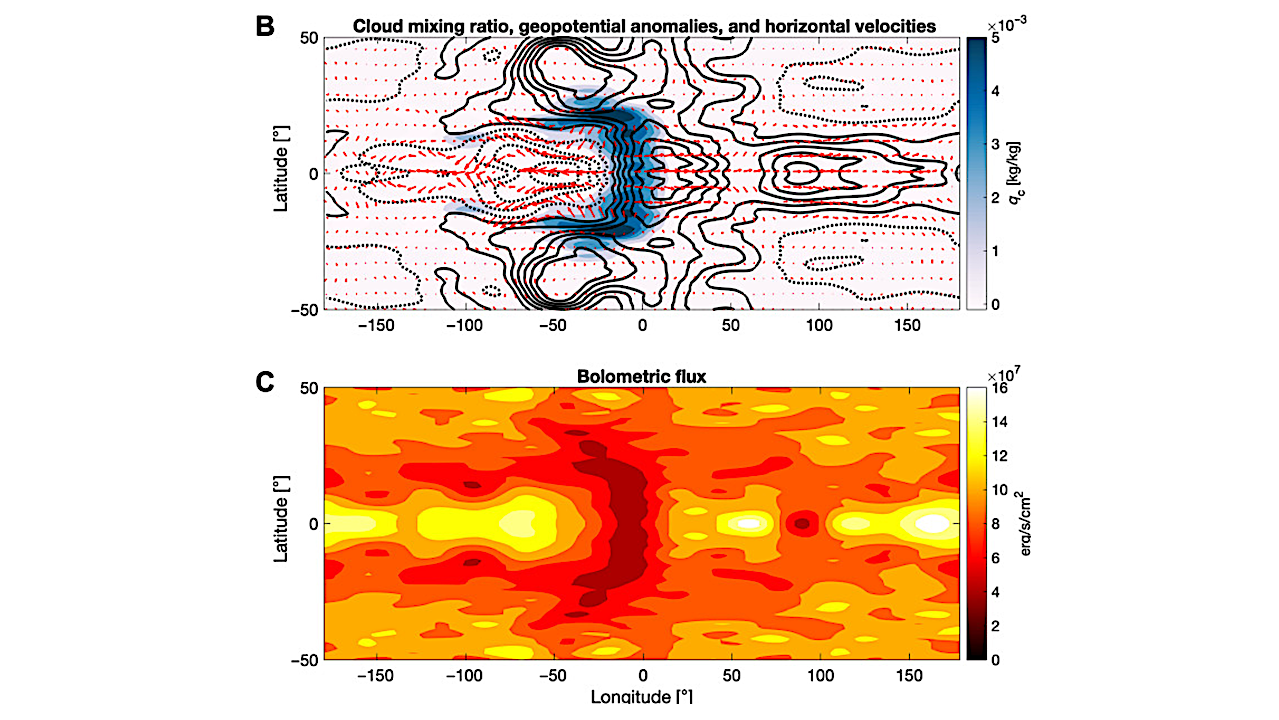
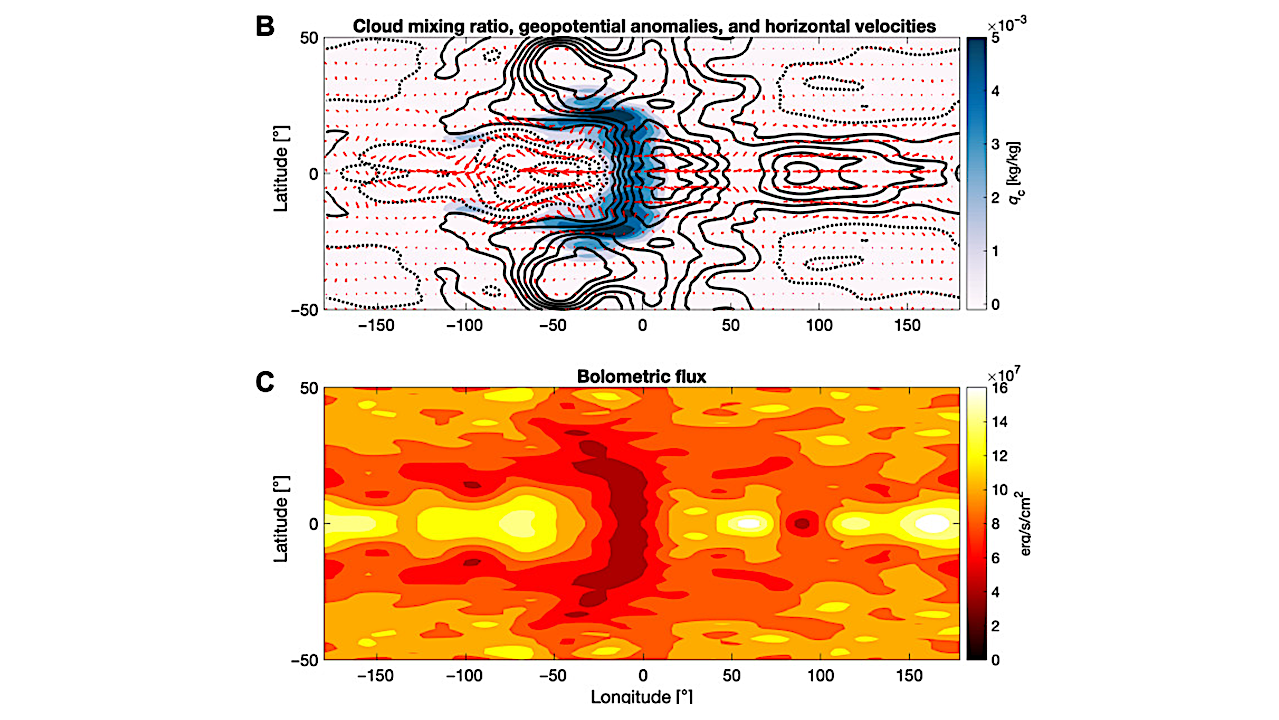
(B) Diagnosis of cloud structure (color), geopotential anomalies (solid lines representing positive values and dotted lines representing negative values), and horizontal velocity fields (red arrows). (C) Top-of-atmosphere thermal flux corresponding to the cloud structure shown in (B). — Science Advances via PubMed
Large-amplitude variations are commonly observed in the atmospheres of directly imaged exoplanets and brown dwarfs. VHS 1256B, the most variable known planet-mass object, exhibits a near-infrared flux change of nearly 40%, with red color and silicate features revealed in recent JWST spectra, challenging current theories.
Using a general circulation model, we demonstrate that VHS 1256B’s atmosphere is dominated by planetary-scale dust storms persisting for tens of days, with large patchy clouds propagating with equatorial waves.
This weather pattern, distinct from the banded structures seen on solar system giants, simultaneously explains the observed spectra and critical features in the rotational light curves, including the large amplitude, irregular evolution, and wavelength dependence, as well as the variability trends observed in near-infrared color-magnitude diagrams of dusty substellar atmospheres.
Astrobiology,











Related Posts

Stay Informed With the Latest & Most Important News
Previous Post
Next Post

Advertisement
-
 01Two Black Holes Observed Circling Each Other for the First Time
 -
 02From Polymerization-Enabled Folding and Assembly to Chemical Evolution: Key Processes for Emergence of Functional Polymers in the Origin of Life
 -
 03Astronomy 101: From the Sun and Moon to Wormholes and Warp Drive, Key Theories, Discoveries, and Facts about the Universe (The Adams 101 Series)
 -
 04True Anomaly hires former York Space executive as chief operating officer
 -
 05Φsat-2 begins science phase for AI Earth images
 -
 06Hurricane forecasters are losing 3 key satellites ahead of peak storm season − a meteorologist explains why it matters
 -
 07Binary star systems are complex astronomical objects − a new AI approach could pin down their properties quickly